
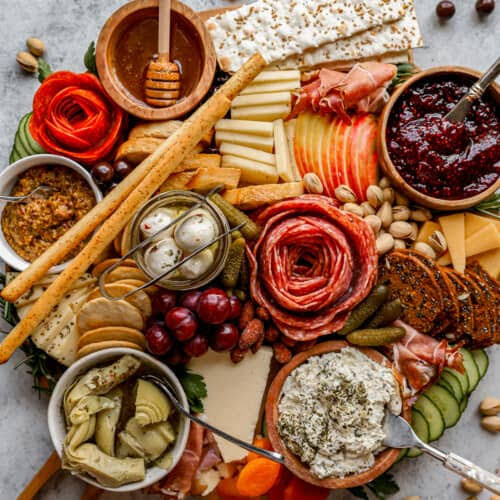
Charcuterie board photo by the Cookie Rookie.
Like all edible novelties, I approached my first charcuterie-board experience with curiosity. First, I had to learn how to pronounce the darn thing: “Char cute er what?”
According to Wikipedia, the word charcuterie is French, and combines “chair” (flesh or meat) and “cuit” (cooked). Together, they literally mean cooked flesh. Yum.
Charcuterie is fun to say. Charcuterie! So refined!
During my initial charcuterie exposure several years ago, charcuterie boards were interesting to sample, and soon, fun to create. Social media went charcuterie crazy, as women (yes, usually women) showed off charcuterie boards that weren’t just lowly boards covered in various nibbles, but sometimes entire 6- and 8-foot-long banquet tables for bridal and baby showers.
Google “charcuterie board images” and prepare to be overwhelmed by a sea of charcuterie boards for every occasion.
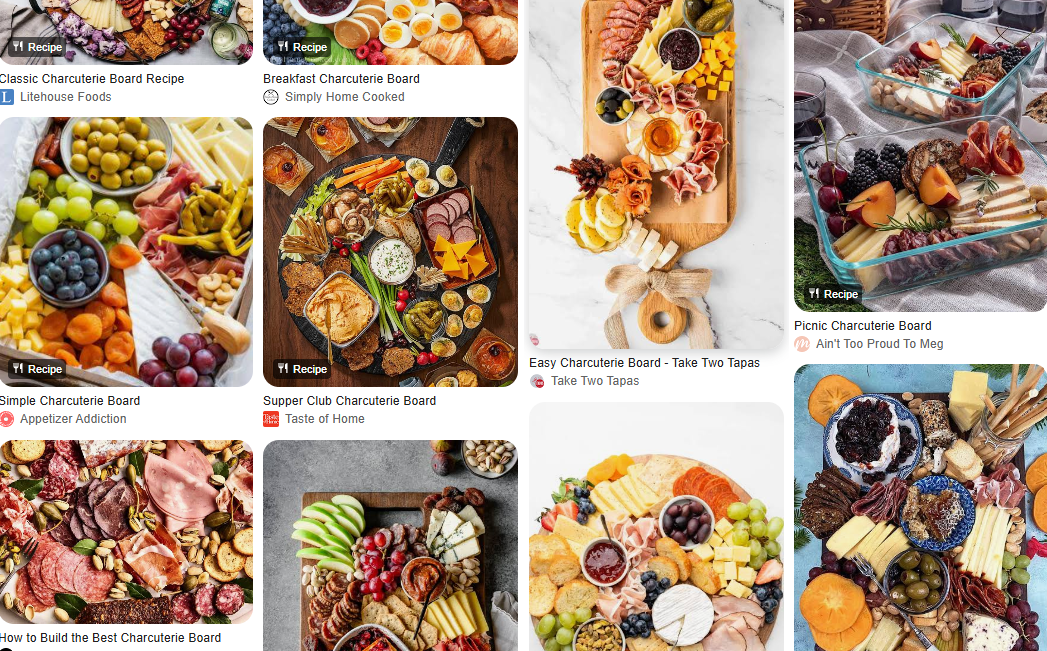
Influencers sometimes filmed their shopping excursions at places like Costco and Trader Joe’s as they selected their charcuterie ingredients. Do the bank-breaking charcuterie math when considering charcuterie experts’ suggested 3-3-3-3 rule for a balanced charcuterie board: Three types of cured meats, three types of cheese, three accompaniments, and three starches.
I’ve watched, stunned, as these charcuterie queens filled their carts with assortments of cheeses, meats, pickles, olives, dried fruits, gourmet chocolates, and fancy breads and expensive crackers, without a glance at a price tag. But price is always on my mind. With each item pitched into the shopping cart, I find myself doing the rough mental calculations of how much all those ingredients would cost: many multiples (3-3-3-3) of $5, $10, $15, $20 food items. Up and up and up the prices climbed. Just the specialty cheeses alone were a cause for grave financial concern, as even tiny triangles of a quality cheese can set you back well into the double digits. As we’ve learned, a good charcuterie board can’t have just one cheese, but the expectation is you’ll offer several. Same with the meats, like imported prosciuttos. Relatively speaking, the hefty packages of pre-sliced dried salami are potentially the least-expensive part of the whole charcuterie creation process, at least in the beginning. But salami slices weren’t enough on their own. No, ma’am. Instead, salami slices were draped in a circular pattern over a drinking glass and transformed into salami roses. It takes quiet a few salami slices to make a rose, so there goes salami’s cost effectiveness. Who wants to bite into a 10-slice hunk of salami rose? Anyone? Anyone? No?
My main complaint about charcuterie boards is they’re expensive to create. Even a modest charcuterie board starts around $50 to $100, and can escalate from there into several hundreds of dollars. For nibbles, people! Have we lost our collective minds?
My other complaint about charcuterie boards – as the cook, not the consumer – is that they contain so many different items that by the time dinner rolls around, everyone’s stuffed themselves on a king’s ransom worth of assorted meats, cheeses, pickles, olives, nuts, dates, dried apricots and fancy chocolates. That’s always been my conflict with appetizers; that they often fill everyone up to the point where guests no longer have an appetite for dinner. But even if you had a dozen ravenous guests, unless they’re teenage athletes, it’s rare for an entire charcuterie board to be completely devoured. What’s more common is at the end of the evening you’re stuck with dibs and dabs of expensive meats, cheeses and a rainbow of assorted olives that will probably languish in the refrigerator in a sea of plastic bags and containers until they eventually expire.
Charcuterie boards’ costs reminds me of something I’ve been meaning to ask you about, to settle my own internal debate. More than six months ago I stopped by a little specialty cheese store for the first time in downtown Redding. It was the kind of upscale shop that makes customers say things like, “Gosh, this doesn’t feel like Redding.” Although that’s considered a compliment in some circles, it’s also a statement that disses Redding for being a country-bumpkin city. Poor Redding! Poor Poverty Flats!
Anyway, this small shop was well-stocked with all kinds of beautifully packaged gourmet items, everything from lavender shortbread and tiny jars of fancy honeys, to an entire case of spendy meats and cheeses. To my great frustration, there were no price tags, so every time I wondered about the cost, I needed to ask.
“Excuse me, how much is this jar of fig jam?”
When the clerk replied with a number that was about four times higher than I expected, I thanked her and discreetly placed the fig jam back where I found it, as if the price weren’t the issue, but rather, I suddenly wasn’t interested in fig jam. This exchange was repeated several times, until I finally asked why none of the items were marked with prices. The owner herself piped up and schooled me in the ways of the culinary world – as if I’d just fallen off a Shasta County turnip truck.
Dum-dum! Peasant!
She said that specialty food shops – for example in places like Los Angeles or Nantucket or New York — don’t display prices, either. In fact, she said that customers there would actually be offended to see prices. How gauche!
I balked at this statement, and pointed out that surely even wealthy people would care, or at least be mildly curious about the prices. She disagreed. I wondered if she’d ever heard that adage about the customer always being right.
Oh, sure, I imagine that if Martha Stewart or Ina Garten or Gordon Ramsey or Paul Hollywood waltzed into a fancy cheese shop, they’d not wring their hands and pepper the staff with, “How much is this?” and “How much is that?” like a little snot-nosed kid at Woolworth’s trying to figure out how far 3 bucks would stretch. Instead, in the lifestyles of the rich and famous, they’d point their manicured fingers around the store and say, “I’ll take that, and that and that, and give me 5 pounds of the truffle cheese and a vat of caviar,” without a moment’s thought about the price.
Keeping with my annual tradition to name-drop my interview with Julia Child when I worked at the paper, let me say that Julia (sorry AP Stylebook, but I cannot call her Child) confessed that two of her favorite guilty pleasures were In-N-Out cheeseburgers with grilled onions, and Goldfish crackers. No wonder I loved her!
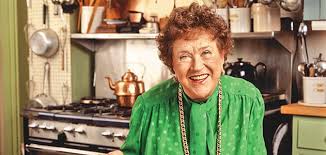
Julia Child photo source: Cordon bleu.edu
But I digress.
Believe it or not, despite the fact that I freely express my opinions on everything under the sun as a writer (and I do have opinions on everything), in person I’m a fairly subdued, get-along kind of gal. I don’t make waves. I don’t publicly embarrass myself or others.
Not so on that particular day in that downtown Redding specialty foods shop. I don’t know what came over me. I pushed back. I argued with the owner about her philosophy about omitted prices, which I said felt snobby, and could unintentionally make customers feel inferior, or ignorant, or, especially in this economy – poor. There were no other customers inside the shop, or I wouldn’t have spoken up. I ended up not buying anything, and vowed that I’d never return. I don’t know if that shop is still open, but if it’s closed, I wouldn’t be surprised.
So, riddle me this: As a customer, do you expect to see prices? Do you want to see prices? Does it feel déclassée to ask for an item’s price, somewhere along the lines of, “If you have to ask the price, you cannot afford it?”
My resolve on this topic was confirmed the day I stopped by a different little market during its Thanksgiving weekend grand opening. I opened my wallet and picked up a small box of gourmet crackers — like the size of a box of animal cookies – for a charcuterie board I was making. I didn’t see a price, but just handed it to the cashier, thinking, well, how bad could it be? I did my best to maintain a poker face when the item rang up for $18, which required a credit card, because I didn’t have that much cash.
Are you kidding me???
Anyway, so back to charcuterie boards. I believe they had their moment, but I hope their glory days are over. It’s time we stop pretending that it’s OK to spend more than $100 on what amounts to a cheese and meat platter on steroids, especially in this difficult economy, when many Americans are having difficulty affording basic groceries, a time when even Hamburger Helper needs a helper because today’s ground beef prices are more in line with yesterday’s filet mignon.
With all that in mind, I suggest that the ridiculously ostentatious charcuterie fad disappears completely. It can live in our memories, and join other dated, flash-in-the-pan food trends like ice sculptures, chocolate fondue fountains, cake pops, and spinach-dip bread bowls.
Plus, at the risk of sounding like a Boomer (which I am), I long for the days when a party appetizer consisted of chips and dips. Remember Ruffles potato chips and clam dip? While I’m at it, I miss the days when weddings were celebrated simply and affordably, with cake and punch. I’m afraid that train left the station, and there’s no going back to cake-and-punch weddings in this era when young folks who subsist on minimum wage and tuna sandwiches go into a lifetime of debt for champagne and limo weddings. Sad, but true.
First things first. I’m leading by example. Feel free to follow. I’m done making charcuterie boards. If I must serve an appetizer, I’ll consider chips and dips, or if I must have cheese, I’ll do Doni’s 1-1-1 rule: One nice cheese – maybe a brie – a bunch of grapes, and perhaps a small baguette. That’s it. Simple. 1-1-1 and done. Boom!
Hello, simple foods and stress-free entertaining. Goodbye, expensive, pretentious, condescending, and complicated charcuterie boards.
I hereby declare charcuterie boards officially retired. Thanks, charcuterie. It was nice knowing you. Now, if you’ll excuse me, I’m going to return to some tried-and-true appetizers, like baby quiches, or homemade breadsticks.
In fact, here’s a recipe for my Chico Inn Breadsticks. Serve them as an appetizer with wine, beer, or some sparkling non-alcoholic beverage, and you and your guests will be happy. Maybe in honor of Julia Child, I’ll go 1-1-1-1 and include some Goldfish crackers. If Goldfish crackers are good enough for Julia Child, then they’re good enough for the rest of us.
Chico Inn Breadsticks
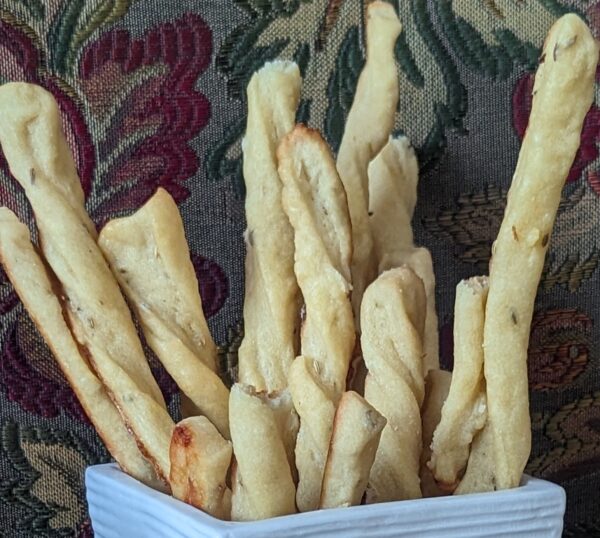
Background: I’ve had this recipe since the late ’90s. It was given to me by Diane Hawthorne, who said the recipe was 25 years old at that point; clipped from a now-nonexistent Bon Appetit magazine. So between my years of having this recipe and Hawthorne having it 25 years before that, now we’re talking about a recipe that’s officially vintage. I only mention this to head off at the pass inquiries about whether the Chico Inn Breadsticks were from “our” Chico, about 70 miles away, because I asked, and Hawthorne didn’t think so.
Yes, this recipe requires yeast, but please do not let that intimidate you, because this recipe is basically made in one big bowl, without any fuss. I bypass the standing mixer and mix everything with a wooden spoon. It’s super easy. Really. I love the fennel seed, but if you don’t like fennel, or you don’t have it, it’s fine to omit it. You could even add finely chopped rosemary, if you want that herby flavor.
Another interesting part of this recipe is the addition of beer, but not a whole can. So, depending upon the hour of the day, you can cook with some beer and drink the rest.
Last, the recipe gives measurements to cut the breadsticks, but as in this photo below, they can vary in size. There’s so much in life that’s out of our control, but these are your breadsticks, and you have control over whatever size you wish.
Please forgive this rude interruption, but before I share the recipe for Chico Inn Breadsticks, I invite you to become a sustaining subscriber of A News Cafe to help keep this site going strong. If you’re already a subscriber, then thank you. If not, we welcome you to join us.
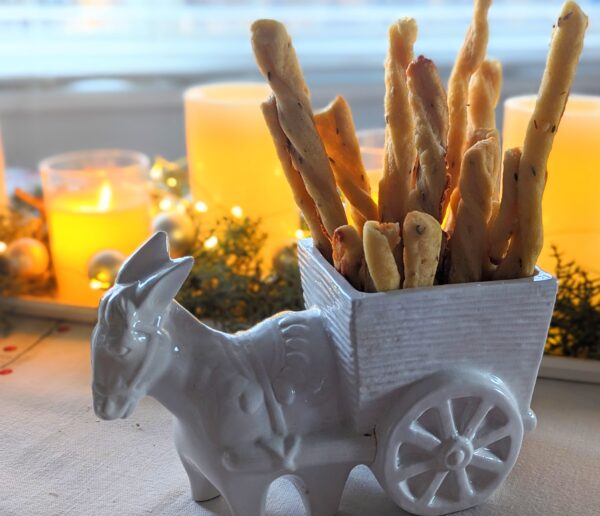
Chico Inn Breadsticks
1 envelope active dry yeast (about 2 and 1/4 teaspoons)
3/4 cup warm water (105 to 115 degrees)
3/4 cup room temperature beer
1 tablespoon fennel seed
1 1/2 teaspoon salt
1/2 teaspoon sugar
Egg wash (1 egg beaten with some water to make it brushable)
Course salt (optional)
In a large bowl combine yeast and water and let stand for 10 minutes to proof. Stir in the next five ingredients and blend well.
Stir in enough flour to make a stiff dough (4 to 4 1/2 cups). Turn the dough out on a floured surface and knead until smooth and elastic. (Don’t clean up that floured surface yet. You’ll need that surface for later.) Clean and dry the original bowl, and light grease with oil (olive oil if possible). Place the dough in the oiled bowl in a warm, draft-free place and cover with a towel or plastic wrap. (If you don’t cover it, the dough will develop a crusty skin.) Let it rise until it’s doubled.
Preheat oven to 350 degrees. Punch the dough down and let it rest briefly. Lightly grease baking sheet(s), or line with parchment paper. On floured board roll dough with a rolling pin to 1/4 inch thickness. Cut into strips about 1/4 inch by 7 inches. Gently roll the strips between your hands until dough is about 8 inches long and place on a cookie sheet. Do not let the strips touch one another. Carefully (so you don’t tear the dough) brush the egg wash over the dough strips. Lightly sprinkle with salt, if you want.
Bake until golden brown, about 10 minutes.
Makes about 6 dozen.


