
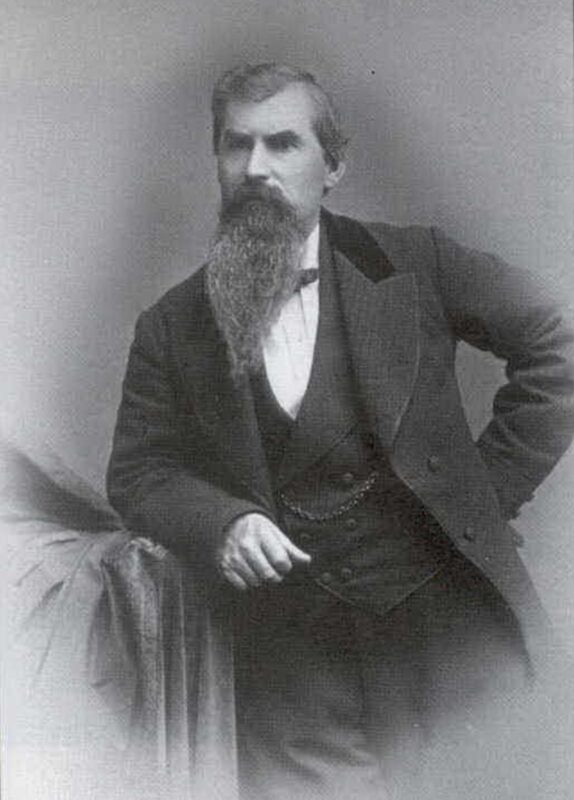
Portrait of Judge Chauncey C. Bush Sr. (1831–1907), pioneer merchant, judge, banker, and civic leader whose career linked Gold Rush-era Shasta with railroad-era Redding. Courtesy of California State Archives.
When the California and Oregon Railroad bypassed the old mining town of Shasta, its merchants faced a hard choice: remain with the community where they had built their names or gamble on an uncertain settlement rising on the Sacramento River flats. Chauncey Carroll Bush Sr. chose the gamble. His decision alone did not make Redding, but few early residents touched so many of its foundations at once—commerce, government, freight, banking, fraternal life, and civic promotion. By the time he died in 1907, the title so often attached to his name, the “Father of Redding,” reflected a lifetime spent helping a new town take shape.
Redding was established on June 15, 1872, when the California and Oregon Railroad, a division of the Central Pacific, made it the temporary end of the line at Poverty Flat, a stretch of swampy, unfarmable ground that earlier settlers had largely passed over. A persistent local myth holds that the town was named for Major Pierson B. Reading, the pioneer who settled Shasta County in 1843 under a Mexican land grant. In fact, it was named for railroad agent Benjamin Bernard Redding of Sacramento. Residents used the spelling “Reading” in the major’s honor for years, until a Superior Court ruling in 1880 upheld the railroad’s spelling and settled the matter.
Bush Sr. was born in Pittsfield, Massachusetts, on July 31, 1831. After he lost his mother in infancy, his father moved the family west to Pittsfield in Pike County, Illinois. In 1850, at eighteen, Bush Sr. joined the westward rush to California, leaving Illinois in March and reaching Hangtown—now Placerville—on August 20. He mined first near Auburn, then reached Shasta County by early 1851 and took up a claim near French Gulch.
That claim was only the beginning. Bush Sr. packed supplies by mule through rugged country, worked as a store clerk, and eventually entered business for himself. By the 1860s, C. C. Bush and Company operated a substantial wholesale and retail store on Main Street in Shasta, carrying the provisions and goods a mining district required. Bush Sr. also represented insurance companies. In September 1860, he won election as justice of the peace in Shasta Township, beginning the judicial career that made “Judge” a permanent part of his public identity.
Bush Sr.’s politics changed with a turbulent era. He was active in the Douglas Democratic organization in 1860 and ran as a Union Democratic candidate for county judge the following year. He also served as vice president of Shasta County’s Soldiers’ Relief Society, which raised aid for Union servicemen. Later records place him in county judicial service through the 1860s and into 1872, after which he studied law and entered practice.
On June 27, 1865, he married Ida Matilda Schroeder, who had arrived in Shasta as a young teenager. Their first home stood on High Street, across from Shasta’s Union Church. The house had been built in 1854 by a carpenter named Barton. A newspaper account published after it was destroyed by fire in 1904 stated that Bush Sr. had purchased the property in 1855. Chauncey and Ida had seven children: Maria Merrick Bush; William Bush; Eda Ellen Bush; Chauncey Carroll Bush Jr.; George William Bush; Jennie Brown Bush; and Harry Edward Bush. Only four survived childhood.

Ida Matilda (Schroeder) Bush (1847–1925), a pioneer and the wife of Judge Chauncey Carroll Bush Sr. She shared in the civic and social life of early Shasta and Redding. Courtesy of California State Archives.
The railroad changed the direction of Bush Sr.’s life. When it chose lower ground along the Sacramento River rather than extending its line to Shasta, he tried to keep the route at the old county seat. When that effort failed, he recognized where the region’s future lay. He broke ground for a cellar on July 22, 1872—reported as the town’s first permanent improvement—and his family moved to the new settlement that summer. Lots went on sale two weeks later, on August 3; seventeen sold at an average of $108 each. By August 11, Bush Sr. had opened Redding’s first general mercantile store, even as he continued to operate his Shasta business.
The new town grew with startling speed. On September 1, 1872, the first passenger train arrived in Redding by way of Red Bluff, Cottonwood, and Anderson, drawing a large crowd to the depot. Among the passengers were Charles Litsch and Mary Jane Culverhouse, the only woman aboard. Barely three weeks later, on September 23, the U.S. Post Office Department appointed Bush Sr. Redding’s first postmaster. The post office operated from his residence at the corner of Sacramento and Market streets, on the ground later occupied by the Redding Hotel. By November 22, only three months after the first lots sold, seventy new houses had already been built.
Bush Sr. built more than a store. He partnered with George Merrick Hatch in a ranching venture near Wells Ferry and later joined Henry F. Johnson in a forwarding and commission firm at the railroad terminus. Their business handled freight between the rail line and the towns and mining districts farther north, placing them within the supply chain that served northern California and southern Oregon long before modern highways.
The young town was not gentle with its builders. A major fire in 1873 destroyed the C. C. Bush and Company store, leaving losses beyond the insurance carried. Bush Sr. rebuilt and continued. In 1879, he helped organize Redding’s first fire department, the Hook and Ladder Company, serving as its inaugural foreman. That same year, he helped organize Reading Lodge No. 254, Redding’s Masonic lodge, and became its first worshipful master. His influence extended into statewide Masonry as well; in 1883, he helped lay the cornerstone for the Garfield monument in Golden Gate Park. In Redding, the Bush name became attached to commercial property, including Bush Hall and the Bush Block, where tenants operated businesses serving the growing railroad town.
Redding was incorporated on September 5, 1887, with the official filing following on October 4. On October 10, Bush Sr. became the first president of Redding’s Board of Trustees—an office then equivalent to mayor—and served until Jerry Culverhouse succeeded him the following April. Bush Sr. was associated with the Bank of Shasta County from its early years and later served as its president and manager. He also supported moving the county seat from Shasta to Redding, a change completed on May 19, 1888, the same day Redding held its first court session.
The Bush household maintained a civic life of its own. Ida Bush and daughter Eda hosted Presbyterian gatherings and charitable events, and the family home became a familiar setting for meetings, music, and fundraising. That quieter work complemented Bush Sr.’s public and commercial achievements.
Bush Sr.’s commitment to promoting the community had begun much earlier. In 1888, he helped organize the Shasta County Board of Trade, chaired its founding meeting, and became its temporary president. The organization set out to publicize the county’s communities, resources, and opportunities to a wider audience. By the first years of the new century, Bush Sr. was still doing that work. As president of the Board of Trade in 1902, he corresponded with a prospective developer about a woolen mill. Later that year, he helped organize Redding’s reception for a touring group of San Francisco businessmen, chairing the meeting and delivering the public welcome. The effort was intended to promote the town and its prospects for investment.
His most visible late investment came in 1902, when Bush Sr. erected a brick building at 1449 Market Street beside the Bank of Shasta County to provide new post-office quarters for the federal government. Architect Matthew W. Herron designed the building, and Holt & Gregg Company of Anderson completed its brickwork. The post office opened there in 1904; the building later housed a cigar store and other businesses. Nearly a century after Bush Sr. built it, the Shasta Historical Society purchased the property in 1996, moved its archival collections there the following year, and formally opened its new home in 1998. It remains a direct, physical link between Bush Sr.’s investment in early Redding and the institution that preserves the county’s history today.
The following year, a notice signed by Bush Sr. called for bids to remodel the Bush Block on California Street. The proposed work included excavation, brickwork, carpentry, plastering, glazing, roofing, and painting—another practical sign that he was still reinvesting in Redding’s business center decades after arriving at Poverty Flat.
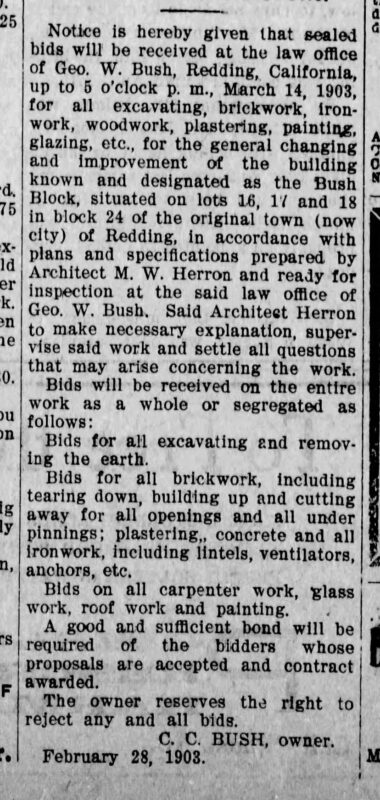
In 1903, C. C. Bush sought bids for extensive improvements to the Bush Block, a commercial property in the original town of Redding. From the Searchlight newspaper of Redding, March 8, 1903.
His later years did not remove him from public responsibility. In 1903, the Armory Hall Building Association named Bush Sr. secretary, with his son Chauncey Carroll Bush Jr. as treasurer and his son George as manager. In 1905, he served on several Shasta County grand-jury committees inspecting public buildings, records, finances, and roads. That June, he joined Judge Edward Sweeney and George O. Perry in representing the county at a San Francisco dinner honoring the National Irrigation Committee.
That same year, Chauncey and Ida celebrated their fortieth wedding anniversary during an Order of the Eastern Star observance. Beneath a large wedding bell, they renewed their vows before family and friends, with their son George—then a justice of the peace—performing the ceremony.
Bush Sr. attended the 1907 session of the Grand Lodge of Masons in San Francisco as grand Bible bearer, his final official duty. He died in Redding on December 21, 1907, at the age of seventy-six, and the Superior Court adjourned that morning in his honor. His influence remained visible in the institutions and properties he had helped build, and in the example he set. Judge Chauncey Carroll Bush Sr. was buried in the chapel at Evergreen Cemetery in Oakland, California, alongside members of his family.
Redding’s growth rested on the work of merchants, railroad laborers, farmers, families, civic officials, and countless others whose names history remembers less often. Calling Chauncey Carroll Bush Sr. the Father of Redding should not erase any of them. It recognizes his remarkable ability to adapt, rebuild, and keep investing in the community as Shasta County’s center of gravity shifted from the old mining town to the railroad city on the Sacramento River. More than a century after his death, his story remains one of the clearest bridges between those two worlds.

Judge Chauncey Carroll Bush Sr. (1831–1907) in later life. A pioneer merchant, banker, civic leader, and one of the principal builders of early Redding. Courtesy of California State Archives.
 Jeremy M. Tuggle, a native of Redding and descendant of 11 pioneer families who settled Shasta County between 1849 and 1889, has researched Shasta County history and genealogy since 2003. He is the author of Rooted in Shasta County (2003) and A Journey Through Time: Ono and the Bald Hills (2008), and maintains the local-history blog Exploring Shasta County History, and maintains a YouTube channel called @jeremytuggle6424. Tuggle served for twelve years as the Education and Community Engagement Manager at the Shasta Historical Society and received a 2017 Community Service Award for historic preservation from the Major Pierson B. Reading Chapter of the National Society of the Daughters of the American Revolution.

