
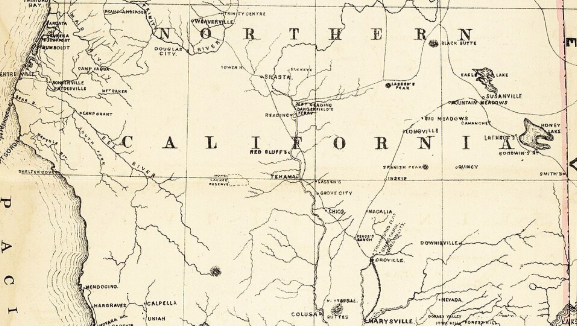
1866 Northern California map source: wikimedia.org.
When Shasta County was created on February 18, 1850, it entered a new and uncertain era. The Gold Rush had brought miners, merchants, traders, politicians, adventurers and drifters into the region, and mining camps were growing faster than a permanent government could keep pace.
Among the men who helped build that government was Michael Oppenheimer, a little-known pioneer whose brief career as sheriff has long been clouded by gaps and contradictions in the historical record. The Shasta County Sheriff’s Office today recognizes him as the county’s first elected sheriff, beginning September 7, 1850. Yet his name appears only briefly in many later accounts, leaving the impression that he simply disappeared from office.
The surviving evidence tells a different story. Oppenheimer was elected sheriff — contemporary newspapers identified him as serving in the office — and he won another election in 1851. His death in February 1852 created a vacancy that led to a special election that April. The mystery is not that Oppenheimer disappeared, but that his story was interrupted before much of his life could be preserved.
A New County and Its First Sheriff
Shasta County was one of California’s original 27 counties, created during the months surrounding the Gold Rush and statehood. California entered the Union in September 1850, as communities across the new state moved toward organized county government and elected offices. Before official law enforcement was firmly established, mining camps often relied on miners’ committees, citizens’ groups and other informal forms of justice. As the population grew, the need for a sheriff became harder to ignore.
Oppenheimer emerged during this period, as newcomers from Jackson, Michigan, were gaining political influence in the county. Among those who traveled west from Jackson were attorney Homer A. Curtiss, Reuel C. Baker and Oppenheimer, part of a larger wave of eastern migrants who became involved in the county’s new political and legal institutions. Curtiss became Shasta County’s first district attorney, while Oppenheimer became sheriff. They did not merely come west to mine gold. Some came to practice law, establish businesses and seek public office, helping create the institutions that would serve a rapidly growing population.
Oppenheimer in Office
For years, historians questioned whether Oppenheimer actually served as sheriff or was simply a name on an early election return. Contemporary newspapers help answer that question. An October 1850 report in the Daily Alta California identified him as sheriff and stated that he and the other county officers were performing their duties and maintaining good order.

A letter Curtiss wrote to the Jackson Citizen in Michigan on October 26, 1850, reporting the results of a Shasta County election, provides further evidence. He wrote:
“M. Oppenheimer is elected Sheriff of this County for the next two years.”
Curtiss also reported his own election as district attorney. Together, these accounts establish Oppenheimer’s election and recognition as sheriff, evidence that later historical lists alone could not supply. Curtiss’s reference to a two-year term, however, raises a question because Oppenheimer appeared on the ballot again in 1851. Whether this discrepancy reflected changes in election arrangements or other circumstances has not yet been established, and the surviving evidence does not provide a definitive explanation.
Several additional details come from the Shasta County Sheriff’s Office historical presentation, available online in its document titled Michael Oppenheimer, rather than contemporary newspapers. According to the presentation, Oppenheimer’s September 1850 victory was challenged by another candidate who alleged voter fraud. A lawsuit followed, but both parties reportedly agreed to dismiss it in October, allowing Oppenheimer to continue as sheriff. Although the original court proceedings have not yet been examined, the account suggests that disputes over the office began almost as soon as county government was established.
The Election of 1851
The following year, Oppenheimer stood for election again, defeating William G. Ross, the regular Democratic candidate. Oppenheimer ran as an Independent Democrat with support from Whigs. Transcriptions of the election figures disagree on Ross’s total, but the result is not in question: Oppenheimer won.
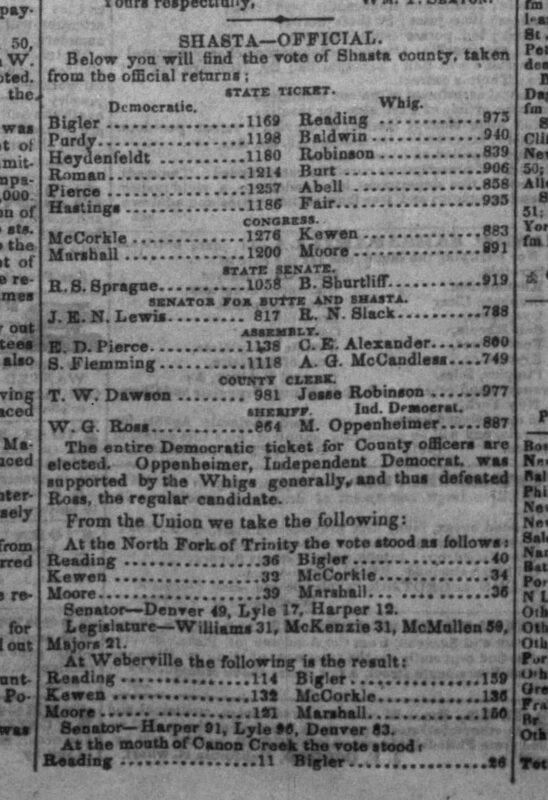
A September 1851 report in the Daily Alta California documented the Shasta County sheriff’s election involving Michael Oppenheimer and William G. Ross. Oppenheimer, running as an Independent Democrat with Whig support, defeated Ross, the regular Democratic candidate, securing another term as sheriff. Source: Daily Alta California, September 20, 1851.
His second election, however, reportedly produced another legal challenge. According to the Sheriff’s Office presentation, a fellow candidate filed a lawsuit following the September 1851 election. During the dispute, David Corsaut is believed to have served as acting sheriff, although the circumstances of his appointment and the length of his service remain uncertain. This may explain why some later histories associate Corsaut with the office before Oppenheimer’s death and illustrates the difficulty of establishing an uninterrupted chronology of the county’s earliest sheriffs.
Illness and Death
Sometime after the 1851 election, Oppenheimer became seriously ill while staying at the Shasta Hotel in the town of Shasta. Contemporary reporting described his condition as an “inflammation of the lungs,” a nineteenth-century description of a serious respiratory illness. He died in February 1852, bringing an unexpected end to his brief political career.
A contemporary newspaper report clarified what happened next:
“In consequence of the death of Mr. Oppenheimer, Sheriff elect of Shasta, a vacancy has been created in that office.”
That sentence is among the most important pieces of evidence in reconstructing his story. The newspaper described Oppenheimer as “Sheriff elect” and explicitly connected his death to the vacancy. Although that designation raises questions about the precise timing of his second term, it does not erase the earlier newspaper evidence identifying him as sheriff in 1850.
The same report named Isaac Roop, John Gillson and F. Bates as candidates for the vacant office. David Corsaut was announced as a candidate later. Roop was already a prominent pioneer and trader who would become an important figure in Nevada history, while Gillson and Bates were also involved in early Shasta County politics. Only months after Oppenheimer won another election, the county was preparing to choose his replacement.
The Legislature Steps In
The vacancy was not filled informally. The California Legislature authorized a special election. On March 8, 1852, the Sacramento Daily Union reported legislative activity concerning the matter, and on March 25 it reported that the House had passed the authorizing bill.
The county still needed a sheriff until voters could choose a successor. According to the Sheriff’s Office presentation, the Court of Sessions appointed James M. Coats to serve during March and April 1852. The original Court of Sessions proceedings have not yet been examined to confirm the date or circumstances of that appointment.
On April 13, the Sacramento Daily Union announced:
“A proclamation ordering the election of a sheriff for the County of Shasta, has been published. The election will take place on the 14th inst.”
The election was held on April 14, 1852, and Corsaut won by 130 votes. His tenure, however, would soon encounter difficulties involving the requirements of the office.
David Corsaut and the Conflicting Timeline
Later histories identify Corsaut as one of Shasta County’s earliest sheriffs and generally place him immediately after Oppenheimer. The Sheriff’s Office identifies him as the county’s second sheriff. Yet some lists assign Corsaut dates that appear to overlap with Oppenheimer’s service and election, creating a chronology that is difficult to reconcile with the contemporary newspapers.
The election evidence establishes that Corsaut won the April 1852 special election. His possible earlier service as acting sheriff during the 1851 dispute offers one explanation for the overlap, although the exact nature of that service has not been established.
The Sheriff’s Office presentation also reports that Corsaut was suspended in May 1852 because the required bonds had not been submitted. The Court of Sessions then appointed Coats again, on June 15, 1852, and Corsaut resumed the office in September after satisfying the bonding requirement. The available account does not clearly identify who carried out the sheriff’s duties between Corsaut’s suspension in May and Coats’s June appointment, leaving another question about the early succession of officers.
These developments help explain why Coats appears among the county’s earliest sheriffs despite Corsaut’s election victory. Rather than a straightforward succession of elected officials, the county experienced disputed elections, possible acting appointments, a vacancy and interruptions involving bonds. The Court of Sessions records remain important for verifying the appointments and clarifying the dates of service.
The 1977 Search
The confusion persisted long after the 19th century. In 1977, members of the Shasta County Historical Records Commission examined old county records and sheriff’s office materials in an effort to reconstruct the history of the county’s earliest sheriffs. The surviving records did not provide a simple timeline, and conflicting information about Oppenheimer and Corsaut left researchers uncertain whether Oppenheimer had actually taken office, how long he served and when Corsaut assumed the position. More than a century after his death, even the basic details of his service remained unclear.
The Mystery Is Smaller Now
The newspaper evidence does more than add dates to Oppenheimer’s biography. It changes the interpretation of his tenure. Earlier accounts could make it appear that he was elected and then vanished while another man took over. The contemporary record shows otherwise. Oppenheimer was recognized as sheriff in 1850, won another election in 1851, became ill and died in February 1852. His death created a vacancy that led to a special election, which Corsaut won by 130 votes.
There is still more to learn. Oppenheimer’s birth information remains difficult to establish, and his burial place has not been located. The circumstances of his illness and death deserve further study in contemporary newspapers and county records. The original 1851 election return should be consulted to resolve the conflicting vote totals, and the Court of Sessions records may help clarify the election disputes and the early succession of sheriffs.
But the central question has changed. The surviving evidence does not support the impression that Oppenheimer abandoned his office or disappeared from California. His career ended while Shasta County’s government and law enforcement institutions were still taking shape, and the confusion that followed arose from gaps and contradictions in the historical record.
Michael Oppenheimer did not disappear. He died at a moment when Shasta County was still learning how to govern itself, and his story was interrupted before much of his life could be preserved for future generations.
 Jeremy M. Tuggle, a native of Redding and descendant of 11 pioneer families who settled Shasta County between 1849 and 1889, has researched Shasta County history and genealogy since 2003. He is the author of Rooted in Shasta County (2003) and A Journey Through Time: Ono and the Bald Hills (2008), and maintains the local-history blog Exploring Shasta County History, and maintains a YouTube channel called @jeremytuggle6424. Tuggle served for twelve years as the Education and Community Engagement Manager at the Shasta Historical Society and received a 2017 Community Service Award for historic preservation from the Major Pierson B. Reading Chapter of the National Society of the Daughters of the American Revolution.

