

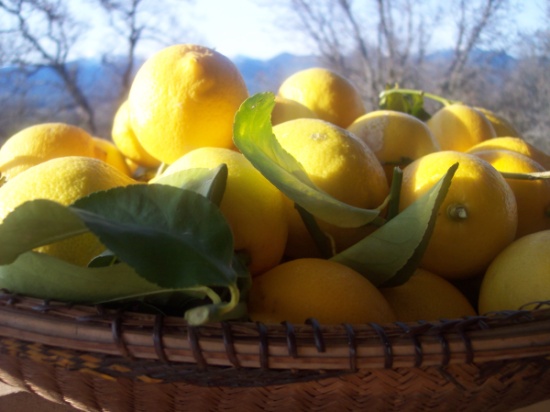
During winter in many parts of Shasta County, an abundance of citrus — especially lemons – is akin to summer bumper crops of homegrown zucchini that stealthy, zucchini-weary gardeners sometimes leave in bags upon unsuspecting friends’ and neighbors’ porches.
No worries if you don’t have lemon trees. Here in the North State, this time of year there’s no shortage of people offering lemons for sale on various social media platforms, from Facebook Marketplace to Nextdoor.com.

Just one of many lemon posts on Facebook Marketplace.
I’m lucky. One of the first things I did after I bought my old west-Redding house was to replace the lawn with pea-gravel paths, flower beds and a trio of citrus trees. There’s one tree for each of my grandchildren; a Lisbon lemon, Myer lemon and navel orange.

I’m delighted to report that all three of the grandkids’ trees — each as unique as the children themselves — have been fruitful. The thin-skinned juicy Myer lemons were the first to ripen, followed by the large, thick-skinned Lisbon lemons, some of which still have some green. The navel oranges still aren’t ripe, but almost.
What I love about growing citrus is that unlike other highly perishable, more delicate fruits — like peaches — citrus can remain on their branches for a long time without spoiling, so there’s no need to panic and pick them all at once.

Today, lemons are the star of the show. The good news is that nearly anything you make with lemons can also be made with oranges and/or grapefruit. Limes? Not so much.
First comes limoncello, one of my favorite things to make from lemons. The first time I tasted limoncello was in Florence at a fancy restaurant where the waiter brought out tiny, complimentary glasses of ice-cold limoncello. Delicious!
Limoncello is basically a lemon liqueur, and like many liqueurs, it can be either sipped straight, or incorporated into cocktails or other recipes.
Lemon curd is one of my other favorite things to make using lemons. I cannot make lemon curd without thinking of my friend Jan Gandy, who passed away almost six years ago, and who shared her lemon curd recipe with me decades ago. The wonderful thing about recipes shared by loved ones is that even after they’re gone, their memories live on every time you prepare their recipes.
Let’s get straight to the recipes. Enjoy!
Limoncello

Doni’s sister’s pretty bottles of limoncello.
In early December my Christmas gift to my sister and one of our friends was brunch, followed by a limoncello-making session. Our little limoncello class was my solution to our friend’s request to not give presents, but experiences. In the photo above are sister Shelly’s finished bottles of limoncello.
Limoncello
12 lemons
1 liter vodka
4 cups white sugar
4 cups water
Cut thin strips from the lemons, avoiding the white pith. Place the lemon peels in a large glass bottle or jar that contains the vodka. (Some people prefer to zest the lemons. Your choice.)
(Don’t throw away those naked lemons. Place them whole in the freezer for when you want to juice them.)
Cover loosely and let steep between 6 to 8 weeks at room temperature. I keep mine in a corner on a kitchen counter. Sure, if you’re in a hurry, you can steep the lemon in the vodka less time, but the flavor won’t be as potent. Check your lemon/vodka mixture occasionally, and poke down any floaters, so they’re completely submerged. If they’re stubborn and won’t sink, remove them, to avoid growing mold on the exposed peels.

When the day has come to make your limoncello, strain the lemon peels (or zest) from the vodka. Discard the lemon peels. I know. It feels wasteful. If you’re a real die-hard food recycler, maybe you could chop them and add them to a boozy lemon cake, or candy them with boiled sugar; something I’ve always been tempted to do. If you do it, let me know how it goes.
Now for the simple syrup. Without the simple syrup you’d just have lemon-infused vodka, not that there’s nothing wrong with that. But the addition of simple syrup is what transforms the lemon-infused vodka into lemon liqueur, or limoncello.
To make the simple syrup, stir together the water and sugar in a saucepan until the sugar dissolves. Boil for 15 minutes, without stirring. Remove the heat and allow syrup to cool to room temperature.
(Note: You can also prepare the simple syrup in the microwave, which is how I do it. I use a large plastic pitcher into which I place the water and sugar, and stir well. Then I place it into the microwave on high for about 6 minutes, the same process as when I’m making hummingbird food. I stop at the half-way point and stir, then return it to the microwave.)
Stir your lemon-infused vodka mixture into the syrup, and blend well. Strain one final time, just to ensure you’re left with a super clear, beautifully pale yellow liquid.
Pour into glass bottles or jars, and cap with a cork, stopper, or lid.

The Dollar Tree is sometimes a good source for bottles. Notice the absence of lemon sketches on Doni’s labels.
Let sit covered at at room temperature for 1 to 3 weeks. Then move the bottled limoncello to the refrigerator or freezer.
Serve chilled glasses in tiny glasses, or pour over vanilla ice cream for a lemony affogato, topped with whipped cream. Or, you can incorporate it into cocktails or other recipes.
Jan Gandy’s Lemon Curd

Jan Gandy’s recipes for lemon curd and scones are among Doni’s favorites.
Next month my friend Jan Gandy will have been gone six years. Her lemon curd was the absolute best, and for that matter, so were her scones, a perfect accompaniment for the lemon curd. Being as though I mentioned her scones — and you can see the printout of her recipe in the photo — I may as well share Jan’s scone recipe today, too. But first, the lemon curd:
Jan Gandy’s Lemon Curd
2 cups granulated sugar
4 eggs, well beaten
1 cube (1/4 lb.) butter
Finely grated rind and juice of three lemons (roughly 2 Tablespoons rind & 2/3 cup lemon juice)
In double boiler, combine and heat together sugar, lemon juice, and the butter. When the mixture is hot add the beaten eggs and cook, stirring, until thickened. Pour into sterilized jars. Keeps refrigerated up to 6 weeks.

Jan Gandy’s Buttermilk Scones
2 c. all purpose flour
1/3 cup sugar
1 1/2 tsp. baking powder
1/2 tsp. baking soda
1/4 tsp. salt
6 T. unsalted butter, chilled
1/2 c. buttermilk
1 large egg
1 1/2 tsp. vanilla
2/3 c. currents or raisins (optional)
Preheat oven to 400. In large bowl, stir together dry ingredients. Cut butter into 1/2 inch cubes and distribute over flour mixture. With a pastry blender or two knives (scissor fashion) cut the butter into the mix until it resembles coarse crumbs. In a small bowl combine buttermilk, egg and vanilla — add this mix to the flour mixture and stir. Add currents.
Knead twice (any more will make the dough tough). With floured hands, pat dough into an 8-inch circle on an ungreased cookie sheet. With a serrated knife, cut dough into 8 wedges, BUT DO NOT SEPARATE.
Bake 18-20 minutes, until top is light brown and a toothpick comes out clean with inserted into the middle of one wedge. Remove from oven and cool 5 minutes before removing from the cookie sheet. Serve warm or place in an air-tight container.
Basic scone-making hints: Use fresh baking power and soda. Use real butter and be sure it’s unsalted. Don’t over-knead or scones will be tough. Scones are like biscuits – best eaten right away. I have frozen them, but they must be tightly wrapped so no air gets to them. For variation try different dried fruits besides currents and raisins – craisins, dried cherries and chopped dried apricots or peaches are great.
###


