
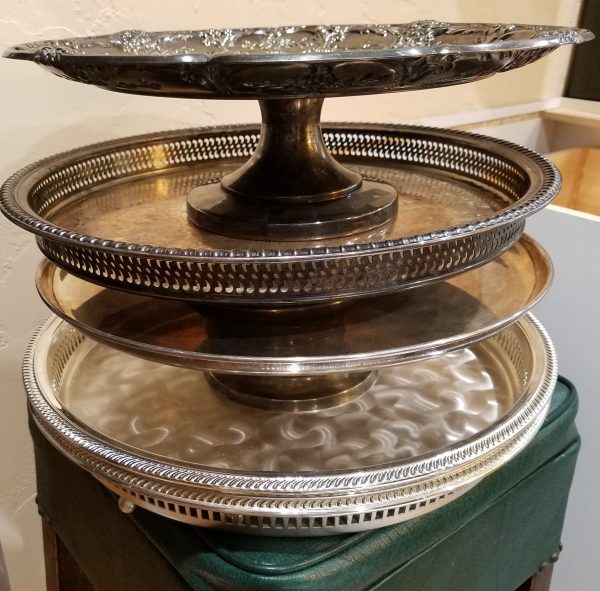
The phone call was from a lovely woman I’d not seen in a while. It was good to hear her voice. She cut to the chase.
“You wrote recently that you collect dishes, and silver serving pieces, too, right?”
A pleasant-natured person, on this particular day her voice sounded like a cross between excited and anxious, with a touch of a urgency, and just a skosh of panic. With some dread, I sensed this conversation’s direction. I tried to head it off at the pass.
I explained that yes, it’s true I do have a large collection of dishes. I often joke that I am not a hoarder because my things are artfully curated in cabinets. And yes, it’s also true that I have amassed a rather considerable array of silver (plated) trays and pitchers and whatnot, mainly left over from my former catering days. Confessions aside, I clarified that I’m not exactly in the collection mode, per se. In fact, quite the opposite. If anything, believe it or not I’m trying to lighten my load. I’m currently trying to rid myself of the large quantity of stuff I’ve accumulated over a lifetime. My single-car garage is packed. Every closet, drawer, and cupboard is full.
When I say I’m “trying to” rid myself of these belongings, I mean that I think about it a lot. Oh sure, I’ll occasionally sell an item or two on Facebook Marketplace, but the hassle factor is real. But every occasional item successfully sold on FB Marketplace is just a drop in the bucket of what remains behind, begging — needing — to be dealt with and banished from my life and home.
The thing is, I’m in the same boat as others my age, which is to say that my grown kids are not remotely interested in my collections. They lack the sentimentality (read: guilt) in which my generation was so steeped that we sometimes find it literally painful to part with items, especially those attached to memories.
I hear it all the time: We Boomers in particular cannot let items go — even those that lack monetary value – if they belonged to parents, grandparents, aunts, uncles and the dearly departed.
I’m slightly atypical when it comes to inherited items. After my mother’s death at 42, the family who took us in held a massive yard sale in their driveway and sold most of our belongings. I guess I can’t blame them. They had their own house full of their own stuff. Consequently, I can count on one hand the items I own that belonged to my parents. But I’m no quitter. I made up for the MIA items by spending decades collecting my own collectibles. Yes, a therapist could probably help with this issue, but that’s another subject for another day.
Back to that phone call. I could tell that my reply was not the one the woman wanted. Clearly, she was disappointed. Apparently, she’d assured her sister that she’d found “a good home” — mine — for their mother’s silver-plated items. Because I’m not a heartless monster, I agreed to stop by and take a look. She was ready for me. Her dining table held an impressive display of shining silver-plated items, arranged in the same room that held two glass-doored cabinets chock full of fine china and delicate stemware – things she was keeping — as many were precious heirloom dishes passed down through generations’ worth of her family’s maternal lines. She reminisced about the incredible, wonderful dinners and special events — I recall attending one — that featured those dishes and glassware. She winced as she admitted that she no longer entertains the way she once did, and she no longer hosts the kinds of fancy gatherings centered around the extravagant meals she once served. We’re talking the the glory days of decorative napkin rings, engraved place-setting cards, candle holders, reflective chargers, and linen napkins that required ironing.
Life is more simple now, but her china cabinets didn’t get the memo. The same is true at my house.
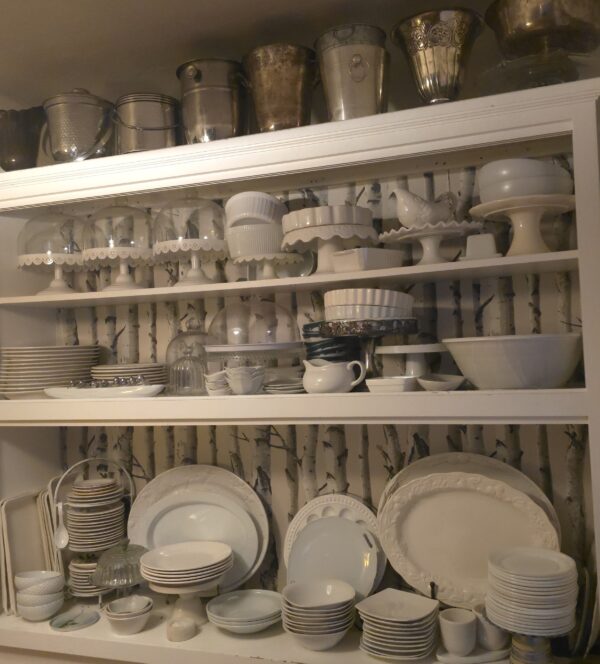
As a Baby Boomer, I am among those of our certain age who are painfully aware that time is ticking toward a physical deadline to downsize, discard — and, pardon my French — get rid of crap we don’t need, because we have plenty, or we have multiples. We’re not getting any younger. Our kids and our younger relatives don’t want our stuff, either, because they have plenty of their own stuff. Many of our parents are no longer with us, so we have not only our own stuff, but we’re sometimes the recipients of our parents’ belongings, and even their parents’ belongings, things considered ultra precious because many of our parents’ generation survived the Depression era, which forged into their DNA the need to save every single thing that each hard-earned penny purchased. Even the term keepsake seems an olde-timey justification for keeping some cherished mementos just for the sake of something deeper, as if we we’d be struck by amnesia about some special memory without that particular keepsake, followed by many, many other keepsakes.
I don’t know if you’ve heard of what some consider a massive generational epidemic of estrangement from parents, initiated primarily by Gen Xers and Millennials who cut all ties to their parents, sometimes with no apparently good reason. Wouldn’t it be something if one of the reasons for inexplicable estrangements was to avoid being saddled with their parents’ stuff (and perhaps care) after they die?
Yes, that’s an extreme concept, but so are acres of storage units crammed with excess stuff even our largest American homes cannot hold. What’s also extreme is the fact that true hoarders are so prevalent that there are entire television programs dedicated to what’s classified hoarding as an bona fide mental illness. I watch those programs. You’d think I’d find those shows so disturbing that I’d be inspired and motivated to start dumping stuff. But it doesn’t work like that. Instead, I look at the authentic hoarders — some of them surrounded by towers of trash and collections — and with some relief I boast that I cannot relate, because my house looks orderly, at least on the surface.
But show me that recent episode where a weeping woman clutches a small chipped vase, insisting through sobs that she must keep it, because it belonged to her dead mother, and I’m embarrassed to admit that that, I can relate to.
A good friend is in the business of conducting estate sales, sometimes because an older person is in transition between their home and assisted living, so they must drastically downsize to move into a smaller space. More often, his estate sales are requested by the family on behalf of someone who’s died. I’ve attended many of those estate sales, and I always experience a cauldron of mixed emotions. First, I feel sad for the departed person, and all their personal belongings left behind that sum up that deceased person’s life, right down to rusty tools, Tupperware, canes, walkers, shower seats, appliances and bathroom supplies. I feel embarrassed and guilty to imagine how mortified those departed people would surely feel to see strangers vulturing over all those things that once held such importance and deep meaning.
Next, though — and God help me for saying this — I attend those estate sales because I feel excited to find more cool stuff to buy. And I always do. Do I need one more thing — one more anything? No. Absolutely not. (See therapist, above.)
All those thoughts crossed my mind as I looked at the silver-plated items stretched across the lovely woman’s highly polished dining-room table. Actually, much to my surprise there were a few things I found interesting, so I gratefully accepted those items, wrapped carefully in labeled felt bags with words like, “silver platter” and “silver butter dish”. She thanked me multiple times, and said she couldn’t wait to tell her sister.
“Thank you! Thank you!”
Me? I felt like a cat burglar making off with a family’s loot wrapped in hand-sewn felt bags.
Before I left, we enjoyed wine, poured into the woman’s mother’s gorgeous wine glasses. We talked about life, kids, aging, gardening, exercise and families. Of course, we talked about stuff; how we ended up with so much, and how in the world can we can get rid of it so our kids and grandkids and nieces and nephews are not stuck with it, and so they won’t hate us because of it.
I shared a story, of the time I interviewed a woman after her home had burned to the ground, how I’d expressed my condolences about the fire’s destruction, and how difficult it must be to start over at Ground Zero. The interviewed woman replied that aside from irreplaceable personal things — like family photos — in some ways, the fire was cleansing, because she’d already forgotten all that she’d had, and exactly what she’d lost. She said in some ways, the fire came with a silver — albeit sooty — lining of revitalization and renewal.
I’m not asking for a fire. But I am looking for a quick, easy and maybe even profitable way to downsize. I dream of a huge Baby Boomer flea market with a sea of tables loaded with all those unnecessary things. I’d certainly rent a table or two or three and can bring a carload of good stuff to sell. Count on it.
It would be a huge success, as long as the Boomers vowed to not buy from each other.
How about you? Do you have more stuff than you need? Are there things you have difficulty letting go? Is it too late for a support group?
###
If you appreciate award-winning journalist Doni Chamberlain’s commentary, profiles, food stories and features, please help support this site as a loyal subscriber of A News Cafe. Thank you!


