
Mine was not the usual college experience—how could it have been with World War II swirling around us? I have tried to explain, to myself and others, just how encompassing and upsetting that time was. Everyone was on the move. Long-time dreams and careers were cut short as people plowed into the war effort.
I graduated from High School in 1940 and was all excited at the prospect of going to college at USAC (Utah State Agricultural College—now Utah State University). I was awarded a small scholarship, mostly because I was the only graduate planning to attend that school. Thinking back, I might have been the only student in that class of 38 who went on to college. USAC is in Logan, a pretty little city in the north part of the state.

In the early fall when the paper is full of ads of things you should buy to outfit a dorm room, I can’t help but compare them to our preparations. We bought nothing new. We raided our mothers’ linen closets for bedding and that was it. Jean (my cousin and roommate) had a small radio, which was a luxury.
We both started out with majors in Secretarial Science—yes, they did have such a major then. Breakfast and dinner were included in our dorm rent, but lunch was on our own. At the end of the month when funds were low (my father deposited my $35 monthly allowance on the first of the month) I remember going to the Commerce Library which was on the top floor of a building on the edge of the campus and as far away as possible from any cafeteria or food odors, and working on my shorthand.
We made good friends in the dorm and pledge week was exciting, being courted by several of the houses on campus. We both pledged the same sorority, and did the things pledges do—mostly serving dinner at the chapter house with great emphasis on proper serving and table manners.
When one of my sons pledged a fraternity and subsequently lived at the chapter house, I held great hopes he would learn those niceties. Not so. Fraternities are different—more of a food trough than fine dining I learned.
Then came Pearl Harbor. When we returned from Christmas vacation the campus was changed. Nearly every upper-class man was gone to war. The college had an active ROTC unit and all those fledgling officers were off to do what they had trained for. Others enlisted or went to work. It was not the same campus.
My sister who was then teaching school in Ogden had been recruited to work at Hill Field, a large Air Force supply and repair depot about 10 miles south of Ogden. With her superior skills, she was quickly tabbed to be secretary to the commanding colonel.
She suggested I apply for a job for the summer. This I did and was soon working in the Personnel Office. I then managed a transfer (perhaps with my sister’s help) to the Operations Hangar—a prime spot. My office overlooked the runways and the tarmac and I could watch all the air activity from my desk. I typed lots of orders and correspondence, but eventually found myself working in the Air Office. This was where all incoming pilots checked in and outgoing pilots picked up their orders. It was exciting and busy, and a bit disconcerting when I discovered that some of the pilots were younger than I was. One of my jobs was maintaining a large blackboard where all flights in the air were listed—adding and erasing flights as they took off or landed. If an incoming plane was overdue, I reported it to my boss which caused a bit of a hubbub until it was located.
The upshot turned out to be: I didn’t want to leave that job when it came time to register for school, so I decided to lay out a year. I lived in a basement apartment in Ogden with two wonderful roommates and I rode to work with a carpool and the ride to the base was fun and we all became good friends.
I don’t quite remember how much longer I worked there, but sometime in the summer I lived in Albany (near Berkeley) at the urging of my roommate who wanted to be on the coast when her fiancé came back from serving in the Pacific. We lived with a nice couple and I worked for about three months at Kaiser Shipyards where I made more best friends. (Where are all those people now? I can’t even remember the names.)
But school beckoned and I returned to Salt Lake and enrolled at the University of Utah, another new experience. It was a changed campus, also. I had one man in one class! I was a lone Greek—Kappa Delta didn’t have a house there, which didn’t bother me, I was never a sorority girl, anyway. I had one advantage, though. Utah required a freshman composition credit, which I had missed my freshman year, so I had to take it then. The teacher was wonderful. She was a lovely lady, who happened to be Dean of Women. Perhaps because I was an upper classman in with all those freshmen, she took an interest in me. She got me involved with a Red Cross unit on campus where I worked and made more good friends. She was an excellent teacher and I was really inspired to please her.

I lived with my Aunt Kate while I was at the U in a lovely old Craftsman house, within walking distance from school. I remember walking across a little park, with snow spilling into my boots with every step. My roommate was a good friend from High School and we had a great time. There weren’t men at school, but Salt Lake was swarming with servicemen, and we didn’t lack for social life. It seems we spent a lot of time writing letters to the loves in our lives—Helen’s future husband was serving in the Army in Italy. My true love was a Marine who married a lady Marine. I never forgave him.
We mostly went out with officers because they were more likely to have transportation. One Captain I saw quite a bit was a Chemical Engineer from Douglas Proving Ground who had worked on the Manhattan Project. He spent one whole evening diagramming and explaining how an atom bomb was detonated. I don’t remember any of that, but I remember his name was Francis Xavier.
I finally graduated in 1945 with a degree in Spanish and went on with the rest of my life. I have never felt cheated or abused that my “normal” college life was interrupted by the war. Life is too interesting to dwell on regrets.
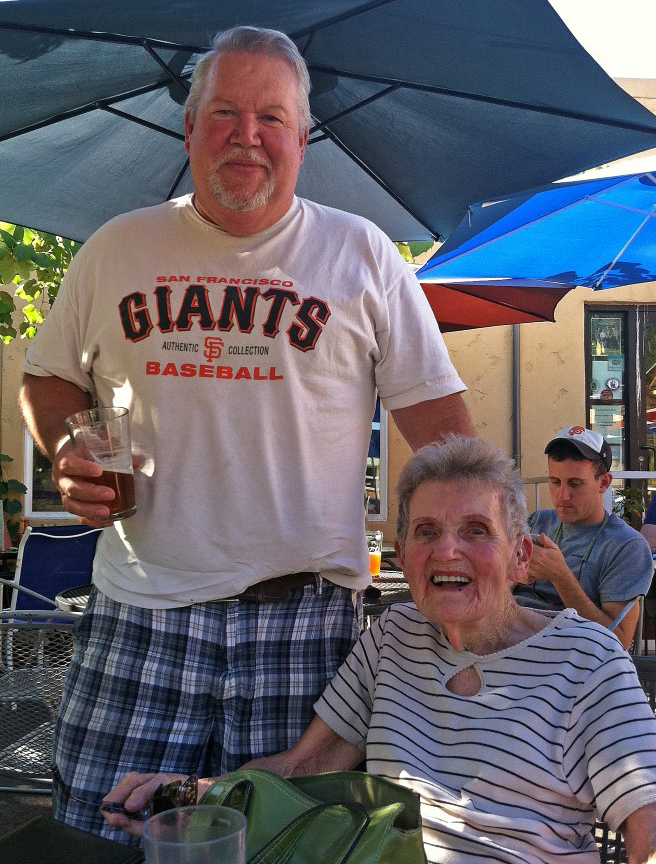 Peggy Lewis, the mother of A News Cafe contributor Jon Lewis, has been a student at the Modesto Institute for Continued Learning since 1983. The institute is a program sponsored by the Modesto Junior College Division of Extended Education and is “designed for the mature adult student who seeks to experience learning for the joy of it.” She wrote this story as an assignment for MICL’s Writer’s Workshop and has graciously allowed A News Café to share it. Peggy, at age 96, continues to write.


