

Doni: First, I want to thank you, Michele Burton and Michael Barr, for teaching line dancing in Redding every Monday night at the Senior Center through the Redding Recreation Department. That class is, hands down, one of the most fun things I do. That’s not to say your classes are at all easy, or that they’re not frustrating, or that I don’t ever feel like a klutz.
Also, I want to mention that the Senior Center is just a venue, it doesn’t mean that the students are all seniors. The dancers range from young single women and young mothers to great-grandmothers. Not that it matters like hell it does if someone mistakenly assumes I must be a senior citizen if I take a class at the senior center. OK, I’ve beaten that to death. Let’s move on.
Seriously, the payoff of sometimes having something click enough that I “get” a dance and can move in unison with everyone else, it’s just such a euphoric feeling. It’s a good physical workout, and a mental one, too. But I wasn’t thinking of those things when I signed up. I signed up for line dancing because it sounded fun, and because my twin and I wanted to learn how to do the Electric Slide at her son’s shows (he’s a musician in the Chris Gardner Band). But also I joined because it doesn’t require being part of a couple which is just too freakin’ depressing. Are these common comments from your students?
Michael: Yes. We get all kinds of comments, but some of the most common ones include being able to take a dance class and not have to worry about ‘a partner’ relationship. It is a big plus for many. The social aspect is a large part of this activity.
Doni: I can attest to that.
So, you teach line dancing in Redding, but you live in the Corning area? That’s quite a drive every week. How did you end up teaching in Redding?
Michele: About seven years ago we were recommended by the previous teacher who taught couples and line dance, respectively. The Redding Recreation Department has done a great job in getting the word out about our class.
With the contacts we have in the area the class became a viable option for us. In Corning, there are few lifelong activities available to adults. The opportunity to share what we love and be part of the dance community in Redding is great. We actually have another dance connection to Redding, which we can talk about later.
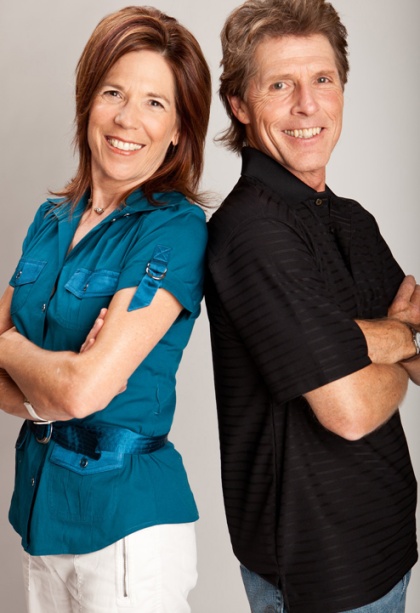
Michele Burton and Michael Barr of Corning teach weekly line dance classes in Redding.
Doni: But I guess relatively speaking, considering the distances you travel to teach dance, Redding’s not the farthest you’ve traveled to teach, right?
Michael: I teach once a week in the Bay Area. With a part-time job in Palo Alto on Wednesdays and Thursdays, and a wonderful mother-in-law living nearby to feed and house me, the Wednesday-night San Mateo class fit right in with the schedule.
As for further travels, we have been working line dance events in many parts of the USA since 1994.
We have also been very fortunate to travel and teach in Japan, Korea, Australia, England, Canada and France. Who would have thought!
Doni: Wow. That’s very cool. So you’re basically internationally renowned teachers!
Can you tell a little about each of your dance backgrounds? I’ve heard rumors that you both have influential dancers in your family.
Michele: Michael’s parents were in the arts and gave him an early-on exposure to music and dance. His father was a pianist, growing up and learning his trade in New York during the late ’20s, ’30s and ’40s.
His mother was a singer and dancer in New York working the USO shows and for well-known band leaders. They met during the ’40s in New York and decided to have a family. His mother took the kids to the suburbs and his dad took to the road as a traveling accompanist and arranger for popular singers.
Michael’s grandfather was also in the music industry and played first cello in the New York Philharmonic Orchestra.
Michael: Michele’s parents were athletic sports enthusiasts, encouraging their kids to participate in recreational and competitive sports. Whether it was softball, field hockey or dancing, her mom and dad were there. They were always highly involved in their children’s lives (for better or worse – ha ha). Michele’s mom, Lorraine, is still involved today, at age 86, dancing and choreographing right along side Michele and me.
Michele: How did we meet? The first official meeting was a polite handshake at a choreography competition during the awards ceremony. To this day we laugh because my dance placed first, but Michael’s was the one that circulated and received worldwide recognition. We think that was about 1994, but we each led our own lives and didn’t get together as a couple until 1999. Since then, we’ve been attached at the hip in dance and in all aspects of our lives. We feel lucky to have so much, besides dance, in common.
Doni: Well, it shows. You are very sweet together.
So, subject change. I notice that neither of you have an ounce of jiggle on you. Do you have to eat 5,000-calorie-meals three times a day to mitigate the fat you burn off dancing?
Michael: No, we really do eat the same as most folks … trying to keep it as healthy as we can. We both have metabolisms that work pretty well. We try not to abuse it as we know we are lucky. Like everyone, we have our vices, and ours is coffee ice cream!
Doni: Funny, I like coffee ice cream, too, but I don’t look like you.
Speaking of liking something, what is it about line dancing that you like? Do you do other kinds of dance?
Michele: Through the years there have been a number of reasons for our love of line dancing. It has changed as the years go by, but during the past 15-plus years we have learned much about competition, choreography, teaching, and walked into a social aspect that is second to none. We are part of a community of dancers from all over the world. We can go to another country and call someone and most often connect with folks that have the same attraction as us to this wonderful activity. As far as other kinds of dance, we can get by doing some couples dancing, but have not found the time to take the necessary lessons.
Doni: Oh, I’m sure you’re being much too modest when you say you can “get by” doing some couples dancing. But back to your classes. What’s the worst part about your demanding teaching schedule?
Michael: … Having a good dinner and then realizing that we can not just sit down and watch a movie on TV or take a siesta, but we have to get in the car and get it in gear. Once we are there, no problem, but getting out of the house sometimes can be hard.
Doni: Monday (April 18) is the start of yet another beginner class at the Senior Center in Redding. That will be the last session until fall. This will be my third of many more to come beginner class. I plan to keep taking beginning Tell the truth, do the beginners classes make you want to scream?
Michele: Not at all! Herein lies the challenge to a teacher. We work on ways to make it clear and to bring students along in a way that works for them. We all learn in different ways. We are always tweaking the process and without the beginners we would be missing a rewarding aspect of teaching. It’s a continual learning process for us too.
Doni: What do you do when you’re not teaching dance?
Michael: My part-time job in the Bay Area is as an assistant office manager in an architect’s office. While at home I can be found in the garden or the garage fixing (or breaking) something.
Michele: I like to say I graduated from high school after 33 years as a high school teacher. Learning about investments intrigues me, while gardening takes away stress (although the next day my body reminds me I’m not 20 anymore!). I would be remiss not to mention the enjoyment of each other’s company on a bike ride, walk, or outing to a little hole-in-the-wall café.
Doni: Maybe that energy level has something to do with the name on your business cards, and your website, and T-shirts: Boogie Til The Cows Come Home. It begs the question: Why that name?
 Michele: Back in the early ’90s I choreographed for, and danced with, a line-dance team in Redding, The Derringer Dancers. (Some folks might remember The Derringer, a great country bar in Redding). During this era, team competition was big, and The Derringer Dancers were highly successful on the competition circuit.
In 1995 and 1996, as a way to raise funds for travel and competition, the team organized a dance workshop in Corning and called it “Boogie Til The Cows Come Home.” The name stuck, as did the cartoon “cows” that are always used in our shirt designs. In 1999, Michael and I rekindled the workshop as we know it today.
Doni: You two dance so beautifully and effortlessly that I could just sit down and watch you for hours and weep because no way will I ever dance like that. You’re both so graceful and smooth and fluid. And you’re so patient with those of us who are missing a crucial dance gene. Does it frustrate you when others seem to struggle with what comes so easily to you? When I say others, I mean me.
 Michael: We would be lying if we said we never get frustrated. But therein lies the quest. We have a few people in our lives that act as mentors. When we can be around them we always seem to learn something we can bring to class, which has helped us achieve a small change here and there that we are always looking for with our students. We all dance to a different drummer as they say, and what we try to do is celebrate the rhythm that each of us hears with as much direction to keep them in line (pun intended).
Doni: Does that mean you can teach anyone to dance, and, again, when I say anyone, I mean me.
Michele: Yes! Will that person fit in with a group? Maybe, maybe not. But if the person is willing to stick it out and be accepting of themselves with as little comparing as possible, then there is always a spot on the floor for them. The ones you may be talking about (not yourself) are folks who might not come back. It is truly up to the person to persevere.
Doni: I know what you mean by that spot on the floor. My comfort zone is smack-dab in the middle of the room, so I’m never at the high-pressure spot at the front of a line.
Hey, I’d like to talk about the music, for a sec. Not that I’m complaining, but I was expecting country music. But you don’t play country very often. Is that typical of line dancing? Plus, you teach us rhumba steps, and waltzes and other dances that I wouldn’t characterize as line-dancing.
Michael: In some parts of the country that is the case, that country music is played for line-dancing. But over the years, numbers were dwindling in the late ’90s, and the music started to change. In many respects it now encompasses all genres and has more appeal to a wider audience.
Michele: We are from the country days of line dancing, and although we love it, we tend to go with the flow of the majority. It has a lot to do with the dances we bring to the class. In the world of choreography you have many people putting their dances on the Internet. As we travel to workshops around the country we see new dances all the time. In most cases, the music to these dances is non-country.
Doni: Interesting. Hey, here’s something else I couldn’t help but notice: Your classes are predominantly made up of women – lots of women. What’s that about, and do you have a message for men?
Michael: I met my partner on the dance floor and if I wasn’t there life would have been very different, and I’d rather not think about that.
Michele: It’s a long-standing fact that men have more trouble with movement then women. It’s all in their minds and has nothing to due with lack of rhythm compared with women. It’s one of those things we will probably be working on for some time to come. Our only advertisement is obvious: If you like the odds – 10 women to one man – dance class is the place to be.
Doni: <Sigh>
Where was I? Oh, we were talking about you. Do you two ever just mindlessly walk anywhere, or are you always counting steps? Seriously, have you ever just broken out into dance in public?
Michele: We actually tend to be on the shy side in public … when we are not with a microphone, and teaching, mind you. So no, you will not see us getting off a subway in New York and breaking into dance, but the thought is a lot of fun.
Doni: You’re both accomplished choreographers, and I notice that if you Google your names, you’ll see all kinds of references to your dance steps. That must make you feel pretty proud.
Michael: Without a doubt, the recognition is humbling. We are very thankful for the opportunity to see our dances done by folks around the world.
Doni: Before we wrap this up, do you have any line-dancing tips before tonight’s class? I’m taking notes.
Michele: Sometimes line dancing has nothing to do with learning steps. It’s about an outing; socializing with others, getting in touch with your own skills, and having an enjoyable experience. Learn what you can, be patient with yourself, and OWN what you know.
Doni: Own. What. You. Know. I like it. Great words to live by.
Oh, one more question, and you don’t have to answer if you don’t want to, but what’s the significance of the bracelets you both wear?
Michael: The bracelet, which says, “Courage – Passion – Grace” and “Go Jo Go” is in honor of our friend and mentor Jo Thompson Szymanski. Jo is truly the nuts and bolts plus the artistic force in the line dance world.
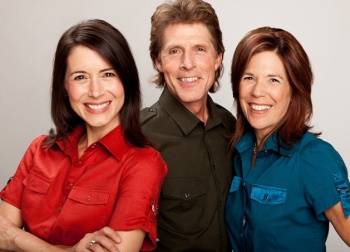
Left to right: Jo Thompson Szymanski, Michael Barr and Michele Burton are friends and professional dancers.
Seven years ago Jo was just starting her pregnancy and was diagnosed with aplastic anemia.
Jo gave birth to a healthy girl but the blood disorder continued. The drug therapy that followed put the disease in remission but not until she had gone through eight operations on her joints due to side effects of the drugs.
In 2009, Jo returned to the dance floor with all, and we mean all, the style and grace she commands on the dance floor and in all of life’s situations.
In the summer of 2010 Jo’s blood showed an abnormality which could and most likely would lead to leukemia. Jo, with a perfect match from her brother Eddie, received a stem cell transplant in November of 2010. She is doing fine and passing all the tests so far. Her recovery will take the rest of 2011, and possibly part of 2012.
She moved with her family to Houston to have the transplant and be closely monitored. The bracelets were created to start collecting donations for the costs the family would have to meet. Donations have been coming in from all over the world. Here’s Joy’s blog that tells of her progress. She has touched thousands of people and they are giving back.
Doni: That’s an amazing story, and Jo sounds like an amazing woman. We truly wish her the best.
This is probably a good place to end this conversation. We’ve certainly covered a lot today. Is there anything else you’d like us to know?
Michele: There is something we’d like YOU to know. You’ve got it goin’ on. In the last couple of weeks, your feet have taken over and your brain is relaxing!
Doni: OK, now I’m embarrassed. Red. Face. But, gosh, I’ll just say thank you. Really.
And thank you, Michele and Michael, for taking the time to talk with me. See you in class. Cha cha cha.
Michael: You are very welcome. Thanks for thinking of us.
Click here for more information about the Redding Recreation Department dance classes, including line dance. (Scroll to nearly the bottom of the page. Note that Mon. April 18 starts the next 7-week dance class session; the final one until fall.)
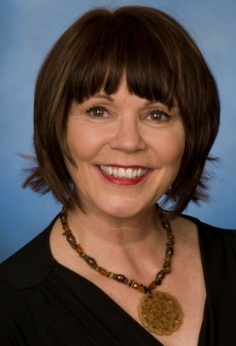
Independent online journalist Doni Greenberg founded what’s now known as anewscafe.com in 2007 with her son, Joe Domke of the Czech Republic. Prior to 2007 Greenberg was an award-winning newspaper opinion columnist, feature and food writer recognized by the Associated Press, the California Newspaper Publishers Association and E.W. Scripps. She lives in Redding, CA.
A News Cafe, founded in Shasta County by Redding, CA journalist Doni Greenberg, is the place for people craving local Northern California news, commentary, food, arts and entertainment. Views and opinions expressed here are not necessarily those of anewscafe.com.


