
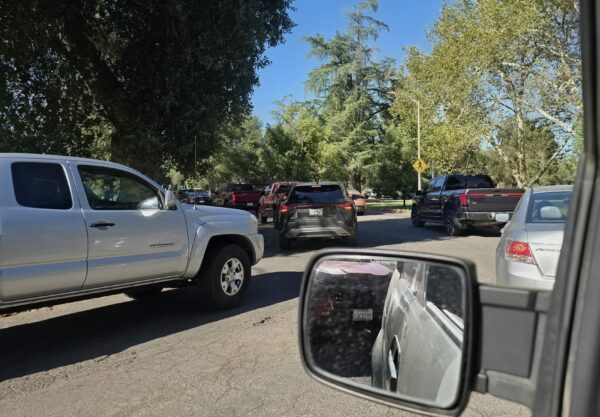
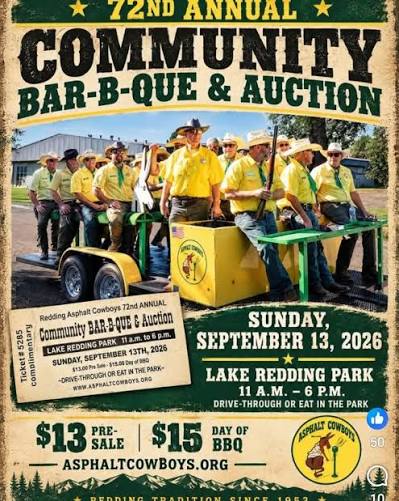
In all the years I’ve lived in Redding, one week ago was my first time to join thousands of other cars for a drive-through community barbecue in Caldwell Park to purchase Styrofoam containers full of barbecued tri-tip or chicken, along with cowboy beans, coleslaw and bread. The event was the Redding Asphalt Cowboys’ 72nd Annual Community Bar-B-Que and Auction fundraiser.
Initially, I sucked air a bit as I pulled off Court Street in one of two long lines of vehicles, and looked ahead to a stream of traffic that inched methodically through the park toward tents staffed by Asphalt Cowboy workers. The first tent accepted payment, or pre-paid tickets. There, another volunteer placed signs on windshields to identify the number of meals and if they were chicken or tri tip. At the next tent an Asphalt Cowboy helper didn’t just hand over the meals, but in my case a woman opened the car door and carefully placed three meals on the passenger side floor for safekeeping. She removed the windshield signs and I was on my way in probably less than 10 minutes — from park entrance to exit. The entire process was faster than I’d expected.
I brought the food home to share with two family members. Two of us had ordered tri tip, while one had favored chicken. The person who had chicken pronounced it good, as did the two of us who had tri tip. I was impressed with the quantity and quality of meat. The meat was moist, tender and well-marbled. The grilled bread was good, too.
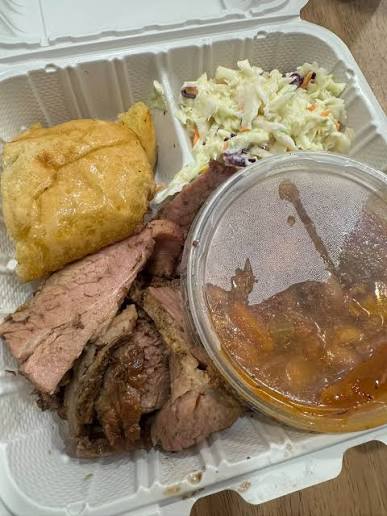
Bread, tri-tip, beans and coleslaw prepared by the Asphalt Cowboys. Photo source: Instagram
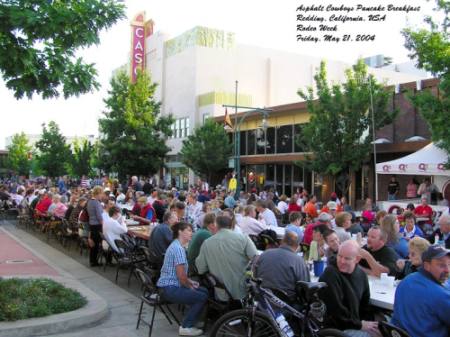
As someone who has experience with small “c” catering, I marveled at how the Asphalt Cowboys could prepare and serve meals for about 10,000 people. It’s an incredible organizational feat, but I’m not surprised. The Asphalt Cowboys are famous for other food events, such as their annual sit-down downtown Redding pancake breakfast for about 10,000 citizens who dine on pancakes and sausage, where pancake batter is mixed in a cement mixer designated just for that duty.
I give the Asphalt Cowboys an A+ for technical execution of its Sept. 13 community barbecue. I cannot begin to imagine how much planning went into pulling off this massive culinary event. We could only guess how far in advance they ordered and prepped food. The day of the event they managed traffic, barbecued and sliced the meat. Volunteers filled the containers with the chicken, tri-tip, bread, beans and coleslaw. They kept the vehicles moving in and out of the park quickly and efficiently. Bravo! Gold stars all around.
Here in Shasta County, with the exception of perhaps Jack’s Bar and Grill, you’d be hard pressed to find a more sacred cow than the Asphalt Cowboys, and for good reason. Rarely is heard a disparaging word about the Asphalt Cowboys, mainly because this non-profit does so much good for the community. If you’re unfamiliar with the Asphalt Cowboys of Redding, Inc., it’s a 501(c)4 non-profit organization that works under the auspices of the Shasta County Sheriff’s Department.
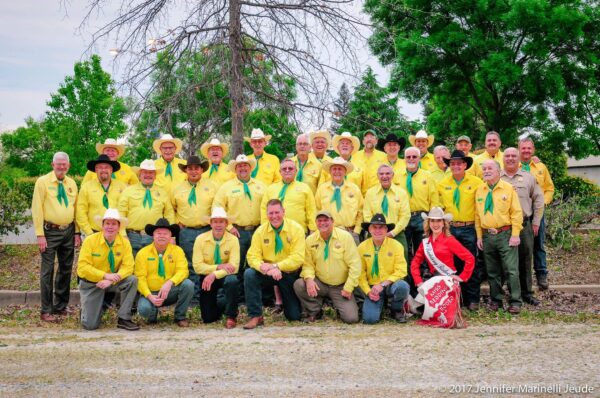
Asphalt Cowboys 2017 group photo, when Tom Bosenko (far right in beige shirt) was the Shasta County Sheriff. Standing behind Bosenko’s right shoulder is Eric Magrini, who was the next Shasta County Sheriff. Photo source: Asphalt Cowboy’s webpage.
The Asphalt Cowboys organization is dedicated to helping the Sheriff’s Department, and has funded everything from Law Enforcement Scholarships and K-9 Units to “armor piercing” bullet proof vests. The Asphalt Cowboys stated purpose is: “To aid and assist, in any way deemed lawful, in helping the Redding Rodeo Association in the promotion of the Redding Rodeo.”
The Asphalt Cowboys participate in many annual events, including Kool April Nites breakfast, Cottonwood Rodeo Parade, Shasta Damboree Parade, Red Bluff Round-Up Parade, and Burney Basin Days Parade. The Cowboys have a special place in their hearts for kids, demonstrated by their commitment to the annual Kiddie Parade during Rodeo week, and “Special Kids Day” when the Asphalt Cowboys and the Rodeo Association join forces to enable special-needs children to experience opportunities to ride horses and/or horse-drawn wagons around the rodeo arena.
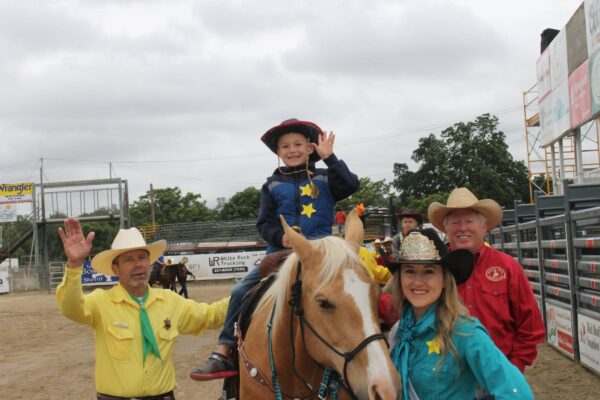
A young cowboy has an opportunity to ride a horse, thanks to the Asphalt Cowboys and the Redding Rodeo Association. Photo source: The Asphalt Cowboys’ website.
I say all that as a way to soften the sting of what comes next: The Asphalt Cowboys are awesome, but with all due respect, in my humble opinion, I believe the Cowboys should consider new beans and coleslaw recipes for next year’s community barbecue. I suggest this because the beans and coleslaw comprised half of the $15 meal. I took one bite each of my beans and coleslaw, and literally didn’t venture another bite. My beans and coleslaw didn’t totally go to waste, as they were fed to my sister’s chickens, who seemed to enjoy them. I could have chalked up my negative review of the beans and coleslaw to my personal taste, but there were comments on social media from people who left negative reviews of the beans in particular, as well as the coleslaw.
Normally, in the spirit of community goodwill and support, I’d overlook subpar beans and coleslaw. After all, we’re talking about huge quantities of food prepared by an impressive community organization. I’d praise the good elements — the meat and bread. I’d forgive the inferior food and focus on all the good things done by the Asphalt Cowboys. I’d acknowledge that the money from the community barbecue contributes to worthy causes. All true.
The thing is, these aren’t normal times. Here in 2026, we face an increasingly tight economy where many families have difficulty affording groceries, let alone the luxury of eating out, or forking over $15 a pop per person per meal. Therefore, when people do splurge to purchase a barbecued meal, it’s important that the entire meal tastes good; not half of it, but all of it.
Of course, food preferences are subjective. No doubt for every person like me who found the beans and coleslaw inedible, there are people who will pronounce them delicious. Fair enough. But objectively I can tell you that my beans were tough, and not fully cooked.
But even worse than undercooked beans was the fact that the beans and coleslaw were bland and tasteless. Granted, perhaps I got a bad batch of especially bland beans and coleslaw, but if that’s the case, then hundreds of other people also received beans and coleslaw from those same offending batches.
While it’s not the end of the world that 50 percent of the barbecue meal became chicken food, one of the most unfortunate parts is that unless I knew that the recipes could be improved next year, this may have been my first and last Asphalt Cowboy community barbecue meal.
But fear not, I come with solutions, but I need your help, too. Today, I offer you my favorite mother-in-law’s best baked beans. No, they’re not the classic savory “cowboy beans”, with thin soupy sauce and hunks of carrots, but they’re a sweeter variety. I can tell you that whenever I’ve made these, there are zero leftovers. Every bean is gone. This is one of those recipes that’s not copied from a note card, but it’s about the ingredients and ratios, all mixed and adjusted for personal taste preferences. I was first introduced to my favorite mother-in-law’s baked beans recipe in the ’70s, a time when canned foods were foundational. Confession: This baked bean recipe “cheats” by starting with prepared canned baked beans that are then doctored to achieve their final glory.
Purists can forgo the canned baked beans and instead rely upon white beans or navy beans to make their baked beans from scratch. For what it’s worth, Martha Stewart uses dried pinto beans for her baked beans. Dried beans are less expensive, too. Soak the beans overnight. The next day drain the beans and put them in fresh water to boil. Simmer for about 30 minutes. Once all your favorite baked-bean ingredients are mixed together bake the bean dish for about seven hours at 250 degrees.
Whether you use canned beans or from-scratch beans, it’s your choice. Beyond that, the remaining key elements for my recipe are ketchup, mustard, brown sugar, molasses, bacon, and the secret ingredient, a splash of Liquid Smoke.
I realize some serious math calculations are necessary to adapt a recipe to feed the multitudes, but if anyone could figure it out, I’m placing my bets on the Asphalt Cowboys.
I don’t have a favorite coleslaw recipe. That’s where you come in. If you do have a favorite coleslaw recipe, please feel free to share it in the comments second. For the record, I absolutely do believe coleslaw is the right salad side for a barbecue of this magnitude. I wouldn’t dream of suggesting potato salad, as it’s too risky, not because of the mayonnaise, but because of the cooked potatoes, which are prone to bacteria growth. Nothing spoils a community barbecue like a massive salmonella outbreak.
So coleslaw is the ideal summer salad choice. Cabbage is sturdy, unlike lettuce. The trick is finding a recipe that holds up, one that isn’t too wet, and one that has just the right balance of bright colors, crisp texture, and pleasing flavors that walk that magic tightrope between sweet, sour, and crunch, with just the right seasonings. Alas, I do not have a recipe that fits that description, but perhaps you do.
First, some backstories about coleslaw and baked beans. I’d always assumed that coleslaw was an American thing, like baked beans. I’ve since learned that I was half right, as baked beans originated with the first true Americans — Native American tribes — who cooked navy beans with maple syrup and animal fat in underground clay pots.
Coleslaw is another matter. Although it’s considered the quintessential side dish for American summer cuisine, early coleslaw references can be found around the world, starting with ancient Rome, where dishes were served that featured cabbage, onions, vinegar, spices, and eggs. In later, more relatively modern times, New York’s Dutch founders brought recipes from the Netherlands that starred a shredded cabbage salad that looked like our classic “American coleslaw”.
Fun fact: The term “coleslaw” originates from the Dutch expression koosla, which means “cabbage salad.”
OK, culinary history lesson is adjourned. Let’s proceed to my adaptation of my favorite mother-in-law’s baked bean recipe. Let me know what you think. Of course, as with all recipes here, adapt the recipe to suit your personal taste preferences.
Regarding the following bean recipe, and readers’ favorite coleslaw recipes, there’s no telling whether the Asphalt Cowboys will be receptive to our suggestions to revise next year’s community barbecue recipes, or if they’ll stick with their favorite recipes, no matter what.
That’s OK. Either way, we’ll have some great recipes to enjoy for the remainder of the summer to accompany our barbecued meats and grilled breads.
Please forgive this interruption. Before I share this recipe, I extend heartfelt thanks to A News Cafe’s wonderful paid subscribers who make this website possible. To those who enjoy A News Cafe, but haven’t demonstrated your appreciation with a contribution, I invite you to join your fellow A News Cafe fans to help support this site with a donation of any amount. Thank you!
Doreeta Domke’s Best Baked Beans
1 small white onion, chopped
1 pound bacon, diced
2 28-ounce cans baked beans, with juices
1/4 cup ketchup
1/2 cup packed brown sugar
1/8 cup molasses
2 teaspoons prepared yellow or Dijon mustard
1/2 teaspoon Liquid Smoke
Salt and pepper, to taste
Preheat oven to 325 degrees. Place the onion and bacon in a heavy oven-proof Dutch oven or pot that has a lid. On medium heat sauté the onion and bacon until the onions are golden and the bacon is cooked, but not overly brown. Remove the pot from the burner. To the pot add the beans, brown sugar, ketchup, mustard, molasses and Liquid Smoke. Taste and adjust flavorings to suit your preferences. Add salt and pepper to taste.
Cover and set the covered pot on a baking pan in the center rack of your preheated oven. Bake approximately 1 1/2 hours. Remove the lid for the last 30 minutes of baking to allow the beans to develop a deep brown color.


