

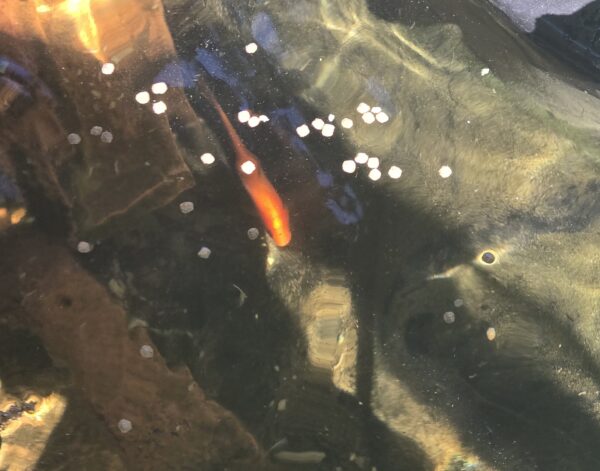
During happy goldfish times, before the massacre.
It’s been three weeks since the first goldfish massacre occurred in my modest garden pond. The devastation was completely unexpected. For nearly two years my pet-store fish had thrived nicely in my Redding backyard pond under the leafy shade of the fruitless mulberry tree that cradles my grown-up treehouse.

A small table under the tree holds two jars; one with fish food, one with pennies. For fishes. For wishes.

My scrappy little fish have survived Redding’s summers, and even North State winters with a bit of snow. The 12 fish — 11 orange and one white — flourished. No segue, but did you know a goldfish can live to be 10 to 15 years old? My fish were on their way toward impressive goldfish longevity, because they more than doubled in size, from about 2 inches to nearly 5 inches. Not bad.
I discovered the pond carnage when I stepped outside one recent spring morning to hand-water potted plants. The pond was a muddy disaster. Nearly all the pond’s water was gone. The pond plants and flowers were strewn about, inside and outside the pond. The fountain, operated by a small electric pump, was on its side, still valiantly chugging away. The old clay sewer pipe that served as a fish shelter was upended and stood askew, like the Leaning Tower of Pisa.
That pipe weighs a good five pounds. Whatever animal did this was strong, and determined. Immediately, my mind went to the poor fish. Sure enough, there they were, flopping around in just a small amount of water. I counted. Only seven fish remained; all orange. The lone white fish was gone.
I knew immediately that a raccoon was the culprit, perhaps even multiple raccoons.
It took several hours to refill the pond with water and plants, clean out the pump, and secure that old clay sewer pipe firmly to the bottom of the pond, in a spot not so easily reached by prying raccoon fingers.
That day I ordered online a few highly rated raccoon deterrents. I didn’t want chemicals, because I’d read that the smell is usually awful, and besides, they didn’t have great reviews.
In the meantime, that night I suspended a pair of old window screens over the pond, weighted down with rocks. Between the screens the fountain stood like a black plastic Statue of Liberty. She would prevail!
The next morning the screens were all cattywampus, and the fountain was knocked over again. I nervously tossed some fish food in the water and waited. Four fish tentatively appeared, then darted away.
This. Was. War.
That night I anchored the window screens with boulders and scrap lumber.
The following morning the screens were pushed into the pond, like colanders, and the boards shoved aside. I searched for the fish. I saw none. Panicked, I sprinkled fish food on the water and waited. Finally, after about 10 minutes a single fish appeared, slurped some food then darted off to the sewer pipe. One fish left out of 12.
Survival of the smartest.
Just in the nick of time, my raccoon deterrents arrived that day. My arsenal included a $29.99 solar ultrasonic animal repellent/outdoor motion detector with LED flashing lights, a $27.99 pair of three-head, wide-angle solar motion sensor lights, and a package of $39.99 solar-powered flashing predator lights said (though not guaranteed) to scare off everything from skunks and raccoons to opossums and feral cats.

If you’re keeping track, yes, I did spend just shy of $100 to protect a 79-cent Petco goldfish.
That day I set up the lights around the pond and waited for dark, when the raccoons, clever creatures of habit, would surely arrive.
That next morning, and the following mornings, all was well with the pond. Sometimes in the evening I go out and stand by the pond, just to see what happens. Every time, there’s now a brilliant display of solar paparazzi flashes, blindingly white LEDs combined with piercing rays of sharp red eyes that glare from kitten-head-sized predator faces. Victory!
Still, I am on guard. I take nothing for granted. So far, each day when I check on Smarty, she’s still there. I don’t want to jinx it, but it appears the flashing motion sensors and predator lights are keeping the raccoons at bay.
The funny thing is, as hard as I’m working to protect that one goldfish, the truth is that I never really wanted a pond, or fish, for that matter. What I really wanted was to attract quail to my back yard. I only came up with the pond idea after I’d researched what made for a good quail habitat. I learned they like lots of underbrush for hiding and for nesting and raising baby quail, so I’ve let backyard trees and shrubs grow low to the ground.
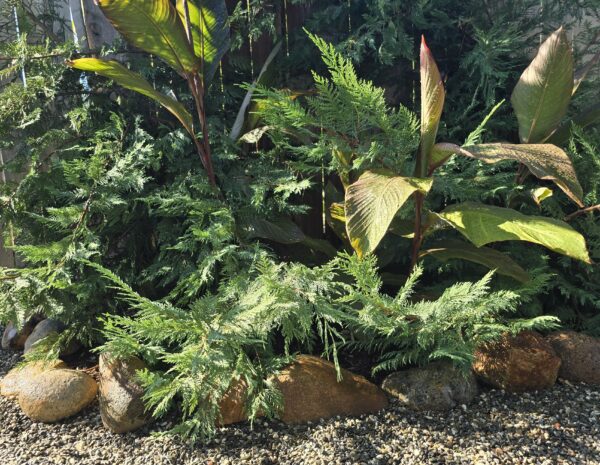
Plus, quail love a fresh water source.
Enter my rigid plastic pond, which I bought on Facebook Marketplace for 20 bucks, used, from someone in Palo Cedro. I hired another guy to dig a deep hole for the pond. I filled it with water, then got an electric pump, then added some pond plants, and bought some snails (man, they’re expensive!), mosquito fish, and of course, eventually, the goldfish. Actually, it turned into a pleasant place to sit and listen to the fountain’s gentle splashes.

Doni hoped that little bamboo bathtub tray would entice quail to walk across the bridge for a drink of water. It’s never happened.
But I still wanted quail. Once, when I lurked on the edges of a Facebook chat where people boasted about an abundance of quail on their property, something frequently mentioned was that some quail lovers leave bird seed out, especially for the quail. Apparently, the quail love it, and they return year after year, with new batches of baby quail. Oh, how people rave about their quail!
But for me, scattered bird seed was a deal breaker. As much as I wanted quail in my yard, and as much as quail may love birdseed, rats also like bird seed. I’m rat phobic. So, of course, when I bought my 1938 house eight years ago, the old former rental had major rat issues. When I say issues, I mean that the attic had been invaded by generations of rats that had lived, mated, given birth, died and decomposed inside ductwork, a system they’d chewed through and claimed as their own, probably for decades. In fact, the ductwork was so compromised and overtaken by rats that although inside the house was oppressively hot when I bought my sweet fixer-upper in July of 2017, the attic was chilly as a Napa wine cellar, with plenty of air conditioning to keep the attic rats comfortable.
The brave HVAC guys who tore out the ratty ductwork wore masks, back when it was rare to see folks wearing masks, before the Carr Fire or COVID.
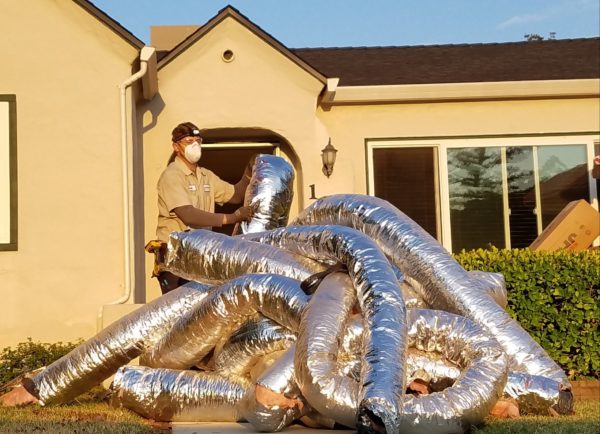
These foil intestines are what’s left of the previous rat-filled ducts. By the way, see that hole above the front door? Prior to being screened, that was a rodent freeway onramp.
Once the ductwork was removed, I hired a man who brought the mother of all vacuums that was inside his truck bed. He snaked the long vacuum hose — about the diameter of a jumbo dinner plate — from the driveway, through my backdoor, into my kitchen, up a ladder and into the attic. One guy operated the hose inside the attic, while another guy on the ground “handled” and shook the hose to ensure everything kept moving into the vacuum. When I say everything, and moving, I’m talking about dead rats, and rat droppings and rats’ nests — and yes, possibly some live rats — into the vacuum.
I hired another guy to clean and sanitize the attic, then patch every single hole (you do know rats can squeeze through dime-sized openings), and put thick screens over every single vent. Many thousands of dollars later I had brand new ductwork in a spanking clean, rat-less attic.
So, anyway, back to the quail, I mean fish.
As I reflected upon my obsession with winning the raccoon/goldfish war at almost any cost, I realized that in another time — say, before 2020 — in my wildest dreams I wouldn’t have spent $100 to save a single goldfish. I acknowledged that in those previous years, had I been faced with raccoons using my pond like Hometown Buffet, I would have probably laughed it off, and admitted that a battle with nature was a lost cause. Most likely I would have given up on the idea of goldfish. I would have kept the electric fountain, the pretty pond flowers, and the Shasta County mosquito fish, because those fish are too small, speedy and dull in color to interest raccoons.
But these are different times, and we are different people because of it.
I don’t know how you’ve coped during our country’s last five years of insanity, amplified to a fever pitch here in Shasta County, but for me, gardening has been my primary therapy; my escape. The more stressed I felt, the more I dug in the dirt, or pulled weeds. I planted bulbs, and rhizomes and seeds, all delayed-gratification flowers that require faith and hope that one day, they’d bloom, and even more important, with any luck, one day I’d live to see them.


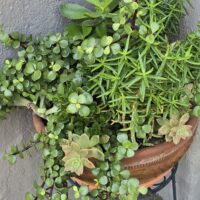
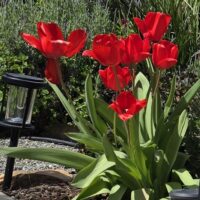
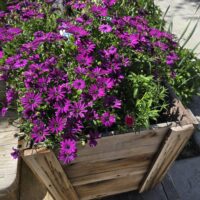
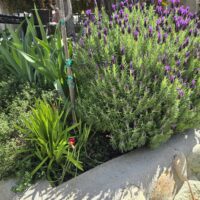

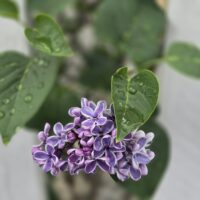

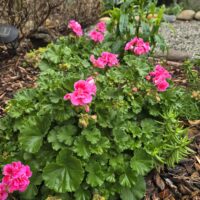

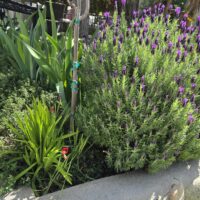
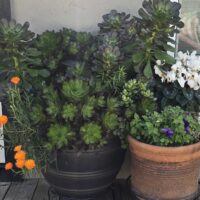


A multitasker at heart, sometimes as I gardened I monitored local extremist radio program recordings at triple speed via earbuds while I pruned and hacked and deadheaded with a vengeance.
I have a sign on my potting shed that summarizes not just my love of gardening, but my need to garden: “To plant a garden is to believe in tomorrow.”
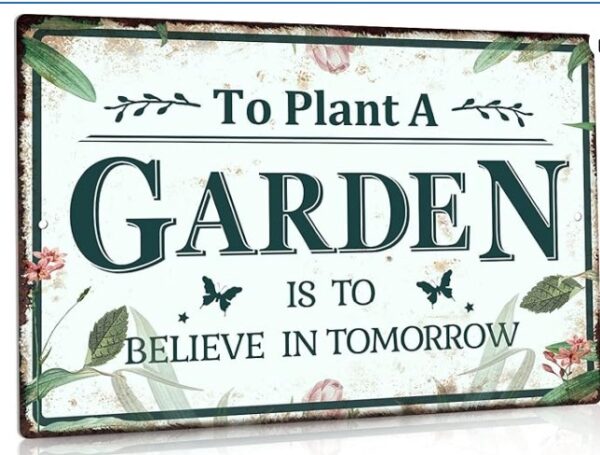
Of course, I have another sign on the same potting shed that says, “That’s what I do. I garden, I drink, and I know things,” which always makes me smile.

Even so, turn on the news and often our smiles turn to frowns, and tears of frustration, anger, disbelief, horror, anxiety, and fear. So much fear.
Fear of a maniacal government we no longer recognize. Fear of World War III. Fear of being unable to stop authoritarian dictators from destroying our county, our country, and our world.
What can we do? We can protest. We can push back. We can speak up. We can show up. We can write. We can support good people and good causes. We can make phone calls. Most of all, we can fight isolation, and gather with people we love over food and wine and walks and talks and laughter.
And when things seem almost unbearable; when the world seems its most frightening and most uncertain, we can force ourselves to get outside in any kind of weather. We can pick up a shovel, dig a hole and plant something beautiful or delicious that won’t appear until fall, or winter, or spring, or summer, or even many years from now.
We can find joy in the promise that planting a seed or a tree or a bulb is the ultimate act of optimism. And if the future seems uncertain, we can hedge our bets and plant something anyway.
And maybe, for me, if things get really crazy, one day I may throw caution to the wind, toss out some bird seed, and hope a few quail will find their way to me.
After that, just for good measure, I can drop some pennies in the pond for many, many, many wishes.
We will prevail.
###
If you appreciate award-winning journalist Doni Chamberlain’s reporting and commentary, please consider a contribution to this site to enable A New Cafe to continue its work.


