

Q: Welcome back, John. It’s been a few years since we caught up with you. You’re still doing your day job as a realtor for House of Reality?
I am still at House of Realty doing real estate. I was a licensed appraiser for a while , but the requirement for licensing and software got to be too much, so now I just do real estate sales.
Q: But you’re still a barbecue master. Can you tell a bit about your barbecue resume?
I got serious started in barbecue out of necessity. We had just bought an older home in Sunset Terrace and my wife wanted to remodel the kitchen. She tore it all out without thinking about how much it would cost to replace. For two years we lived with a microwave, coffee percolator and a Weber barbecue. I learned a lot on the Internet and cooked a lot during those two years.
Q: But you really ran with the whole barbecue thing, and took it to a level few people would dare venture. In fact, if memory serves, I think the first time I met you was when I wrote a story that featured you roasting a whole pig in Caldwell Park. I’ll never forget it. Huge, splayed out on a giant barbecue, still looking very much like a pig. I confess the sight of it made me a bit queasy.
But this isn’t about me. It’s about you. How in the world do you ensure that a piece of meat that large is cooked through? I’d be afraid of killing someone.
I took some classes as they became available. The best thing I picked up was to get a Thermapem thermometer. They run about $95 online but will make you a star. You will know when you meat is done properly.
Q: OK, it’s on my birthday wish list.
John, I took your BBQ Boot Camp class many years ago, and I guess I need a refresher course, because I’m still intimidated by my barbecue. I think there are two reasons. First, because I was married a good part of my adult life, and my husbands were good grillers, so I stayed in the kitchen with the air conditioning. Second is that meat is expensive and I’m afraid to ruin it. I guess with enough experience you learn to not ruin the food.
I remember those BBQ Boot Camp classes. Lots of fun. I want to put my BBQ Boot Camp on YouTube, but am looking for a volunteer video camera person. I have a camera but need someone to run it. No pay, but the food is good.
Q: I can attest to the quality of your food, John. That’s a pretty sweet offer for someone who can do the techie part of getting your videos filmed, edited and up on YouTube. Maybe someone reading today will jump at the chance.
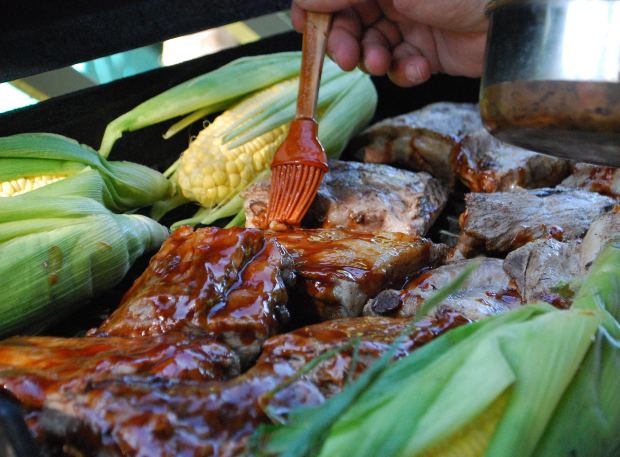
OK, here’s another question that I’ve always wondered. What’s the difference between grilling and barbecuing?
Generally, grilling is over direct heat. About 65 percent of backyard cookers grill over propane because it is easier and quicker. True barbecue is a slow cooking over wood or charcoal at about 200 to 250 degrees. My barbecued ribs take 5 hours at 212 degrees.
The number one question I get about ribs is people want to know if I parboil them. If you think about it, parboil is simply slow cooking at 212 degrees. So if you can hold your barbecue at this temperature, why put the ribs in water and wash off all the flavor?
Q: That totally makes sense. I’m going to ditch my rib recipe that starts with parboiling the ribs. Thank you.
John, let’s talk about your bbq creds. You are a member of the Kansas City Barbecue Society, which is pretty much the gold standard for judging rules and guidelines. Can you tell us a bit about the organization?
I am a Kansas City Barbecue Society Certified Barbecue Judge. The Kansas City Royal barbecue contest if the first weekend in October. They have about 350 teams there. They need judging criteria for about three judges. I judged there one year, and is is an experience. If you want to know more, go to the KCBS website and they have a lot of info.
Q: What is it that appeals to you about barbecuing?
I can cook outside and not make a mess in my wife’s kitchen. The barbecue area is my area outside and hers is the kitchen inside.
Q: Sounds like you’ve found the secret to a successful marriage.
On a serious note, John, I know you’ve changed your barbecue focus following a couple of health scares. First, I’m glad you’re OK. Second, how have you changed the way you barbecue since then?
I have had two heart attacks and suffer from Type 2 diabetes. This second heart attack I spent 45 minutes in the hospital just talking to a dietitian, at my request. At Shasta Regional Diabetes Center I meet with Joanne Tippen, a dietician, and we went over healthy cooking and what foods to avoid. I have done so many barbecued ribs that my wife doesn’t want to eat them anymore. I still take a platter of ribs to parties to share. I am working on recipes for fish and turkey and chicken. I would like to get them up on Youtube, especially since the fish store in Redding has expanded.
Q: Well, I’m glad to hear you’re still cooking, which is part of the reason I wanted to talk with you. I don’t know if you’ve been following a series of summer interviews with some of the winners of the Pros and Joes Grilldown competition Memorial Day weekend. I know that you and I helped judge it one year … maybe the first year. Have you been a judge there since then?
I did not do Pros and Joes this year but I did it last year.
Q: OK, so as you know, the KCBS rules are pretty strict, and some make no sense to me. For example, one of the rules refers to pooling sauces, which is an automatic score of for appearance. Why is that a big deal?
And I’m curious about the whole topic of garnish. It’s OK to have green lettuce, or cilantro, but red curly lettuce or lettuce cores are grounds for a disqualification. What’s that about?
Standardized garnish and pooling sauces are all about not being able to identify any entry in any way. When you get into the contests with big money, this is serious business.
I think that they have learned the hard way over time that this has to be done this way.
Q: Oh, so those rules are about limiting cheating – by the entrants or judges. Interesting. I guess when the stakes are that high, people will try anything to win.
So maybe that helps answer my next question about sauces, where the rules say that chunky sauces are OK to brush on the meat, but no pooling, and no little containers for dipping are allowed. And the chunks have to be a certain, very small size. Are there limits regarding what the chunks can consist of? I mean, can you do anything: onion, apple, pineapple – anything?
Here again, you can do nothing out of the ordinary that will identify your entry.
Q: How about flavoring the meats for contests? I know alcohol is forbidden as an ingredient. What ingredients are contestants allowed to bring from home? What about meat tenderizers? And what about store-bought ingredients, like commercially made barbecue sauces?
You can bring your sauce from home whether you buy, it mix your own or a combination of the two.
Q: That part – that store-bought sauces were OK – surprised me. But it’s about more than taste, because the judges look for three things: appearance, taste and texture. What in the world can a cook do to ensure superior appearance, taste and texture?
So let’s say that all the contestants have meat – chicken, tri-tips, ribs – from the same source. It’s forbidden, according to the KCBS rules, to brine or inject or marinade before the contest. All meat is just raw.
But walk around a contest and watch what is being done. Every cook has his or her favorite trick or technique.

Q: One of the winning contestants said his secret to winning is to find out what the judges want, and then deliver. How is that possible?
I went to a two day barbecue class at the David Klose barbecue factory in Houston. The class was given by many-time-winners James and Lola Rice. They said they tried to find out at every contest they go to what the judges like and what the local favorite flavors were. It blew me away when they said Kraft barbecue sauce is the No 1 seller in Texas. I always considered it kind of mundane.
The point is that since a lot of the judges are local, you need to figure out what the local flavors are, if you can.

Q: I cannot for the life of me figure out what that would be here in the north state. (Readers? What’s your best guess?)
Back to one of the bbq interviews I did for the summer series. That same contestant I mentioned earlier said the secret to his tri-tip was the internal temp at which he removed the meat from the grill. And he’s keeping it a secret, which frankly, surprised me, but whatever.
John, what would you say is the best temperature for tri-tip?
Personal preference, I like about 125 degrees. Also you need to let it rest so the juices re-assimilate into the meat and so the juices don’t run out when you cut it.
Q: Do you, as both a judge, teacher and contestant, have any other tips to share?
If you use a barbecue fork, don’t use one with wide tines, because they make too big a hole and let juices out. Also, use non-iodized sea or kosher salt, cane sugar, and mesquite briquettes.
Q: Super. Anything else?
I do my barbecued ribs every third Friday at the Elks Lodge, It is my tried-and-true recipe. (Readers, you need to be an Elks Lodge member, or a guest of one, to dine there.)
Q: Is there anything else you’d like us to know?
If you have any questions just email me at johnreit@hotmail.com or phone my cell at 530-209-8300. I am still looking for a volunteer to help with YouTube and Facebook, someone who wants to sample some good barbecue.
Thanks so much, John. Much appreciated! Grill on!
Click on the following names for the Pros and Joes winner interviews: Clinton Nash, Justin Tweedy and Steve Wlodarczck.


