
 He was sitting on a bench by the glass door, his face buried in his hands, and he let out a sigh. I recognized him as one of my students.
“Hello!” I said, and he jerked upright.
“Oh. Hello, Mr. Lightfoot.”
I slowed my pace, stopped, and studied him. His face was blank, hard to read.
“Matt, you seem a bit subdued,” I observed. “You OK?”
“Yeah, I guess,” he said.
“That doesn’t sound very convincing. What’s wrong?”
“Nothing. It’s just Monday morning, and it’s grey out there,” he said, pointing to the storm clouds.
I glanced out the window.
“Yes, and it’s a great thing!” I said. “Think of all that rain clearing the air, filling streams, saving fish and growing flowers.”
He nodded.
“And come summer, we’ll have water in the lakes for kayaking, skiing, and swimming.
He smiled wanly.
“And in a few minutes, you’ll be in class. It’s warm and bright in there. The room will be full of fun people doing interesting things.”
I winked.
“OK. OK.” He laughed. “Boy, are you in a good mood?”
I shrugged. “If you say so,” I replied. “I’m just glad to be here, and” I added, “I’m glad you’re here, too.”
We parted, and as I left he shouted to me: “Thanks, you made my day.”
Later, at dinner, I shared the story with my family.
“That’s sweet,” Karin said.
“Yeah,” I replied, “but it surprised me that a quick hello ‘made’ his day.”
My daughter Nicole spoke up.
“Dad, I’ve got a TED talk you should see,” she said. “It’s about ‘lollypop moments.’”
“Lollypops?” I asked, puzzled.
“Small things that make a big difference,” she smiled. “Watch the video, and you’ll see.”
So I did—I found the link to Lollypop Leadership. It’s a six-minute TED talk. And like so many good speeches, it’s a personal narrative. Professor Drew Dudley tells of a brief, chance meeting on campus between him and a student. I won’t spoil the story, but I can tell you that the young woman sought him out years later to thank him. The two had shared only a few seconds of silliness in the lobby of the admissions office, but Dudley’s clowning was life-altering.
To me, the most interesting part of this tale is that the professor had no idea that this exchange had such a profound effect. Dudley didn’t even recall the moment.
As I watched the video, I was moved, and even found myself tearing up.
“I knew you’d like it,” Nicole said.
I nodded.
“I do. It reminds me of your grandmother,” I said. “That was her in a nutshell.”
**
I’ve shared many stories about my Mom, the determined defender of the underdog, the master storyteller, and the late-in-life scholar. But now that I think about it, the biggest impression she made on me—and on all of us—was on how important it is to approach life with joy.
She personified “zest.”
Mom was known to her friends as Kodo, Apache for “Little Ray of Sunshine.” A fitting name. Some of my earliest memories are of her being silly, to cheer us up or to make unpleasant chores fun.
This was the woman who’d turn waxing floors into an ice-skating extravaganza, allowing my brother sister and me to don our socks and scoot about. Often as not, we’d crash into the furniture, walls, or one another, and end up in a tangled heap, laughing.
Our feet smelled of lemon-wax for days.
Even more common were her impromptu performances. If she saw you with your lip hanging out, she’d fling her arms open and burst into song.
Her favorite was:
“You are my sunshine…
My only sunshine
You make me happy
When skies are greeeeeeey.”
This was your clue to smile because if you didn’t, she’d just get louder.
“You’ll never know dear
How much I loooooove yooooooou….”
And if you tried to sneak out of the room, she’d throw her arms around you in a full-hug restraint.
“Sooooooo pleeeeeeease
Dooooooon’t taaaaaaaake my sunshine
A waaaaaaay!”
Mom’s schlock therapy usually did the trick—it was hard not to smile.
Other times, when we were tense or bored, she’d reach into her grab-bag of the unexpected and produce scenes from Mother’s Masterpiece Theater. She’d spring these on us without warning. One morning before school, she was rummaging through a drawer, found a piece of ribbon, and launched into a one-woman show.
She turned slowly, arching her eyebrows with a wild, menacing look, holding the ribbon, moustache-like, beneath her nose.
“You must pay the rent,” she said in a raspy villain-voice.
Next, she put the ribbon in her hair, batted her eyes and adopted the role of a damsel-in-distress.
“But I can’t pay the rent,” she squeaked.
Then the ribbon went back to her nose.
“But you must.”
“But I can’t.”
“BUT YOU MUST.”
“BUT I CAN’T.”
This went on until we laughed.
Finally, she threw her shoulders back, standing all of 5’ 2”. She held the ribbon like a bow-tie and bent her voice into a bravado baritone.
“I’LL PAY THE RENT.”
“Oh, my hero,” she cooed, giving herself a hug and making smooching sounds.
“Curses. Foiled again.”
She bowed deeply while we all applauded. Like most cornball melodramas, this was funny only because it was so over-the-top.
There were many moments like this, and then there were her industrial-strength pranks. The most memorable of these required the assistance of my Dad, his buddies, a welding torch, and a flatbed truck.
This is remembered in our family history as “Mom’s big gift.”
The caper began when she baby-sat a friend’s child. Mom took a bunch of cute snapshots of Mary’s little girl toddling about and wanted to give the pictures as a gift. So Mom found a card and sealed the photos inside.
Then inspiration struck.
Mom was shopping at the mall when she spotted a booth where you could get stuff canned. No matter what the object, if you could cram it in a container, it could be entombed in tin. So she canned the card, and then she canned the can in a bigger can.
So began her mission of mischief.
She took the twice-canned card home, put it in a hatbox and tied it up with ribbons. That box went inside a blanket, which went inside an apple box, which was tucked into a milk crate, which was then mummified in masking tape.
She loaded us in the car, and we scoured the neighborhood for more packaging.
Before Mom was done, she’d boxed and re-boxed the photos like a set of Russian nesting dolls. Dad pitched in, too, helping to cover some of the bigger boxes with steel strapping tape, bailing wire, and shrinkable plastic. At one point Dad stuffed the evolving mass into a grease drum, swathed it in chains, and welded them in place. By the time they were done, my folks had more than two-dozen containers, the last one being a refrigerator box. They wrapped it in candy-cane paper, and dropped the gag gift on Mary’s porch. It took three men and a furniture dolly to get it in place.
Mom left no card or note.
The gift became the talk of the town. Unwrapping it became an uber-demolition project that defied the best efforts of Mary and her husband, Dick. They had to borrow saws, bolt-cutters and a crowbar.
It took them almost a week to unwrap this practical-joke.
And during all this, Mary called Mom to give her the blow-by-blow unveiling of the mysterious and perplexing parcel.
Mom kept mum. She maintained her innocent countenance right up to the last minute.
In the end, Mary and Dick reached the cute baby-pics, and realized who had caused them all the aggravation. They were both miffed and amused. Mom was, as Mary said with mild irritation “a real card.”
Yep. That was my mother. She could drive you crazy, but you couldn’t stay mad at her for long.
I could tell that Mom was different from my friends’ mothers, but it wasn’t until later I realized how important her humor was in keeping us happy—and her alive.
At the age of 38, Mom was diagnosed with breast cancer, and given all of six months to live, pretty much a death sentence in those days. When she told us, she didn’t make a joke of it, but she made it clear that she was going to do what she always did and lead her life to the fullest.
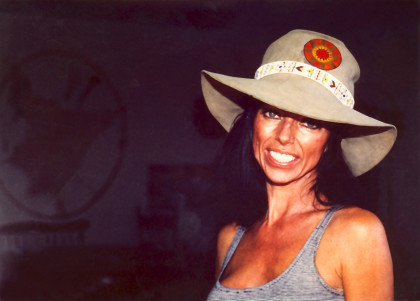
For the next 16 years her good humor helped her beat the odds. During this time Mom’s motto became: “Life is uncertain, eat dessert first.”
And she did.
She never knew from one day to the next how she’d feel or how her body would respond to the latest chemo. So she’d begin her meals with pie, cake or ice cream—or all three. She was determined to enjoy the most fun part of the meal, even if nausea overtook her before she could finish.
In the early days of her treatment, people couldn’t believe she was ill. She was so energetic, upbeat and… happy. She would bring her friends at the cancer center treats or small gifts. But mostly she brought them joy.
Even then, she was fun to be around.
She managed to find hope even when the news was bad. In the end she was bedridden and had a hard time getting out and spreading cheer.
So people came to her.
They came to ask after her health, but mom wasn’t interested cancer-talk. She’d rather hear about her visitors’ lives. She’d talk politics, another one of her passions, but usually she would crack jokes and make us laugh. Without fail, they always walked out feeling better.
Eventually, she lost her battle at the far-too-young age of 54. And we had to carry on—that’s what she wanted all of us to do—but it wasn’t easy. Life was a lot quieter without her around.
But in a very real way, she didn’t leave us.
Mom was so active in the community that tons of people knew her. When I’d visit town, I’d be stopped on the street and asked: “Are you Kodo’s son?”
I’d feel proud, but awkward.
“Yes, and you are??”
“Oh, we’ve never met. But I’d know that smile anywhere,” they’d say. And then they’d share their favorite Kodo-memory. These stories were all the more impressive because I knew her acts of generosity and other-centeredness came as she was fighting her own battles.
And the moments they shared revealed that they knew her. They loved her. And they appreciated even the smallest of her deeds. She lingered in their memory not from the splashy all-out theatrical displays I remember, but her kindness, concern and genuine joy in seeing people. Her thoughtful attitude made all the difference to those around her.
That’s what I flashed back on when I saw Professor Dudley’s Ted Talk.
His tale has a simple point: We all are powerful. We do make a difference. We can transform the lives of those around us by simple, small, seemingly insignificant acts.
And it helps to be playful.
Mom would love that. She’d be the first in line to hand out lollypops or sing you a silly song.
So I’m grateful to Dudley for his TED-talk. He reminded me of one of my Mom’s most important lessons, and one that I’d taken for granted.
The smallest act of kindness can really make someone’s day—even on a rainy Monday.
PS – You can see “Lollypop Leadership” at this link.
 Robb has enjoyed writing and performing since he was a child, and many of his earliest performances earned him a special recognition-reserved seating in the principal’s office at Highland Elementary. Since then, in addition to his weekly column on A News Cafe – “Or So it Seems™” – Robb has written news and features for The Bakersfield Californian, appeared on stage as an opening stand-up act in Reno, and his writing has been published in the Funny Times. His short stories have won honorable mention national competition. His screenplay, “One Little Indian,” Was a top-ten finalist in the Writer’s Digest competition. Robb presently lives, writes and teaches in Shasta County. He can be reach at robb@robblightfoot.com.


