
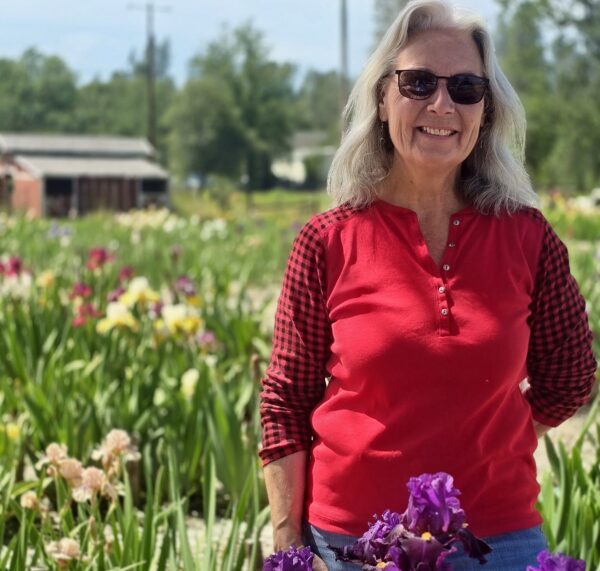
Teresa Moravec stands among thousands of irises at her Anderson property. Photo by Doni Chamberlain
The word “addiction” might be a tad strong when it comes to describing Teresa Moravec’s obsession with irises, but just barely.
Moravec traces her love of all flowers to her mother and grandmother.
“I’ve always loved gardening,” Moravec said as she wandered between thick, tidy rows of colorful irises. “So I’ve always been passionate about growing flowers.”
Moravec said a turning point in her interest in irises arrived in the ’90s when her friend gave her a Schreiner’s catalog. She learned about the 150-acre Schreiner’s Iris Gardens, located in Salem, Oregon.
“Before that, I liked irises, but until I saw the catalog, I had no idea.”
There was no going back for Moravec after that. She began ordering irises from different companies all over the country. At that time she lived with her late husband on a plot of land where Moravec would have liked to have had an iris farm, except that land was down in a holler of sorts, lacked sufficient sunlight, and was difficult to see from the road. As she acquired more irises, she’d sometimes sell them at popular yard sales. Then, she was into roses, and had more than 350 varieties. As much as she liked roses, Moravec said they require more maintenance than irises, which are drought tolerant, and easy to care for.
Her husband passed away, and eventually it was at church where she met Rex — but she calls him Mike — Moravec, who was also single.
“We went to the same church, but we didn’t really know each other. You know, we just saw each other from a distance, and he later said he’d been eyeing me for some time,” Moravec said with a smile.
Rex, 72, and Teresa, 68, married in 2022, which is the same year Iris Country was born. Moravec shared her dream of an iris farm, which is how she ended up moving to Rex Moravec’s Setting Sun Drive property in Anderson, a place Rex and his former wife lived.
She was more into flowers, and he was more into orchards and vegetable gardens, but he made his bride’s dream of an iris farm come true. As Moravec discussed irises, her husband walked toward his truck and waved.
“How are the weeds?” he asked with a laugh.
“That’s what he calls my irises,” Moravec said.
“Drunk monkey” was how Moravec and her husband came to refer to their initial haphazard iris farm design.
“My husband nicknamed it that because we didn’t have it very well planned out, and it was just all over the place. We knew that in order to stay kind of organized as a farm and sell irises, we’d need to be more organized,” she said.
Moravec said there was also the issue of inferior soil. Moravec said that her husband is a “big fan” of wood chips, for how they can suppress weeds, retain moisture and help fortify the soil. At the time, P.G.& E. trucks loaded with wood chips frequently passed their home on the drivers’ way to dispose of the chips produced from trees cut away from power lines. One day Rex Moravec flagged down a driver, and asked if they’d like to dump some chips on their property. The drivers agreed, as it meant they didn’t have to drive long distances to get rid of the chips. The drivers wouldn’t accept money or beer, so the Moravecs kept the men stocked in soda.
Eventually, the Moravecs used heavy equipment to spread the chips over their entire planting area of a depth of about three feet. Even now, as visitors walk between the iris rows, the ground is so soft from the abundance of wood chips that it’s like walking on foam rubber. The couple developed a better system for the irises. Although the wood chips are good for soil augmentation, they’re not a good growing medium for the irises. So Rex built shallow forms in which they deposited quality soil. Once the dirt was in the frames, they removed the frames and then planted the iris rhizomes. The goal was to a grid in place, instead of the “drunk monkey” look. The system worked and the irises thrived. They planted the irises in rows, and in alphabetical order.
Although Moravec insists that irises are easy to grow, and do well here in the North State’s climate, she said irises prefer sandy, dry soil. She said that if she were to pull up almost any iris it would have roughly 12 inches of roots. Irises grow from rhizomes, which is basically an underground plant stem that looks like a ginger root, and can send out roots and spread.
Moravec got a business license, and created a pamphlet that contains the names of the 170 varieties she offers for sale. She’s working on developing a website. She’s meticulous in following proper guidelines for mailing rhizomes, which includes removing every speck of dirt, and clipping away nearly all the green, and even disinfecting the roots with Clorox to meet interstate agricultural requirements. Not all varieties are in stock all the time, and sometimes customers must order their desired irises, and Moravec will call them when they’re ready for pickup. Different irises bloom at different times. For example, the early bloomers are finished, while the late bloomers and “rebloomers” are still going strong. Other irises are completely sold out for the season.
With pride Moravec explained how she was able to name and register a brand new variety of iris that appeared on her farm by an accident of nature. She marveled that the huge purple bloom was one of the largest she’d ever seen on an iris. She was aware that one of the plant’s parents was Sapphire Hills, but the other parent’s identity is unknown. Even so, that genetic union created an entirely new, previously unknown flower, which Moravec had the honored of naming and registering it with the American Iris Society as “King Wave”.
King Wave is currently being grown in one of Moravec’s test gardens.
She said typically, bloom season begins in April, and lasts from May until June, depending upon the flower variety. She said that this year the flowers bloomed about two weeks earlier than usual. Their business hours are flexible, but typically they aim to be open for the public Saturdays, Sundays and Mondays. Sometimes people stop by without an appointment, which usually works out, because Moravec spends so much time working on the farm and tending to the flowers that she’s often there when visitors arrive.

Teresa Moravec deadheads spent iris blooms at her farm, Iris Country in Andersson.
As Moravec gazed across a sea of tall irises, she described a variety of unique iris characteristics, such as one that has a scent reminiscent of grapes, and another is root beer scented. She said that although irises come in seemingly every color, there are no true red irises, just as there are no true blue roses. She said deer usually leave them alone, except if the deer are exceptionally hungry. She explained her color-coding system, such as a red tag means a plant is sold out, and a green tag identifies a rebloomer. There are bearded irises and fuzzy irises and tall irises and miniature irises. She looked surprised when asked to identify her favorite iris — or two.
“I can’t!” she said. “It’s like asking someone to name their favorite child.”
Discovering Iris Country
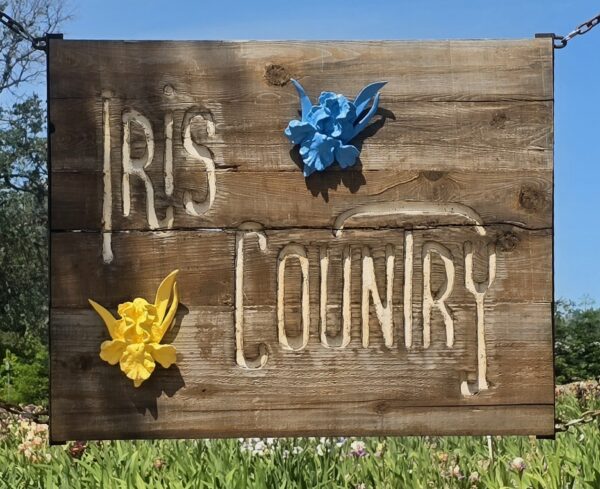
I first learned of Iris Country last month through friend Matt Grigsby’s Facebook posts.
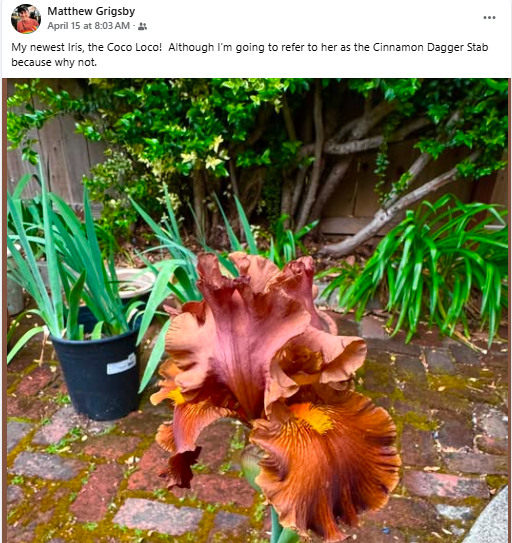
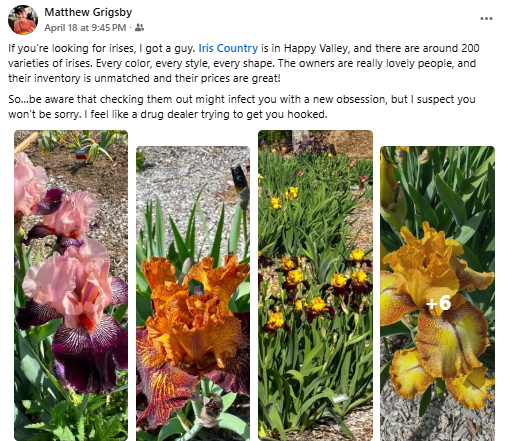
Grigsby’s enthusiastic social media posts followed his visits to Iris Country. He offered subsequent words of caution about what could happen to others who also ventured a drive to see the farm for themselves, a place that’s officially in Anderson, but locals identify it as residing in Happy Valley. Either way, Grigsby knows from experience the risks of seeing Iris Country in person.
“So … be aware that checking them out might infect you with a new obsession, but I suspect you won’t be sorry. I feel like a drug dealer trying to get you hooked.”
Consider me hooked. A dedicated gardener already, I visited Iris Country and discovered Grigsby was correct on all counts: My tour of the iris farm and conversation with Moravec left me smitten with irises, and no, I’m not sorry. Since my visit, I’ve familiarized myself with Iris Country’s Facebook page that illustrates a stunning array of Moravec’s irises, in a kaleidoscope of hues.
Photos by Matt Grigsby
-
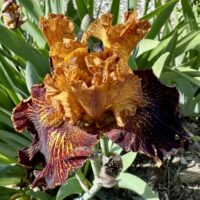
- Who Did It
-
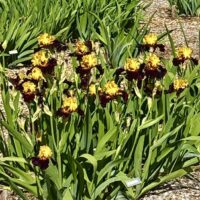
- Treasure Trader
-
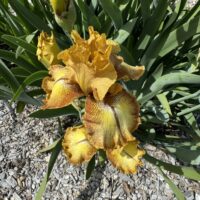
- Spiced Lemon
-
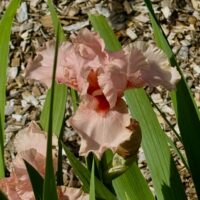
- Spiced Champagne
-
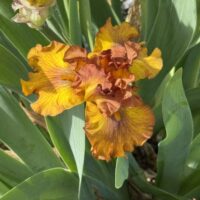
- Spice Trader
-
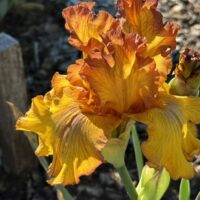
- Sparks to a Flame
-
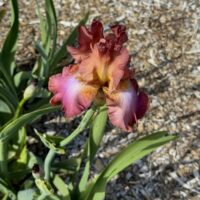
- Loretto Heights
-
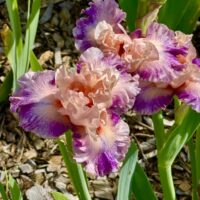
- Fruited Plain
-
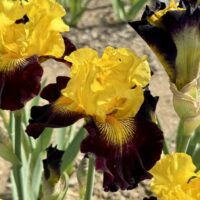
- Explicit
-
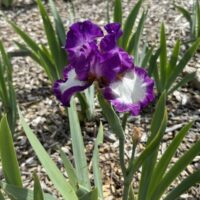
- Footloose Schreiner 1993
-
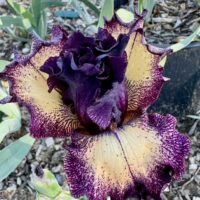
- Epicenter
-
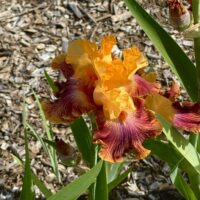
- Bottle Rocket
-
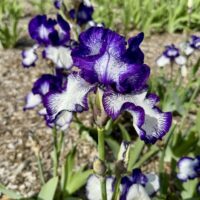
- Art Deco
-
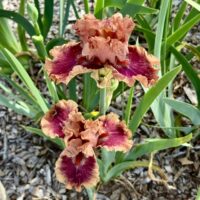
- Ancient Treasure
You may notice from the above irises that the names alone offer another level of intrigue, literally from A to Z: Achy Breaky Heart, Beckon, Caramel ‘n Chocolate, Dracula’s Kiss, Explicit, Fiasco, Glamour Pants, Hoosier Pride, I’m Pretty, Jazzed Up, Kind Hearted, Late Hours, Make a Wish, Neon Cowboy, Oreo, Party’s Over, Quack Quack, Return Address, Smoke Rings, Taste the Magic, Unfurled Flag, Vibrant, Wench, XX World Premier, and Zandria.
Many of the flower names have romantic implications, and could almost be used to send a targeted message to someone special: Chapel Bells, Dream of You, For Lovers Only, Hold My Hand, Jealous Guy, Just Kiss Me, and Romantic Evening.
At the end of my tour I told Moravec that I love dark purple irises, am not a fan of yellow irises for some reason, but I really like pure white ones. Moravec said she had just the one, Got Milk.
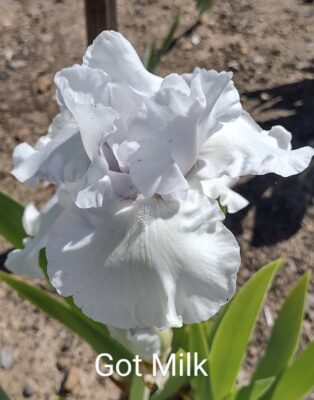
That day I bought two plastic pots of healthy, tall, sturdy Got Milk irises, for $10 each. I’ve just the perfect place to plant them. But you know, I’d like to take another trip out to Iris Country and check out some of the other colors. Plus, the more I think about it, maybe I could carve out a portion of my yard designated just for irises, perhaps with purples in one section and whites in another. Actually, some of the pale pinks were gorgeous, too.
Yes, I realize I may have developed an iris obsession. That’s OK. As addictions go, I’d say this is a beautiful one.
To visit Iris County

Iris Country’s hours vary, so it’s best to contact Teresa Moravac to arrange a visit in advance. She can be reached at iriscountrygardens@gmail.com or 530-209-2574. The iris farm is located at 16096 Setting Sun Drive, Anderson, CA 96007. Directions: Once you’re on Setting Sun Drive, Iris Country is located 1/4 mile on the right from the intersection of China Gulch and Oak Street. Be careful to not rely too much upon GPS on Setting Sun Drive, as some systems direct drivers too far. Rather, look for the signs, and for the flowers. Can’t miss them!
Moravac sells her irises, both via orders and in person, depending upon availability. Visit the Iris Country Facebook page for updates.
###


