

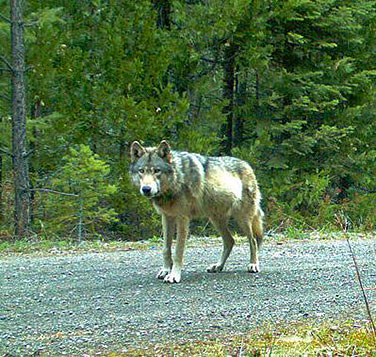
OR-7, the lone wolf that started it all when he crossed into California in 2011.
Waiting for the May 13 Shasta County Board of Supervisors meeting to begin, Jim Rickert leaned his lanky body into a nearby wall and sighed. Jim and his wife, former Shasta County District 3 Supervisor Mary Rickert, own Prather Ranch in Siskiyou County about 110 miles north from Redding. Jim had spent the day working in the slaughterhouse before making the two-hour drive to Redding.
The 77-year-old rancher might have snuck in a well-earned nap if I hadn’t started pestering him.
Prather Ranch raises its cattle with sustainable and humane methods; the grass-fed closed-herd animals are raised on open pasture and given no hormones. Once slaughtered, the premium beef is dry-aged 14 to 20 days and brought to market. There’s also an international demand for the ranch’s high-quality bovine materials, including collagen, hides, bones, blood, and other bovine xenograft materials for medical, pharmaceutical, and biological industries.
Legal Mexican migrants play a crucial role in the cattle business and I asked Jim if he’d experienced any issues since the Trump administration’s deportations began. There has been no trouble so far he said. He was more worried about changes in the state’s overtime law that makes it more expensive to pay his seasonal migrant employees if they work more than 8 hours per day/40 hours per week, as both parties have become accustomed to doing for decades.
Other than weariness, there was no outward signs that Jim had spent the day with his crew slaughtering cattle to satisfy our demand for premium grass-fed beef and quality xenograft materials. He was on hand to support Mary, who was there to speak about what’s really troubling northern California’s ranchers: wolves.

Jim and Mary Rickert.
This especially applies to Prather Ranch, where Rickert says wolves have killed 20 head of cattle during the past two and a half years, mostly yearlings and calves. Another score of cattle were killed across northeastern California during the last quarter of 2024, according to the California Department of Fish and Wildlife.
As a supervisor, Rickert was among the first north state political leaders to sound the alarm—to cry wolf—about the burgeoning gray wolf population, which has grown from a single male crossing from Oregon into California in 2011 to 70 wolves in seven separate packs, mostly situated in the northeastern region of the state.
Since leaving office at the end of last year, Mary and Jim Rickert have continued to push the state to address cattle depredation by gray wolves; they were recently featured in an LA Times cover story on the topic and were interviewed by CBS News. On this night former supervisor Rickert spoke in favor of C5 on the Consent Agenda, which called for joining Lassen, Modoc, Plumas and Sierra counties in writing a letter to California Fish and Wildlife and a local resolution declaring a state of emergency over the growing gray wolf population.
“Wolf attacks are brutal as they generally chew on the rear end of the animal, leaving them to bleed out and suffer,” Rickert told the board. “Wolf presence impacts herd health by elevating cortisol levels, causing cattle to not gain, breed back or lose their calves. This is destroying cattle herds around the North State and as far south as Tulare County. Wolves have become extremely brazen and someday I fear a human life will be taken.”
As we shall see, there’s no question that gray wolves are killing cattle in northern California. But do they really pose a threat to public safety, to humans, as claimed by Rickert and Shasta, Lassen, Modoc, Plumas and Sierra Counties in their letters to the CDFW and their resolutions?
Or are they just crying wolf?

Crunch the Wolf, mascot for the Minnesota Timberwolves.
When it comes to humans and wolves the relationship is, well, complicated. The wolf’s cunning and ferocity makes it a suitable mascot for high school and professional sports teams, such as the Shasta High School Wolves or the Minnesota Timberwolves, the latter team currently facing down the Oklahoma City Thunder in the NBA Western Conference Finals. We respect the wolf’s capacity for violence, at least in sports.
The wolf also serves as a ready stand-in for a threat to our own existence, as in the classic fairytale “The Three Little Pigs,” in which a wolf devours the two pigs in the weaker straw and twig huts but the pig in the brick home survives. I’m sure my Dad’s admonition to take any shit job you can find in hard times to “keep the wolf away from the door” is based on that fable.
Perhaps the most well-known myth involving wolves and humans is “The Boy Who Cried Wolf” story which traces its origin to Greek antiquity and became popularized in the 15th century as one of Aesop’s Fables. A shepherd boy, perhaps bored with watching his flock, discovers that falsely crying “Wolf!” dramatically increases the entertainment quotient as the town springs into action to fend off the non-existent wolf. Inevitably, a real wolf turns up, and when the boy cries “Wolf!” this time, no one answers and the sheep are devoured. In the director’s cut, the boy is eaten as well.

Francis Barlow illustration of the boy who cried wolf from 1687.
Googling “What is the meaning of the boy who cried wolf?” turned up this interesting post from Chris Loper’s self-improvement website:
“’The Boy Who Cried Wolf’ is traditionally told as a story where the moral is: ‘Don’t lie because people won’t believe you when it matters.’ And while that’s not a bad lesson, it’s not very profound. A more useful moral to learn from the story is: ‘All signals should be meaningful.’
“The boy cries wolf when there isn’t a wolf, and the townspeople learn to ignore the warning. The signal usually isn’t meaningful, so when it finally does give a useful warning, no one pays attention. The boy in the story is like a smoke detector that usually goes off for no reason but also goes off when there’s really a fire. This isn’t just annoying; it’s dangerous.”
I concur with Loper. All signals should be meaningful. Is claiming wolves are a direct physical threat to humans, as stated in the following passages from Shasta County’s letter to the CDFW and its declaration of a gray wolf emergency, a meaningful signal?

The Shasta County Board of Supervisors donned cowboy hats for Rodeo Week, Chair Kevin Crye excepted.
“Based on local observations, the Board further posits that wolves are proliferating faster than CDFW is willing to admit, endangering both livestock and members of the public in the most rural areas of the state,” says the letter to CDFW.
“Shasta County requests the direct intervention of the Department of Fish and Wildlife to relocate problem wolves to prevent livestock losses, collaborate with local property owners to legally protect their children, livestock, and property, and continue to actively monitor the status and proliferation of wolves throughout northern California, and has declared a state of emergency in solidarity with our neighboring rural counties,” the letter concluded.
Shasta County’s state of emergency declaration mentions the wolf threat to the public no less than nine times. Here’s several of them, in bold text.
“Whereas since December 2024, Shasta County livestock producers have reported the loss of multiple cattle and other livestock to wolf attacks. DNA tests have confirmed that gray wolves were responsible for a number of these losses, with additional incidents under investigation. These attacks have occurred near rural residences, posing a significant threat to public safety.”
“Whereas, no effective means currently exist to protect the public or livestock from these wolves, leading to concerns that without timely, practical, and locally informed solutions, individuals may feel compelled to take unregulated actions to protect their property and safety, jeopardizing themselves, their neighbors, and eroding public trust.””
(Notice that the real enemy here is not wolves, it’s humans who might take the law into their own hands and illegally kill gray wolves, which are a protected endangered species nearly driven to extinction by overhunting 90 years ago.)
“Whereas, the County of Shasta finds the following threats to public safety: Extreme peril to the safety of persons and property has arisen due to the presence of gray wolves posing an emergent threat to public safety; and persistent wolf attacks have led to devastating losses for livestock producers. Now, therefore, be it resolved that the Board of Supervisors of the County of Shasta proclaims that a Local State of Emergency exists throughout Shasta County due to a significant threat to public safety caused by depredation from gray wolves in close proximity to rural residents within the County of Shasta.”
Clearly, the Shasta County Board of Supervisors is signaling that wolves pose a direct threat to public safety.
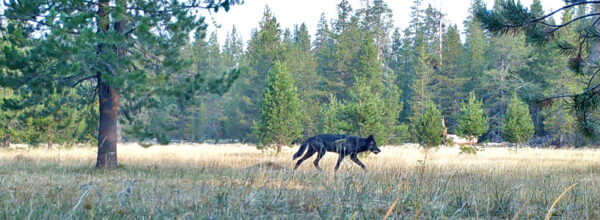
Gray Wolf image courtesy CDFW.
I asked CDFW Information Officer Peter Tira if the signal was meaningful.
“The letter to CDFW claims the gray wolves in southeastern Shasta County ‘show no regard for human presence or basic deterrence measures.’ Is that an accurate statement?” I asked via email.
“Not accurate,” Tira replied. “There have been no wolf attacks on people or even threats of wolf attacks on people anywhere in the state, including Shasta County. We recognize the need for additional and more aggressive deterrent measures to prevent wolf-livestock conflicts as wolf populations increase. We addressed and acknowledged that issue publicly in our April 2, 2025, news release, California Enters Next Phase of Wolf Conservation Plan as State’s Gray Wolf Population Continues to Expand.
I asked Tira if it was true that wolves are proliferating faster than the CDFW claims and endangering livestock and humans.
“Once again, there have been no wolf attacks on people reported anywhere in the state, nor any threats of wolf attacks nor any reports of events that could be remotely considered a threat of an attack on a person,” Tira said. “We do our best to keep track and report changes in the populations. Wolves occupy some of the more remote landscapes of the state, individual wolves can disperse and travel hundreds of miles, and we can’t be everywhere on the ground.”
But they do try to be everywhere. Tira noted that CDFW has partnered with UC Berkeley on the “Gray Wolf Project” to increase monitoring and understanding of wolves using GPS collars, camera traps and most importantly wolf sightings reported by rural residents. UC Davis is also involved in wolf research with CDFW.
I asked Tira if wolves are proliferating in Shasta County faster than CDFW is willing to admit.
“We have two wolf packs—the Harvey Pack and the Ice Cave Pack—that spend time and go back and forth between Lassen and Shasta counties,” he said. “You can see their location and area of activity on our February 2025 map of Approximate Area of Gray Wolf Activity.”
What appears to be the first wolf depredation of cattle in Shasta County occurred near Hat Creek in February, when two heifers were killed and one was injured, according to a CDFW report.
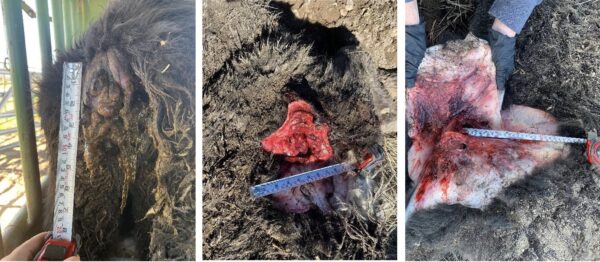
Three heifers were killed by wolves in the Hat Creek area in February.
I found this line toward the end of Shasta County’s anti-wolf resolution problematic, given our local sovereign citizens’ belief that at the county level, the sheriff is the supreme law of the land:
“Be it further resolved that the Board of Supervisors of the County of Shasta duly authorizes and fully supports any and all actions deemed necessary by the Shasta County Sheriff to mitigate and resolve this threat, including use of force to protect life,” the resolution states.
But as it turns out, Shasta County Sheriff Mike Johnson doesn’t need the board’s approval to use lethal force against an animal threatening a human being.
“Local law enforcement has—and always has had—the authority to lethally remove any wildlife they deem a public safety threat to the community,” Tira said. “CDFW’s Law Enforcement Division works closely with sheriff’s offices all over the state, including Shasta County’s, to determine the best course of action should there be any public safety concerns involving wildlife.”
As for the most dangerous animal, man? How likely are they to take the law into their own hands?
“There has never been anyone charged or convicted of killing a wolf in California,” Tira said.
Bottom line: It’s legal to kill a wolf if it’s attacking a human, which has so far never happened in California in modern times. On the other hand, it’s not legal to kill wolves that attack cattle due to their protected status.
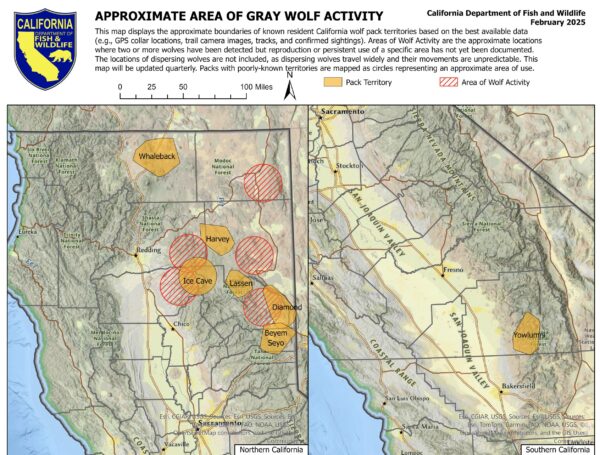
CDFW map of approximate locations of California’s seven wolfpacks. Note Whaleback wolfpack in same location as Prather Ranch.
I asked CDFW spokesman Tira if the agency believes a “state of emergency” exists because of proliferating gray wolves.
“We believe California’s rural livestock producers living near wolves are facing serious and real challenges as the wolf population grows in California,” Tira said. “We are committed to helping these producers and partnering with these rural communities to make sure they have the knowledge, tools and resources they need to help prevent conflict.”
One of those tools is called the CDFW Wolf Tracker, a website which presents data gathered from about a dozen wolves that have been fitted with GPS collars so ranchers and the general public can gain at least some semblance of where the wolves are. I’ve been checking the wolf tracker evert day for the past week, and one of the most notorious wolfpacks when it comes to cattle depredation, the Whaleback wolfpack, appears to be camped out right next to Prather Ranch.
“About three or four nights ago a yearling was attacked and killed,” Rickert told me this week. As in past attacks, the wolf or wolves hid in the timberline surrounding the 1000-acre meadow the cattle were grazing, singling out a weaker yearling for slaughter.
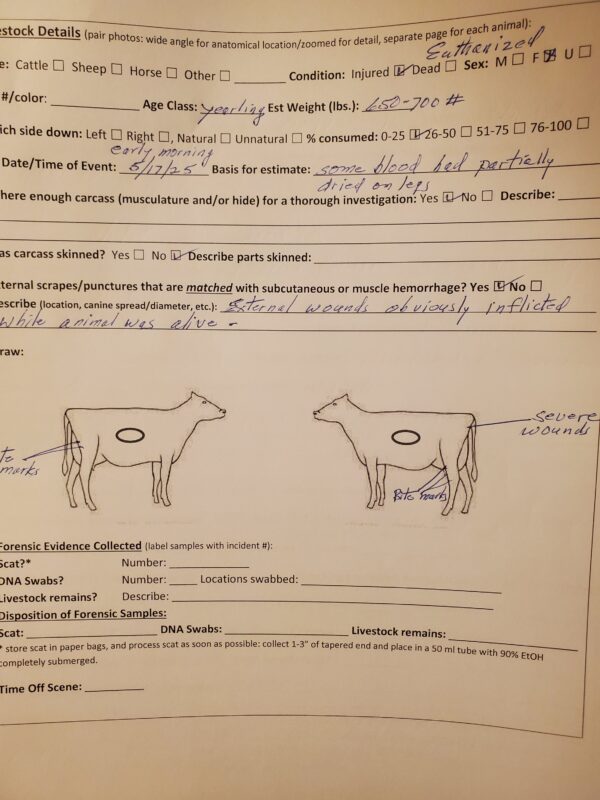
Report on latest wolf depredation at Prather Ranch.

Prather Ranch yearling killed by wolf or wolves displays typical bite marks around rectum.
In addition to the 20 head they’ve lost to wolves during the past two and a half years, Mary Rickert estimates they’ve lost 40 calves, through direct attacks by wolves and through the stress wolves place on pregnant cows. During normal times, three percent to five percent of Prather Ranch’s calves don’t survive. Since the wolves arrived, that number has shot up to 20 percent, Rickert said.
A recent study by UC Davis estimated a single wolf can cause ranchers up to $162,000 in losses due to reduced growth and pregnancies. For the Rickerts, the damages aren’t just financial. They’ve lost the peace of mind gained from running Prather Ranch as humanely as possible.
“We have a deep-rooted commitment to make sure our animals have the best lives possible,” Rickert says. “This is really personal, they’re part of the family to us.”
So far, efforts to repel the wolves, known as hazing, haven’t stopped attacks on the herd. Small packets of scent repellant were placed in the forest, to no apparent avail. Rickert said their herdsman patrolled the range with a ATV during the peak of last fall’s wolf attacks, but that’s difficult to do at night because of the rugged terrain. They’re training their cattle to bunch together in large groups to ward off further attacks. They’re now using a drone equipped with flashing lights and noisemakers to seek out the wolves and, hopefully, drive them off.
Rickert is convinced that some ranchers may be already killing wolves and burying them to hide the evidence—the fine for killing a wolf can be up to $100,000 and a year in jail. She says the saying in ranching circles goes something like, “If it’s not collared, it’s dead,” referring to wolves that haven’t been fitted with a GPS collar by the CDFW.
Rickert believes it’s still possible for ranchers and the wolves to coexist. She hopes the increased attention brought to the wolf depredation issue by the counties will prod CDFW into allowing more effective hazing options, including the use of rubber bullets, physically removing wolves and other behavior modification methods.
After pointing out there have been no wolf attacks on humans so far, I asked Rickert if she thinks wolves are a threat to human life.
“We had eight years where they didn’t bother us at all, until one of them crossed the line,” Rickert said, referring to the first wolf attack on their property two and a half years ago. Now, according to a recent UC Davis study, some wolf scat has 70 percent to 80 percent bovine DNA in it. Having crossed the line, they’ve gained a taste for cattle, and whose to say they can’t gain a taste for us?
“It would not be much of stretch for them to go after humans,” Rickert said.
###
If you appreciate award-winning journalist R.V. Scheide’s in-depth reporting, please consider contributing whatever amount you can afford to help support A News Cafe’s grassroots journalism. Thank you!


