

Following a weekend punctuated by special closed-session meetings to interview prospective candidates for the position of County Executive Officer both Saturday and Sunday, Shasta County Board of Supervisors will take up several other weighty matters beginning at 9 a.m. Tuesday at 1450 Court Street, Suite 263, in Redding.
Chief Deputy Clerk Stefany Blankenship released the official 14-page agenda Friday, along with 804 pages of supporting materials, reports, contracts, and analysis by various county staff members.
The agenda includes 39 actionable items and two additional back-to-back meetings in which the supervisors act as either the Shasta County Housing Authority or the Shasta County In-Home Supportive Services Public Authority.
As if that isn’t enough for a one-day meeting, county supervisors will also hold three closed-session conferences, one with the county’s labor negotiations team and members of the United Public Employees of California, Local 792 – General Unit; the second to discuss labor negotiations with possible replacement for County Counsel Cruse, who is resigning to enter private practice; and the third to discuss labor negotiations with a potential yet unnamed County Executive Officer.
At the conclusion of the closed session conferences, the board is expected as required by state law to report on any decisions reached in closed session.
High on the supervisors’ priority list is finding a suitable replacement for a new voting system approved by the California Secretary of State well enough ahead of the March 5, 2024, national presidential primary so the entire system can be delivered, installed, tested, and county election employees trained on use of the system, noted County Clerk and Registrar of Voters Cathy Darling Allen in a written report.
“The process to prepare for and conduct a presidential primary election requires the voting system to be operational by early summer 2023,” Darling Allen states in her report.
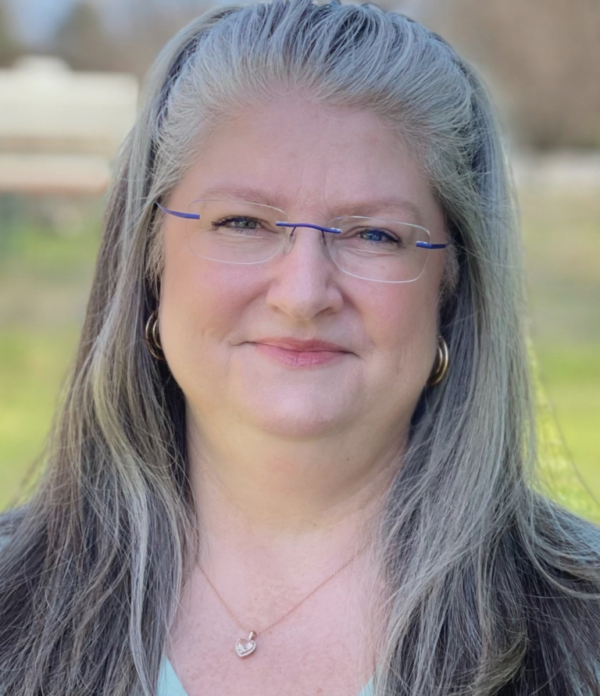
Shasta County Registrar of Voters/County Clerk Cathy Darling Allen.
“On average, it takes approximately nine months to install, train and test new equipment. As a result, in order to conduct the 2024 presidential primary election, the county must have a contract executed that permits installation of the equipment no later than April,” her report continues.
Another wrinkle, Darling Allen notes, is that the candidate filing period for county supervisor in Districts 2, 3, and 4 concludes on Dec. 8.
“It is necessary to have a certified voting system in order to create ballots” suitable for the vote counting system, her report adds.
Finally, Darling Allen noted, the timeline does not take into account any special elections that might be called.
“As of today, the department has received inquiries from two local jurisdictions about conducting special elections on Aug. 29,” Darling Allen writes. Candidate filing for that election date would conclude June 2, with military and overseas ballots due for delivery on July 15.
On Jan. 24, board chair Patrick Jones (District 4), voted with supervisors Chris Kelstrom (District 5) and Kevin Crye (District 1) for early termination of the county’s current six-year contract with Dominion Voting Systems upon completion of a March 7 special election for a City of Shasta Lake council member. Supervisors Mary Rickert (District 3) and Vice Chair Tim Garman (District 2) voted against Jones’ motion.
The county pays Dominion $262,000 annually for a leased vote-counting and ballot-preparation system, including vote by mail options. The Dominion contract was set to expire on Dec. 30, 2025.
In preparation for Tuesday’s meeting, Darling Allen solicited bids from Hart InterCivic Inc. of Austin, Texas, and Election Systems & Software Inc. (ES&S) of Omaha, Neb. California election laws only allow the use of voting systems provided by Dominion, Hart, and ES&S, Darling Allen noted.
In comparing the bids with what her department currently spends, Darling Allen created a quick comparison table:
| ES&S plus Democracy Live software/support | Hart plus Democracy Live software/support | Dominion existing contract |
|
| Fiscal Year 2022/2023 |
$1,698,470 |
$1,372,700 |
$262,000 |
| Fiscal Year 2023/2024 |
$108.846 |
$69,584 |
$262,000 |
| Return Dominion equipment |
$78,501 |
$78,501 |
|
| Additional costs |
$54,495 |
$54,495 |
|
| Staff training |
$231,573 |
$231,573 |
|
| Total 2 years costs |
$2,171,885 |
$1,806,853 |
$524,000 |
Note: Before retiring last month, previous County Executive Officer Pat Minturn guessed the cost of any new voting system would be approximately $1,000,000.
Now, Jones is suggesting the county establish a pilot voting program including hand counting of ballots.
In a review of Jones’ suggestion written prior to Tuesday’s meeting, County Counsel Rubin E. Cruse, Jr., raises eight objections.
Chief among them, any “voting system pilot program” shall not be conducted in a legally binding election without the prior approval of the Secretary of State, Cruse, Blankenship, and Darling Allen each stated in their individual reports regarding Jones’ proposal.
“Staff has been informed that any such voting system pilot program must be submitted to the Secretary of State at least 9 months in advance of an election and the Secretary of State must approve the pilot program at least 3 months before the decision in order for it to be used,” Blankenship noted, citing California Election Code, Section 19209(d).
“While entities can create their own voting systems, creating a propriety voting system can be extremely expensive and, most recently, took Los Angeles County 15 years to develop and obtain state approval through the certification process,” Darling Allen responded.
Also, in elections for federal office, the Help America Vote Act of 2002 requires at least one “direct recording electronic voting system or other voting system equipped for individuals with disabilities” be (located) at each polling place, Cruse wrote.
Pursuant to the Americans with Disabilities Act, the county must provide “meaningful access to private and independent voting.” For example, providing a person without disabilities to record a disabled person’s ballot would violate this requirement “because it would force the disabled to reveal their political opinions that others are not required to disclose,” Blankenship added.
Based on these authorities, Darling Allen concludes, the county has three options for supervisors to consider concerning election voting systems:
1.) Approve and authorize the County Executive Officer to negotiate a purchase agreement with either Hart InterCivic or ES&S Inc. for the period of April 15, 2023, through Dec. 31, 2033.
2.) Negotiate an agreement with Democracy Live for the same service period to lease its remote accessible vote by mail system, software, licenses, and related service. The Dominion system already incorporates this feature.
3.) Rescind the prior directive to county staff to terminate the existing lease agreement with Dominion Voting Systems and continue to use that system until the existing contract expires.
Persons interested in commenting on items of public interest on the board’s agenda are encouraged to show up early as seating is limited and, since 2020, these board meetings usually attract a standing-room-only crowd.
Spectators may also watch a live video feed on their smartphone or computer from the comfort of their home, office, or favorite cafe. Just remember, the audio portion is not censored and may be unsuitable — especially during public comment periods — for a family audience.


