
Today I chat with Dr. Lang Dayton of Redding, a retired physician tho practiced medicine for 46 years, specializing in critical care medicine and pulmonary disease. Join me in welcoming Dr. Lang Dayton to aNewsCafe.com.
Q: Hello, Dr. Dayton. I hope all is well with you, and that you and your home survived the Carr Fire intact.
Dr. Lang Dayton is a retired pulmonologist.
My home survived but everything was covered by ash, including a large chunk of a partially burned roof shingle that rained down [possiby from a firenado] and could have started a fire on my property but did not.

Q: I’m so glad your home survived. It sounds like it was a close call.
You’re a retired Redding pulmonologist who specialized in treating asthma. The air quality in the north state in general, and Redding in particular, where I live, has been horrible lately. Here’s a photo I took from my front porch this morning, when the air quality was above the 400 air quality index.
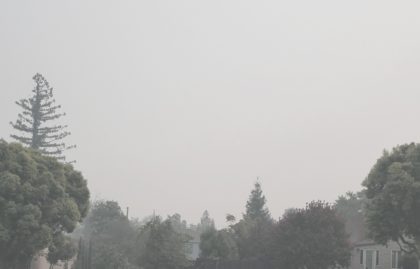
The smoky morning view from Doni’s Redding porch, Sat. Aug. 25.
Here’s a view from a clear day some months ago.

Same view, when the air was clear.
Q: I’m curious about the risks of breathing our north state air, considering the fact we’re surround by wildfire smoke. Basically, I’m concerned about our air quality, and the related issue of to wear or not wear a mask. I’m alarmed when I see children and babies outside in this air. Is it a concern?
Yes. If the outside air is affecting you adversely, or the air quality index (AQI) is unhealthy to you, then either do not go outside or if you do, wear a protective mask.
Q: Should everyone wear masks, or just the at-risk people?
At this point, with improving air quality, a N95 mask should be sufficient for most people on smoky days, unless the AQI is at an unhealthy range. Otherwise, healthy people would not need a mask. Masks often are uncomfortable and make breathing more difficult. Standard-sized masks will not work on children or infants (smaller sizes are available).
Q: What if someone just can’t handle wearing a mask?
People with lung disease may not be able to tolerate them because of the increased work of breathing. If the air quality is dangerous for the individual and they cannot tolerate a mask, they should stay inside (I consider a car with closed windows and air conditioning as being inside).
Q: And what are the ramifications of not wearing masks, maybe down the road a few months, or even years?
While most people recover from most exposures, it is somewhat comparable to tobacco exposure—that it is cumulative and, with sufficient exposure, permanent.
Q: What are the factors that will effect how smoke exposure will affect a person’s health?
- The severity of the air pollution [i.e relates to AQI or Air Quality Index] — higher is worse
- The amount of time of the exposure\ — more is worse
- Age, with the greatest risk at both extremes of life
- Overall health, especially of the respiratory system and sensitivity to airpollutants
- Use of a protective mask – obviously helpful
Q: As I write this, on Sat. Aug. 25, here is the air quality.
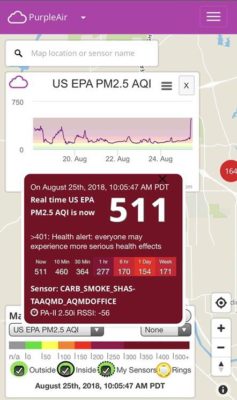
Q: How do we know if the air is safe?
The severity of the air pollution at any time can be learned by typing air quality into your computer search engine and then typing in the name of the community you are in. Infants and small children, elderly people, and those with respiratory diseases [asthma, bronchitis, emphysema] are especially sensitive and can be affected by lower levels of pollution than healthy people.
If it smells smoky, makes you cough, wheeze, or your eyes burn, it is bad for you. The table below gives you an idea of what the numbers mean.
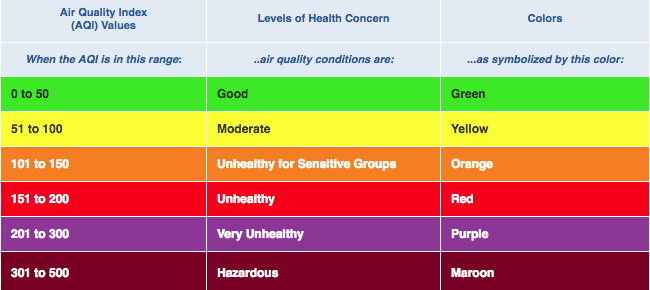
Q: So, according to your chart, Redding’s air quality is considered hazardous. What exactly makes the air so dangerous to breathe?
At this point the main health risk to people in town is due to particulates suspended in the smoky air rather than gases like carbon monoxide. The larger particles, called PM10 are 10 microns [micrometres] in diameter or less.
They primarily irritate the eyes and upper airways. The smaller particles, called PM2.5 are more dangerous because they can get into the lungs and even the bloodstream. If you have to go out in severely polluted air, operating room masks or one strap masks are not protective. The suitable protective masks are described as N=Not oil resistant, R=oil resistant, or P=oil proof. The N,R, or P designations are followed by a number, e.g. N95, P100, where the number indicates that a rating of:
- 95 – should remove 95% of all particles that are at least 0.3 microns in diameter
- 99 – should remove 99% of particles that are at least 0.3 microns in diameter
- 100 – should remove 99.97% of all particles that are 0.3 microns in diameter or larger. HE or HEPA quality filter.
Thank you so much, Dr. Dayton. I appreciate your taking the time to talk with me today. We’ll all be happy when we can breath easy again.


