
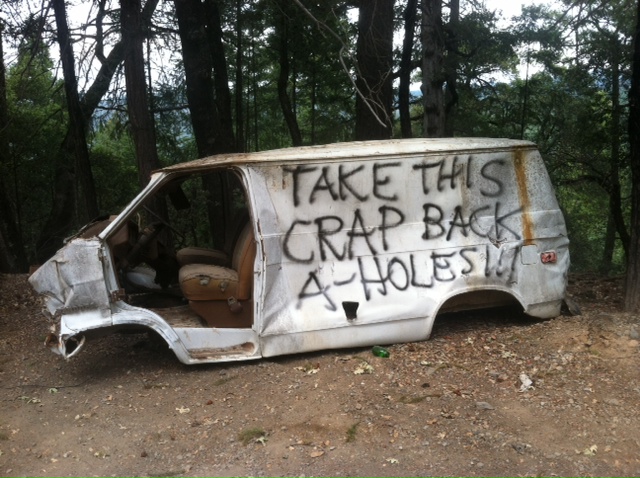
They came in the middle of the night, scraping and scrunching and making one hell of a racket. When Ernie Pasero investigated the source of the noise the next morning, he discovered the dented, rusting husks of three automobiles, bereft of anything that could be parted out, abandoned less than a quarter mile from his house on Phillips Road in rural eastern Shasta County.
They came again the next night, the sound of metal on asphalt and gravel stirring Pasero from his slumber. This time he went out to investigate. Through the darkness he saw a white dually, a Chevy or a Dodge judging by the truck’s flared rear fenders, and several figures working around it. He didn’t approach them. In the morning, six more relics had been added to the collection, making for a total of nine vehicles. At this writing, more than three weeks later, they sit there still, a monument to Shasta County’s ongoing inability to clean up after itself.

The Environmental Crimes Unit
After the vehicles had been abandoned, Pasero and his wife called the hotline for Shasta County Sheriff’s vehicle abatement division and got an answering machine instructing them to leave their information. They never received a call back, nor did any deputies come out to investigate the scene. “We don’t get a lot of services out here,” Pasero confided.
The CHP did come out to investigate. One of the abandoned vehicles, the cab of a small pickup minus the engine, wheels and bed, had been left right in the middle of the road. The CHP officers moved it, and took down vehicle identification numbers and any other information that might lead back to the owners of the defunct automobiles. So far, the CHP hasn’t returned to the scene.
I left several messages on the Sheriff’s vehicle abatement hotline and received no call-backs. That’s most likely because the Sheriff’s vehicle abatement efforts have ceased for the time being, as I learned from Phillip Wacker, investigative technician for the Shasta County District Attorney’s Environmental Crimes Unit.
“Vehicle abatement has been put on hold,” Wacker said. Turns out Shasta County’s vehicle abatement program is a one-man show, and the one man has been shifted to jail duty. The Redding Police Department’s vehicle abatement program is similarly a one-man show and Wacker himself is charged with single-handedly investigating any and all reports of illegal dumping in the county.

Unhappy Dumping Ground
Abandoned automobiles aren’t Wacker’s usual bailiwick. Folks who illegally dump standard household waste comprise the majority of his caseload; he estimates he completes 30 cases each month, and about 350 cases during any given year. Born and raised in Shasta County, he’s been on the job three years.
“The biggest thing we’re finding right now is chairs, couches and mattresses,” he said. Waste Management currently charges $7.75 to dispose of large pieces of furniture in local landfills. “People don’t want to pay the fee, that’s the bottom line.”
As the saying goes, you can pay now or pay more later. When Wacker tracks a culprit down, he gives them a choice: pay a fine ranging from $450 to $1000 or clean the mess up. Wacker said people generally choose the former, but when they don’t, the responsibility for cleaning up the mess, including the paying of any applicable dump fees, falls to the county.
No one is quite certain how much waste is out there, hidden in the nooks and crannies of the county’s 3847 square miles. Choose a given country road or path, and the chances are good you’ll eventually run into an abandoned couch, refrigerator or washing machine. Construction debris, including sinks, toilets, carpet and tile are common finds. Near my home in Whitmore, tons of potentially toxic wallboard has been dumped in the woods.

Who You Gonna Call?
What can be done? Citizens of Shingletown recently took matters into their own hands. With help from the county, including dump fee waivers, 20 volunteers cleared the waste and vehicles from several abandoned transient encampments in the Christy Creek area. Hauling services were provided gratus by a local contractor and labor was bribed with barbecue. The recipe appears to work well in communities with large pools of volunteers.
But residents who live in more remote areas like the Paseros are pretty much on their own. Most folks out here are fairly conscientious, and a select few make a habit of picking up trash along the side of the road whenever they see it. But anything more than a pickup load—not to mention nine abandoned automobiles—requires time and resources most rural residents can’t muster. So the debris and car bodies continue to pile up in mounds.
Who Shasta County’s rural residents should call in such situations remains somewhat unclear. I’ve put in several phone calls to the Sheriff’s Department and have yet to have a message returned. One question I’d like to ask: Why has abandoned vehicle abatement been put on hold? What could be keeping deputies so busy? Wacker said that to the best of his knowledge, the responsibility for disposing of abandoned vehicles in Shasta County has shifted to the CHP. I have a phone call in with them, too.
In the meantime, calling Wacker at the District Attorney’s Environmental Crimes Unit is probably your best bet. He went straight out to the crime scene on Phillips Road after speaking to me the first time, and I suspect the abandoned vehicles will be removed soon. Stay tuned.

Update: The Undersheriff Weighs In
The day after this story first posted, Shasta County Undersheriff Eric Magrini returned my call. Magrini had a ready answer for why the abandoned vehicle abatement has been put on hold: There’s a staffing shortage at the Sacramento County Jail.
The jail is normally staffed with 22 special service officers, who like deputies are Sheriff’s office employees. In addition, there are four special service officers who provide various community services. One was assigned to vehicle abatement before the department was put on hold.
Magrini explained that the department was put on hold because the jail is currently operating with only 11 special service officers, half the normal staffing level. He attributed the shortage to rapid turnover of employees as well as officers being out on vacation. Vehicle abatement services will be rebooted when staffing levels at the jail improve.


