

American policing is at a crossroads. The recent death of 25-year-old Freddie Gray while in the custody of the Baltimore Police Department was just the latest in a long series of officer involved killings that have focused the public’s attention on the use of deadly force by police.
The use of excessive force isn’t confined to urban black males. I occasionally do freelance work for Fatal Encounters, an online database that’s attempting to catalog every officer-involved fatality in the United States, and it’s clear the phenomenon is widespread and crosses all color lines.
For example, I live in rural Shasta County, California, where police have killed at least nine men since 2009, six white, two Native American and one Latino. In six cases, the men were armed. Four suffered from mental illness. Alcohol use was involved in at least one death. None of the men appear to have been wealthy. Seven deaths have been ruled justified and two are pending investigation.
All of the Shasta County cases are representative of the difficult, potentially lethal situations individual law enforcement officers across the country face on a daily basis. They’ve got a lot on their plate. As a society, we’ve abandoned the poor and the mentally ill. We’ve chosen to continue fighting a failed war on drugs. Instead of addressing those issues in a meaningful fashion, we’ve left the entire mess for the police to clean up.
Totally outmanned, law enforcement have adopted what Commander Dale Brown calls “fearlosophy,” the use of fear to justify the use of force. Brown is the founder of the Detroit Threat Management Center, a private security company that teaches communities and corporations how to properly manage human threats and create non-violent outcomes, instead of the never-ending string of fatalities visited upon us now.
Based in Detroit, Brown recently visited Chico at the behest of Sean Worthington, a founder of Liberty Rising, a fledgling group of Butte County libertarians who, like presidential candidate and Kentucky Senator Rand Paul, are decidedly pro-cannabis. I met Sean (on the internet) while working on a previous story I wrote for A News Cafe.com, “The Valley of Fear.”
That story documented the militarized weaponry and tactics used by northern California law enforcement’s marijuana eradication squads, even though growing medical marijuana is legal in the state of California and recreational cannabis is about to become legal across the nation. As I was working on the story, the events of Ferguson, Missouri were exploding on TV screens across the globe.
In these incendiary times, Commander Brown’s initial advice may sound counter intuitive.
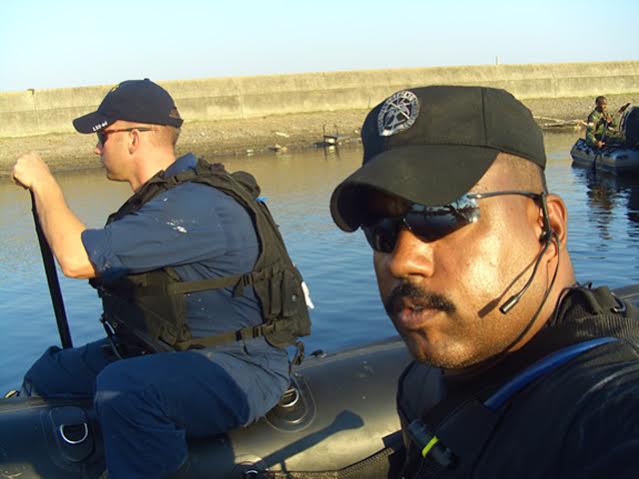
Commander Dale Brown
“Embrace your law enforcement community,” he tells me on the telephone from Worthington’s house, right after lunch one afternoon in March. “An adversarial position will not work.”
His company first gained major recognition in the late 1990s, after successfully stopping an organized crime ring from preying on a Detroit-based trucking company. His company has been applauded for its volunteer work helping victims of domestic abuse as well as providing additional security during Hurricane Katrina.
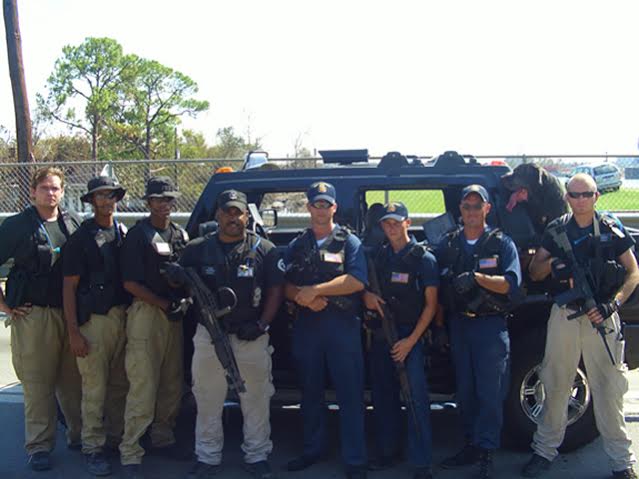
Dale Brown and Detroit Threat Management Center provided security and rescue services during Hurricane Katrina.
Other clients have included a high-profile Detroit night club plagued by gang violence. The gangs did not leave peacefully.
“We gave our word,” Brown said. “We stopped it. It was violent. We sent the message that it’s probably better not to have problems with us.”
Brown has spent the better part of three decades developing a security training system he calls Eclectikan. It combines elements of tactical psychology, tactical law and tactical skills in order to better manage human threats and create non-violent outcomes. In Brown’s view, anyone can and should learn how to apply these tactics to some degree, including children.
Perhaps the most important information Brown has to impart to youngsters concerns the steps that should be followed by anyone confronted by a police officer: Don’t run, keep your hands out of your pockets and say hello.
If only someone had taught me that as a teenager–and that’s the point. Brown’s company offers its services, including self-defense training for boys and girls, to private companies as well as public entities such as school districts. His philosophy includes a hefty component of altruism. Instead of arresting destitute and mentally ill homeless people in street encounters that can turn deadly in a heartbeat, the focus is on getting them help.
“Why should any one have to die because they had a bad day?” Brown asks rhetorically.
Brown’s Chico visit came immediately after two separate incidents of violence in the downtown residential district favored by Chico State University students. A male student was killed in a shooting at a house party and a woman was brutally beaten and hospitalized by an unknown assailant, leading Chico State students concerned about safety to take to the streets in protest.
“Public safety is the most pressing issue in our community on many levels,” explains Worthington, who teaches at nearby Butte College. “Students are marching, demanding more safety. Liberty Rising wanted to bring Dale Brown here to get people to consider alternatives.”
Worthington’s libertarian vision of alternative policing is consumer-driven and involves splitting today’s force into two separate departments: law enforcement and public safety. The department of law enforcement would be publicly funded and handle enforcing laws and catching criminals, the roles traditionally ascribed to police departments.
The department of public safety would function as a highly visible deterrent force in neighborhoods, schools and business. These services could be provided by competing private enterprises like Brown’s Threat Management Center and in Worthington’s view should include an emphasis on self-reliance.
“We as individuals should own firearms, join neighborhood watch groups and hire private security,” Worthington said. “Unfortunately, we usually just think it is the police’s responsibility and call them after a crime occurs.”
A future Chico Department of Public Safety built along these lines might go a long ways toward creating a safer environment for students, residents and businesses. It wouldn’t necessarily come cheap, especially if providing facilities for the mentally ill and homeless people sleeping in the streets is factored into the equation, in accordance with Brown’s altruistic philosophy. By providing a 24/7 visible deterrent, the department of public safety would free up law enforcement to investigate crimes and catch criminals.
There’s no reason besides money that a public agency can’t provide such services, but there’s a benefit to hiring a private company to do the job: Accountability. When someone is killed on Brown’s watch, there’s no immunity because he’s not a public servant. If it’s his fault, he can be held liable in criminal and civil court.
“I’m a civilian,” he says. “ I’m accountable to create a non-violent outcome.”
To that end Brown’s security officers are trained in the use of a wide variety of nonlethal weapons, including tasers, stun grenades, rubber balls and electric shock wands. The training is ongoing and mandatory. Firearms training is also included. Brown notes that the fear expressed by some police officers that a suspect might reach for their service weapon can be a sign of poor training. Service weapons are held in retention holsters that make that virtually impossible.
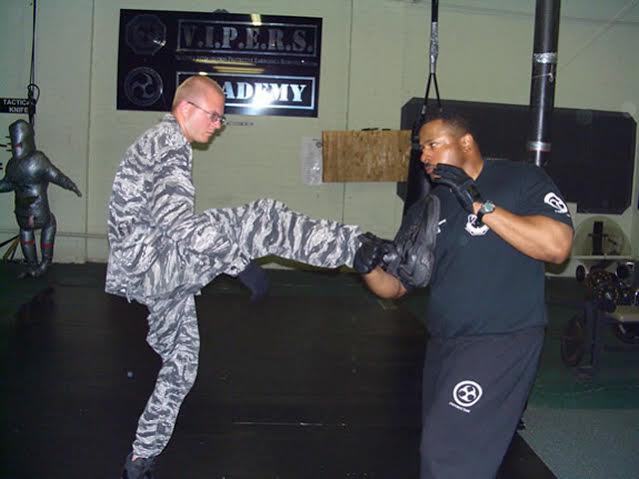
What to do when someone tries to kick you in the face.
When Brown and his troops are all geared up, they could easily be mistaken for members of Seal Team Six. Just days before I talked to him, police in Ferguson were highly criticized for their militarized appearance and tactics. I documented similar tactics deployed against northern California medical marijuana patients in “The Valley of Fear”.
I asked Brown if the militarization of police forces is necessary to protect public safety. His spin on the topic was brilliant.
He calls the look of today’s kevlar-clad police officers “paramilitary positive.” The guys who made “The Incredible Hulk” had it backwards, Brown says. Bruce Banner should have turned into the Hulk before he came to town.
That way no one would have ever messed with him. “I’m a big, nice Rottweiler,” Brown says convincingly. “ I will never do anything to hurt you.”

A friendly Rottweiler.
It’s not well known, but Rottweilers kill more people than pit bulls. An ex-girlfriend of mine had one the size of small horse. I used to wrestle with him like he was a human being and occasionally he’d overpower me, pin me down and lick my face nonstop. He always let me back up, but in the back of my mind, I always wondered, what if he doesn’t?
 R.V. Scheide has been a northern California journalist for more than 20 years. He appreciates your comments and story ideas.


