

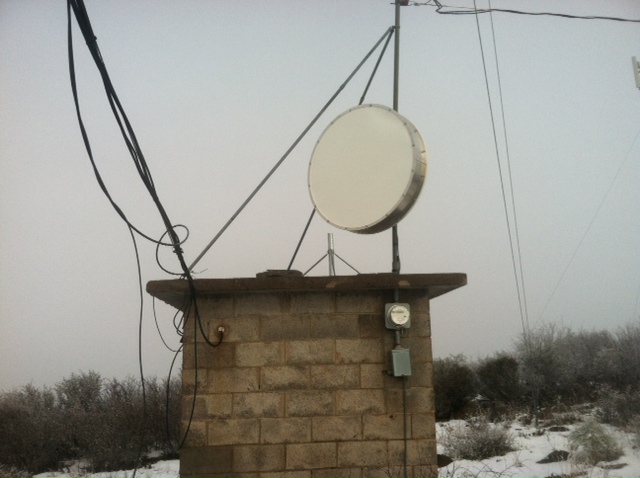
Com-Pair’s microwave dish on Haney Mountain
Say what you will about the State of Jefferson—and please do in the comments section below—the quixotic political movement seeking to carve out a 51st state from northern California and southern Oregon gets at least one thing right: City slickers don’t care all that much about the needs of country folk.
One of those needs concerns the near total lack of reliable, affordable high-speed Internet in rural areas. Or any Internet at all, for that matter.
As I noted in the first installment of this ongoing series on rural Internet access, those of us out here in the sticks, beyond the reach of cellular service, have essentially two choices. We can purchase a relatively affordable but super-slow digital service line (DSL) from the local telecomm company, or more expensive satellite broadband Internet that’s fast but prohibitively expensive.
For reference, the Federal Communications Commission defines broadband Internet as services that provide a minimum of 25 megabytes per second (mbps) download speed and 3 mbps upload speed. If you live in the big city (Redding included) you may be getting that already. If you live in the sticks, chances are you’re not getting anything near that. You can check the speed of your service by using the Speakeasy Speed Test.

Pam and Henry Giacomini
Shasta County District 3 Supervisor Pam Giacomini, who lives approximately 50 miles east of Redding in Hat Creek, gets her Internet the old fashioned way, DSL service from the local telephone company. Although it offers only a maximum 1 megabyte per second download speed and an upload speed less than half that amount, it’s enough to run the family business, a fourth-generation cattle ranch specializing in grass-fed beef.
However, sometimes things go wrong in the country, as Giacomini, my district supervisor, explained when I visited her ranch last October. In August 2014, the notorious Eiler fire scorched 32,416 acres in the Hat Creek area and came a hairsbreadth from jumping Highway 89 and burning down Giacomini’s ranch. Last February, a fierce wind ripped through Lassen National Park, roaring down the valley and snapping trees like so many matchsticks. Giacomini says 80 truckloads of timber were carted off after the windfall.
In both cases, Giacomini’s telephone line was taken out, taking her Internet with it. For days, she had to travel four miles in either direction to get cell phone service in order to communicate with emergency responders. Looking at the miles of burnt hillside across the highway from her ranch, it’s easy to imagine the fear and frustration she felt.
Shasta County has been making some headway on the issue of providing rural cellular telephone and Internet service, and Gicomini has been participating in the effort. But contrary to popular belief, county supervisors can’t always just snap their fingers and make it so. As with most rural issues, it’s all about the money, and the big telecommunications companies just aren’t inclined to provide service in areas with so few customers.
“There is a need out here,” Gicaomini says. “They [the telecom companies] have to be profitable, but at what point is there an obligation to rural communities?”
The Little Company That Can
On an overcast morning in early January, I headed out to far eastern Shasta County with Guy Lemke, Managing Network Engineer for Com-Pair, a small but growing Internet service provider headquartered in Anderson. Lemke was wearing a green-and-yellow State of Jefferson t-shirt, so naturally the topic came up.
I call the State of Jefferson political movement quixotic because I believe its stated goal of creating a 51st state would require defying political gravity.
Lemke, while not officially a member of the movement, believes that what was done in court can be undone in court. Specifically, he’s referring to the 1964 Reynolds v. Sims U.S. Supreme Court case that established the “one person, one vote” principle, thereby transferring political power to more populous urban counties at the expense of rural counties.
We both agree that rural residents could benefit tremendously from Internet service, and Lemke and Com-Pair are doing something about it.
We were on our way to Haney Mountain, where Com-Pair maintains a 40-foot-tall microwave tower on top of the 4414-foot peak. The tower is roughly 55 miles due east as the crow flies from Com-Pair’s data center on Lake Boulevard in Redding.
The broadband signal is transmitted, using a series of servers, transmitters, receivers and routers, from Lake Boulevard to Haney Mountain via a series of “hops.” First the signal hops 8 miles west to a tower on 3480-foot South Fork Mountain, then 43 miles east to the tower on 5580-foot Bunch Grass Mountain (near the Hatchet Mountain wind turbine station) and finally 20 miles to Haney Mountain.
Guy Lemke, Managing Network Engineer for Com-Pair
This set-up is called a microwave “backbone.” Several days before our trip to Haney Mountain, Lemke gave me a tour of the Lake Boulevard exchange center and demonstrated how the system works.
“Everywhere we cover in northern California, we own our own microwave backbones,” he said. “We cover Lassen, Modoc, Trinity, Shasta and Tehama counties and will soon provide service in Siskiyou County. We go into the rural areas, where there is very little infrastructure or none at all and bring the service in.”
Anyone within line-of-sight of one of Com-Pair’s mountaintop towers is a potential customer. For example, the McArthur Farm Store is in line-of-sight and can pick up the signal with a small receiver mounted on the roof. Through a device known as a repeater, that signal can be broadcast to other nearby homes and businesses not within line-of-sight of the tower.
Com-Pair offers several Internet packages at market rates, from Basic service featuring 512 kilobyte per second download speed and 256 kilobyte upload speed for $30 per month to Premium service featuring 10 mbps download speed and 2 mbps upload speed for $100.
The Premium package comes close to matching satellite service in speed, but it is more reliable thanks to redundancies built into Com-Pair’s network. Unlike satellite companies, Com-Pair doesn’t have data caps, meaning you can binge watch Netflix to your heart’s desire without ringing up expensive overages. A Custom package is also available offering more bandwidth depending on the customer’s needs.
“With satellite, they are very limited in what they can do,” Lemke said. “They have data caps, they’re expensive. If a storm comes in, you can’t do voice over phone, you can’t do video, because you’ve consumed all the data you’re allotted and they shut you down. We sell you a pipe, and as long as it’s legal use, you can use as much as you want.”
Com-Pair currently has more than 10,000 customers, spread out from Hayfork to Weaverville to Lewiston to Mountain Gate to Whitmore to McCarthur and beyond. The California Department of Forestry and Cal-Fire subscribe at several locations. The Trinity Center and every school in the Trinity County School District are hooked up with Com-Pair.
“We basically built a network within our network for them [Trinity County School District], just like the big boys do, and we provide service for about 10 percent of what Verizon was charging them for one school site.”
If you’ve never heard of Com-Pair, you’re not alone. Even though they’ve been around since 1999, I didn’t learn about the company until a reader comment on a previous rural Internet story. It has everything to do with Com-Pair’s fairly unique business model.
“We don’t advertise, we do word-of-mouth,” Lemke explained. “As they get the service and they like it they start talking to their relatives and their neighbors and it spreads that way. We will do things other companies will not, and we don’t charge them for ransom. It has been a very nice business model.”
Misty Mountain Hop
The gravel road winding up Haney Mountain was muddy the morning we visited the site, which Com-Pair shares with several other telecomm providers and a TV station. On the way up, we encountered employees from another company who’d gotten their manlift stuck. Lemke hooked a chain up and pulled them out with his Dodge diesel four-wheeler, then we proceeded to the top.
We’d waited for the clouds to disappear but the mountaintop was still shrouded with mist when we arrived at Com-Pair’s tower. It wasn’t as large as I was expecting, just a simple 40-foot-tall steel tower set next to a cinder block shed with a 3-foot dish on the roof.
The Haney Mountain site has pre-existing electrical power, which is backed up by a nickel cadmium battery set inside the pillbox. Some Com-Pair sites are powered by solar panels with a similar battery storage and backup system. The equipment inside the small hut is fairly minimal; the transmitters on the tower are about the size of a shoe box.
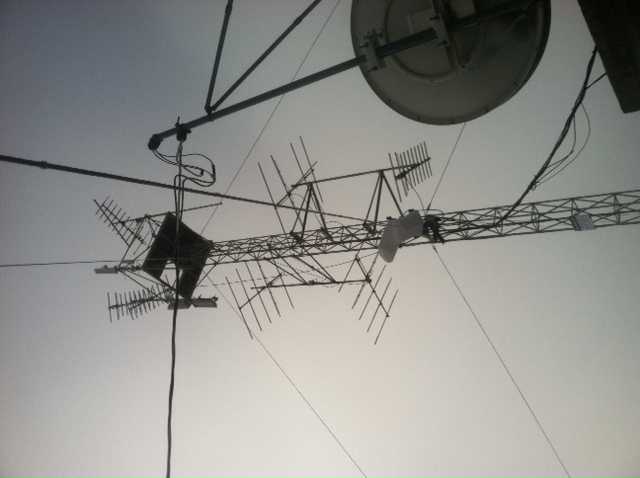
Com-Pair’s Mount Haney microwave tower.
“It’s pretty rock-solid, because when I build these systems, I build them,” Lemke said. “I don’t do just enough, I do massive overkill. We build it so that we’re not going to have worry about it, unless a major natural disaster or someone goes up and shoots a site.”
Fortunately, vandalism hasn’t been too much of a problem.
“We have had one incident over in Hayfork, but the locals took care of it, because I was going to pull service out of that area,” he said. “The locals decided that since there was no broadband over there besides us, they better make sure that nobody does anything. We go into these communities that don’t have anything, and they get something that’s as good or better than the bigger cities. You tend to find they’re very protective of it.”
One reason we’d come up to the site was so Lemke could show where Com-Pair’s next hop will be, across the valley and on into Nevada, where they’ll connect with a sister company in Gerlach and eventually project all the way to the Black Rock Desert. Unfortunately the view was obscured by clouds, but you can’t fault Com-Pair for not having vision.
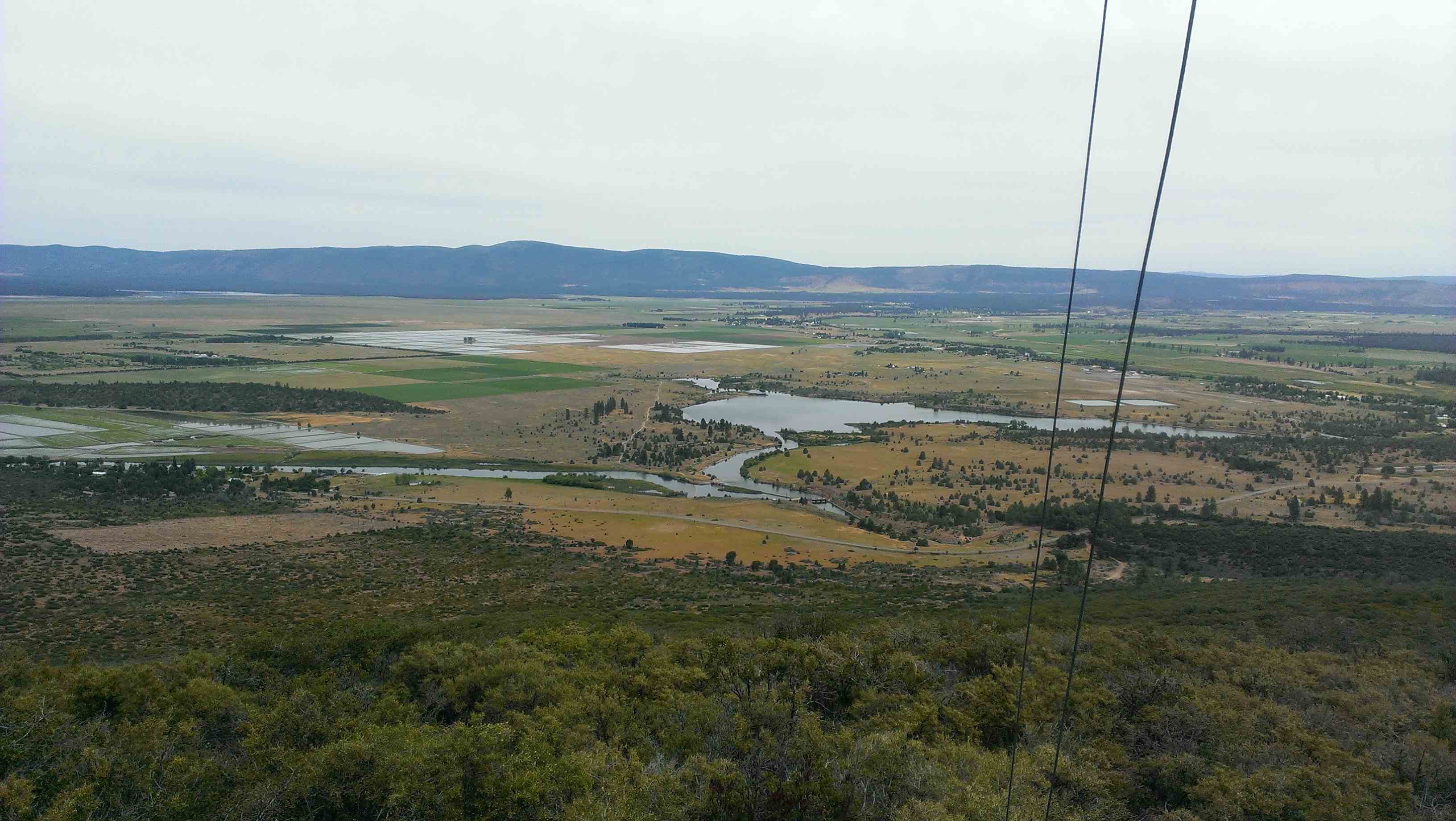
The view from Haney Mountain.
Virtual State of Jefferson
I had mentioned Supervisor Giacomini’s communication issues to Lemke, so we descended the mountain and made our way toward Hat Creek. We turned south on Highway 89, with Lemke looking in the rear view mirror, trying to keep Haney Mountain in sight. A few miles before we reached the sign marking Hat Creek Hereford Ranch, the mountain disappeared from sight, which meant there was no way to directly hop from Haney Mountain to the ranch.
Lemke was not deterred. We stopped in the road leading up to the ranch house and he began scanning the horizon searching for a hilltop where a tower might be erected. He was already familiar with the area—he estimates he drives more than 3000 miles per month on northern California’s rural byways—and had a couple of sites in mind.
I hadn’t called the supervisor in advance, and I was hesitant to drop in on her unannounced. Sensing Lemke’s disappointment, I mustered up some courage and knocked on her door. Her husband Henry answered, he fetched his wife and I re-introduced myself. She graciously welcomed us in. I went back to the truck and retrieved Lemke, and when Giacomini got one look at his State of Jefferson T-shirt, she made no bones about her thoughts on the political movement.
It’s understandable. The State of Jefferson movement hasn’t made many friends with traditional politicians, and Giacomini has been working on rural politics for most of her career, first with the California Farm Bureau and now as a Shasta County supervisor. She understands the reality of defying political gravity.
Lemke’s a talker, whether the subject is technology or politics, so before we went too far down the political road, I steered the conversation back toward the subject at hand by suggesting that if we could just connect all of rural northern California to the Internet, politics wouldn’t matter. We could have a virtual State of Jefferson that would benefit everyone.
Both Lemke and Giacomini seemed to like that idea, and Lemke proceeded to explain what it would take to bring Com-Pair to her ranch. Born and raised in Redding, he has several degrees in computer engineering and communications and worked in the Bay Area high-tech industry before moving back to Shasta County. His knowledge is extensive, and his spiel, some of which is presented above in simplified form, is dizzying.
“Don’t worry,” I told the supervisor. “He’ll start speaking human in a minute.”
Then Lemke did the darndest thing. He asked the supervisor for her wifi password, typed it into his cell phone, clicked on a voice-over-phone application that connects to his cell phone number, and told her to call him on the ranch’s land line. For the first time ever, a cell phone rang on the ranch—Lemke’s.
True, Giacomini’s router, from which the wifi was emanating, is connected to the Internet via DSL. But if she had a wireless internet service like Com-Pair, and a disaster like the Eiler fire or last February’s windfall took out the hard telephone line, she’d still be able to use her cell phone. The supervisor instantly made the connection. Her eyes lit up, and she began excitedly questioning Lemke about what it would take to bring wireless internet to Hat Creek.
She asked Lemke to submit a proposal and he said he would. When exactly he’ll get around to it is uncertain. He’s a busy man. I may have coined the phrase “virtual State of Jefferson” but Lemke and Com-Pair are well on their way to making it happen.
Currently, ATT and Charter are Com-Pair’s “upstream” providers, providing hard-line fiberoptic broadband that is then transmitted via the towers. In turn, Com-Pair provides broadband to several smaller local “downstream” internet service providers. Lemke is in the process of connecting to another broadband upstream provider in Medford, Oregon.
“I’m the main engineer, I work on the networks,” he said. “We have two fiberoptic backbones right now, and I’m working on bringing a 10 gigabyte fiberoptic backbone from Medford to here.”
In February Lemke plans to launch his own project, the Jefferson State Access Exchange. Eventually it will connect with the Southern Oregon Access Exchange on the other side of the border. Combined with expanded services into Nevada, thousands of rural customers will finally have access to the Internet.
Slowly but surely, Jefferson State is getting wired.


