

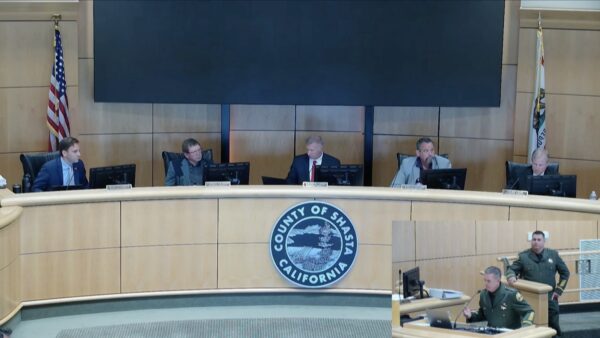
Sheriff Michael Johnson (corner) addresses Shasta County Board of Supervisors last week.
Shasta County’s recommended fiscal year budget will shrink 3.5 percent according to figures released last week during three days of budget presentations at the Board of Supervisors. The recommended budget for 2025-2026 is $685,293,258, nearly $25 million less than the recommended 2024-2025 budget of $710,125, 646.
The number of recommended full time equivalent county employees has slipped to 2,083, down from 2,113 this year and 2,240 the year before. According to a budgeting principle adopted in February, no new programs or positions can be approved without demonstrating revenue support. Finding funds isn’t going to be easy since recommended discretionary revenue is $72,860,700, a 10.69 percent decrease compared to
$81,585,763 this fiscal year.
More ominously, the budget text warns, the state and federal funding Shasta County depends upon for many of its programs may be shrinking as well. President Donald Trump’s erratic tariff regime has rocked global trade and roiled equity markets. Predicted to roughly break even on it budget in January, California now faces a projected $12 billion deficit and a governor not inclined to support voter approved tough-on-crime initiatives like Prop. 36, which, as Shasta County Sheriff Michael Johnson says, “makes drugs illegal again.”
While the three days of public budget hearings held last week were as mundane as you’d imagine and not well-attended by the public, reports from the county’s more than 90 departments revealed many of them are facing a crisis when it comes to recruiting and retaining qualified staff, from County Counsel, to the Coroner to the District Attorney’s office to Public Health. Positions that remain vacant for more than a year are being eliminated, reducing vital services provided by the Health and Human Services Agency and other safety net programs.
Deputy County CEO Erin Bertain acknowledged the coming economic storm as the budget meeting kicked off on Tuesday.

Erin Bertain, Shasta County’s deputy county executive officer. (File photo by Michael Chapman/A News Cafe.)
“Even though the Legislature will have to pass something in the coming days, all signs point to additional changes to the state budget well into the next fiscal year,” Bertain said. “The federal government is also in a state of flux with even more unknowns. The relationship between the state of California and the federal government is also a concern as it makes the transfer of revenues from the federal government to the state and counties unreliable.”
Translation: Hard times are coming around again, and we’re not ready.
“As the economy continues to take a downturn, more participants seek relief through entitlement programs, taxing already scarce resources,” she said. “We’ve seen a significant upward trend in recent fiscal years and are anticipating to see that continue. Social Services Fund has taken a significant hit in the last couple of years, and as a result, HHSA is required to transfer 10 percent of realignment for public health to social services to ensure adequate funding.”
Similar financial juggling is going on in department after department as administrators and staff reckon with diminishing funds and employees. New legislation like Prop. 36 requires law enforcement, public safety and social services to prepare and coordinate for the expected increase in criminal drug addicts who chose a recovery program instead of being charged with a felony even though the state a yet to allot any funds to enable counties to provide treatment. That’s just part of the grim reality underpinning the three days of budget hearings held last week.
As Board Chair, District 1 Supervisor Kevin Crye was in his own element, the master of ceremonies for the affair, greeting each administrator with a demeaning wisecrack about their age or looks or inquisitiveness in a domineering communication style known as conversational narcissism. It’s always about King Crye but remember: He’s just kidding.
As the three days ground on, is was easy to see who Crye and his MAGA colleagues District 3 Supervisor Corkey Harmon and District 5 Supervisor Chris Kelstrom favored. It was even easier to tell who they didn’t like.
Recruiting and Retaining Employees Remains Major Issues
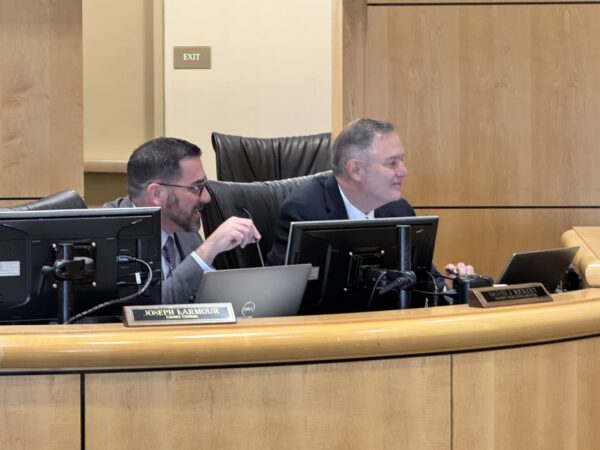
Shasta County Counsel Joseph Larmour and CEO David Rickert.
It’s been just over a year since Crye helped engineer the hiring of present County Counsel Joseph Larmour. As he has done in the past, Crye attempted to provoke Larmour into saying something negative about his predecessor. Larmour didn’t take the bait.
“So we have been recruiting consistently,” Larmour said. “Currently, we have two County Counsel positions open that we’re recruiting for. A third County Counsel position we intend to underfill at this time with another legal secretary due to an increase in workflow for the legal secretaries. Due to the low staffing level, County Counsel’s office is focused on maintaining essential services, migration to a new case management system and a process which improves efficiency.”
Larmour praised recent hire Assistant County Counsel Tricia Webber, who he says provides leadership and direction when he’s not in the office. His office currently has 14 FTEs.
“Again, we have had significant turnover and have new lawyers who have not generally been working in the County Counsel offices,” he said. “So that takes a significant amount of training. I’ll say that the attorneys in my office are doing a great job.”
Crye asked if a paralegal recently hired by Larmour could take the place of an attorney.
“At this point, my staff is overwhelmed and we’ve been recruiting and it’s been difficult,” he said. “We attempted to hire extra help. Extra help has proven to be difficult to find.”
Shasta County Assessor-Recorder Leslie is in charge of assessing local taxes.
“Everything is taxable unless exempt,” she said. “The largest portion of our assessment role is homes, but we also have business equipment and other assessments such as boats, tractors, aircraft, possessory interest assessments. We examine the documents that are recorded to determine ownership for assessment purposes.”
While the Assessor-Recorder’s office has struggled to find qualified auditor the last couple years, she said all her positions are filled now, with 41 FTEs.
Shasta County Treasurer/Tax Collector Lori Scott anticipates her department being fully staffed as budgeted.
“We went through interviews last week and we’ve now chosen someone, so we’ve got to go through the process to bring that person in,” Scott said. “It’s very hard to keep people because the line staff would pay just a little over $18 an hour. So it’s hard to keep people there because they find other jobs and move up or even go outside of the county for that.”
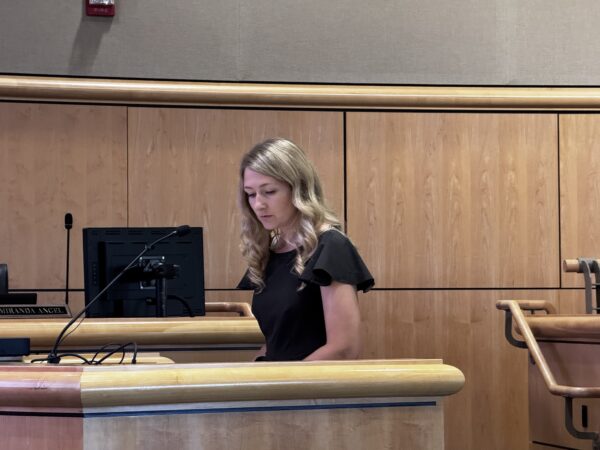
Shasta County Support Services Director Monica Fugitt.
Shasta County Support Services Director Monica Fugitt, who oversees personnel hiring, said, “Our outreach team has been working hard to implement and leverage tools available through the new NeoGov Attract module to better target and recruit qualified job applicants and provide stronger recruitment analytics. In our talent acquisition team, over the past year, we’ve transitioned and built resources and processes to support the transition to in-house screening for recruitments. This has definitely been a process that’s required continual improvement.”
“We have been working closely with staff and with departments to ensure that they are well-trained and communicating with their departments to make sure we are bringing in qualified candidates, but ensuring a standardized, fair and equitable job applicant process,” Fugitt said.
Fugitt also noted a graph showing the increasing amount of time county staff have been working on Board of Supervisors meetings, which have grown progressively longer since the COVID pandemic. The more hours staff work, the more expensive the meetings become. Her suggestion to consider cutting down on the number of meetings was later picked up by District 4 Supervisor Matt Plummer, but no one else on the board appeared to support the measure.
An Ongoing Shortage of Medical Professionals
Shasta County HHSA Director Christy Coleman is used to working in crisis mode.
“Some of the ongoing issues facing our county include an increasing number of homeless individuals, a harmful substance use epidemic, a shortage of livable wage jobs, a high rate of child abuse and neglect, and a variety of social issues,” Coleman explained. “HHSA is unlike most other county departments because it delivers direct client services across the large populations of our county.”
“For example, nearly one-third of Shasta County’s population receives Medi-Cal. Our enrollment for the month of April was close to 60,000. HHSA also has a housing authority for a four-county region, and we are part of a seven-county model for delivery of drug Medi-Cal services for SUD treatment services.”
Her budget request provides for 1,035 full-time positions. Exactly how many positions have been “deleted” during the past several years is unclear.
“This includes the deletion of 18 positions,” she said. “We have 154 vacancies, or a 13.3 percent vacancy rate, which is lower than the county’s vacancy rate (the county overall is 14.5 percent). Vacancies and hiring qualified applicants in critical areas continue to be one of our greatest challenges. Despite this, our dedicated staff continue to administer over 100 programs in our community to address a variety of needs.”
“Over the last year, we have worked to reduce positions that have been vacant for 12 months or more. In fiscal year 23-24, over 150 positions were deleted. All positions were vacant. And many had been vacant for over 12 months. As mentioned previously, our current vacancy rate is 13.3 percent, which is a significant decrease from years prior.”
Her department is keeping a close eye on support and care costs and the welfare and care budget which is on track to grow from $40 million annually today to $80 million by fiscal 2028-2029. Staffing for Prop. 36 remains a pressing issue.
“So we have been in meetings with other departments to try to figure this out,” Coleman said. “Clinicians continue to be a recruitment that we do have a hard time hiring for just across the board. Clinicians are hard to hire for. So we are using internal people that we have currently. We do have a couple more in background and so we’re hoping that referrals are not too great.”
However, if there are too many referrals it will cause a backlog in multiple HHSA programs.
“Have we thought about how we’re going to step up to an unfunded mandate from the state voter approved initiative and how are we going to actually start performing Prop 36 with no funding?” Coleman asked rhetorically. “We have. A lot of meetings we’ve had already. We’ve started referral processes, paperwork to make sure that all the players involved know how it’s going to flow through.”
“So we’re just making do with what we have without additional funding?” Supervisor Plummer asked.
“Correct,” she said. “That’s the name of the game with HHSA. We always have unfunded mandates and we just try to figure out as best we could to do with what we can with the resources we have.”
Katie Cassidy, Branch Director for Shasta County Public Health, said the county is conducting a salary study to determine how much physical and occupational therapists, in demand for local youth, need to be paid to attract them to Shasta County.
Meanwhile outside of last week’s budget meetings, Shasta County Health Officer Dr. James Mu officially declared a public health crisis due to the physician shortage in Shasta County.
“The effects of this workforce shortage are most acutely felt in rural and underserved areas, where geographic and financial barriers compound the lack of medical access,” Dr. Mu said. “If no action is taken, this crisis will deepen. As more physicians retire and fewer take their place, the healthcare system in Shasta County will continue to lose stability, threatening the long-term health and well-being of our residents.”
Election Plans on a Cocktail Napkin

Shasta County ROV Clint Curtis says hello at the Redding Pride festival.
Newly selected Shasta County Clerk/Registrar of Voters Clint Curtis did not impress during his presentation to the board, which is troubling considering he’s the person in charge of next June’s primary election less than a year away. The Elections Office request of $5,358,316 for fiscal year 2025-2026, an 18 percent increase over the current fiscal year, was submitted by former ROV Tom Toller and Assistant ROV Joanne Francescut, the latter of whom was fired by Curtis as his first act in office last month.
Cutis apparently plans to appeal this budget proposal but provided no written information, charts or diagrams on what exactly he’s planning. It’s all in his head and it’s good to keep in mind that Curtis has long been one of MyPillow CEO Mike Lindell’s primary sources for bogus election fraud claims. Lindell is currently being sued for defamation by Dominion Voting Systems and a former Dominion executive for damages totaling more than $1 billion.
“We need a new building that we can actually set up where the public has complete visibility of the entire process,” Curtis said. “We hope to acquire that really quickly and get that in place, and hope to do so with basically the same amount we’re already spending for the buildings that we presently have, because right now we’re separated.”
“We will be changing things,” Curtis said. “We’ll be doing full reconciliation at each precinct before the ballots ever leave the precinct. Once they’re returned to central, we will do the tabulations at central, but we’ll do a reconciliation before it gets in the machine and after it gets in the machine.”
Curtis said mail-in ballots won’t be opened early, they’ll be opened only at the precinct and will be counted at the same time as the regular ballots. Everything will be on camera. Sort of, anyway.
“Of course, when you open the ballots, it can’t be on camera, because you can’t tie the signature together, but that will be separate, and then we’ll have trusted parties there from both the Democratic and the Republican, Libertarian, whatever parties wanna stand there and watch to make sure that they know that’s right, and then we’ll appear on camera, and everything will be nice and clean,” Curtis said.
Noting that Toller’s budget request wanted to place new ballot tabulators in every precinct, Curtis called that a bad idea, and is asking for just 20 tabulators for the central precinct, wherever that turns out to be.
“So in order to complete the count on election night, since we’re bringing in all of the mail-ins too, we’re not doing any pre-counts, we need 20 additional tabulators,” Curtis said. “We’ll get that information to you later, but basically that will allow us to do within two hours 144,000 ballots. So even if 25 percent of the machines crash, you’ll still be able to do 108,000 ballots, because I always assume something’s gonna go wrong, so let’s assume 25 of them break, you can still do the whole election in two hours.”
“So instead of being the last county to report, we’ll be the first, which would be kind of nice,” Curtis claimed. “Every process will be on camera and live streamed. It’ll be very cheap. We’ll go through that later, but that won’t cost that much. We’re going to limit expenditures and avoid unnecessary expenses by providing for volunteers that would greatly supplement the staffing costs. So they’ll be able to do a lot of the reconciliations on camera, which the staff has to do now.”
“We’re gonna try and do everything in house,” Curtis concluded. “We’re gonna eliminate all those extra costs from handing everything out. And then we’re gonna have control of it.”
A skeptical Supervisor Plummer asked Curtis if a lease for the proposed new building and any required renovations would be more than the county is paying now and Curtis assured him it would remain the same.
“Supervisor Plummer, you have a recommended budget from the CEO’s office,” Larmour said. “Any additions to that or requests by Mr. Curtis would have to be voted on and approved by the board.”
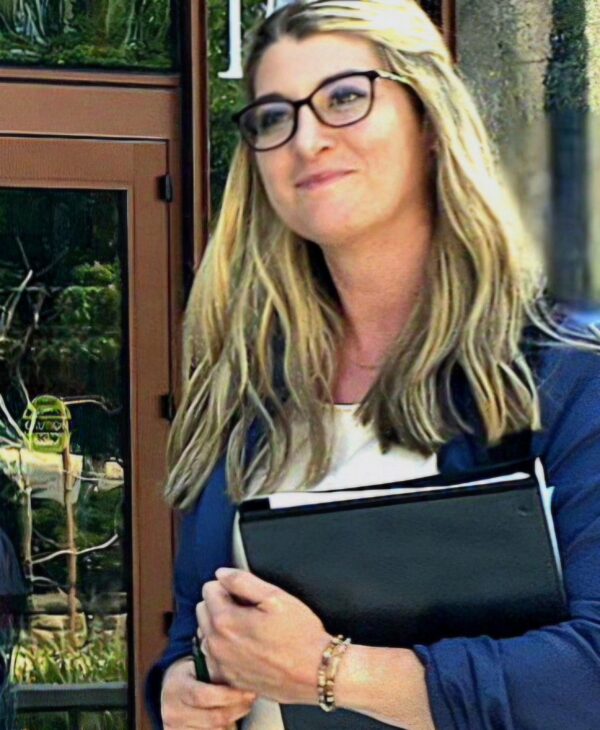
Joanna Francescut.
A News Café reached out to former Assistant ROV Joanna Francescut to get her take on Curtis’s cocktail napkin proposal. Francescut plans to run against Curtis for the ROV position in the June primary. Francescut disagreed with Curtis that placing ballot tabulators in each precinct is a bad idea.
“When preparing the budget with Mr. Toller, our aim was to request appropriate allocations and resources to count ballots as efficiently as possible,” Francescut said. “Precinct tabulators are an excellent solution for increasing both efficiency and trust in the election process. Whenever voters place their ballots into a tabulator—whether at the polling place or an early voting location—staff processing time is reduced. If there was an overspray issue similar to what occurred in November 2024, voters would immediately be aware and have the opportunity to correct it on the spot.”
Noting that Curtis plans to pursue grants, Francescut suggested he get busy since the present grants expire on June 30. She agrees with Curtis that the ROV needs a new building. In fact, she and Toller included a new building in their original budget request for 2025-2026.
“I researched a couple of good options earlier this year,” Francescut said. “Without the hand counting hurdle (former ROV) Cathy Darling Allen and I were facing in 2023, there could be some good locations available either for sale or lease. The old Big Lots next to Petco was the location Tom and I had requested to buy in our initial budget request. That request was denied.”
Francescut reminded Curtis that California has laws requiring reasonable compensation for any person on a vote by mail or precinct board, limiting the use of unpaid volunteers. She also questioned his claim that all the votes could be counted in one night.
“We receive the majority of vote by mail ballots back on election day,” Francescut said. “Those ballots will then need to be signature verified and sorted by precinct prior to deployment to each polling place. If I am understanding his process correctly, we will need to deliver ballots out to Fall River Mills to be opened and then reconciled under a camera and then brought back to central for counting. I don’t see how that can be accomplished in two hours after the polls close.”
Public Works and Resource Management: Keep the Public Friendly
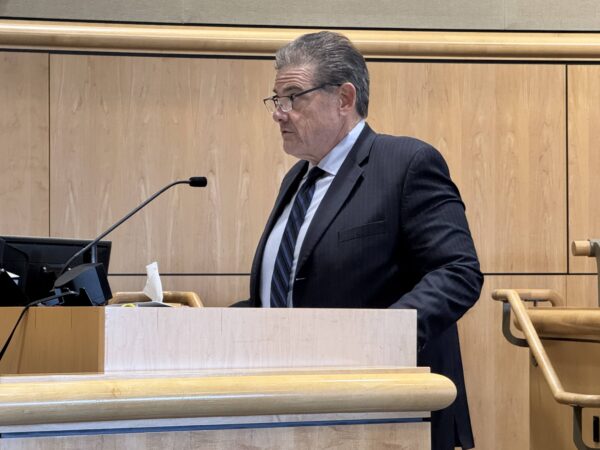
Director of Public Works Troy Bartolomei.
Director of Public Works Troy Bartolomei was stoic about the positions he’s had to delete to balance the budget.
“As you can see here, we have this nice, concise mission statement that’s been written and refined over the years, and I prefer just to say if it’s in the unincorporated area of Shasta County and it’s in government area, if it’s a facility, if it’s a road, if it’s a bridge, if it’s a building, if it’s maintained, we’ve touched it. We maintain it, we build it, and we even tear it down sometimes.”
Doing a good job means no one knows your name.
“As long as nobody knows our name and things are getting done, you’re doing a good job,” he said. “That’s how we like it. So far, I don’t think anybody has known our name, so that’s pretty good.”
During the past two years, five custodial positions have been deleted.
“So what we were able to do, we were able to take one of our custodians and move them over to a grounds maintenance worker position, and then the other four custodians we lost were all gone by attrition,” Bartolomei said. “So we did all that without any layoffs.”
Shasta County Director of Resource Management Sean Ewing was fortunate to be able to hire one new Code Enforcement Officer for the Building Division for a cost of $122,000 counting salary and benefits. That brings the total number of Code Enforcement Officers to 3, plus one manager.
“I’d like to be able to have one code enforcement officer essentially for each supervisor’s district and then that way we can make sure that we’re addressing things more timely and being able to take more cases to hearings,” Ewing said. “But for now we’ve got one additional position which will allow us to get a manager, so that’ll give us three code enforcement officers and one manager.”
Ewing said it’s difficult to shift staff during absences because each code enforcement officer has specialized knowledge. That increases the pressure on management. The department tries to foster a collegial relationship between its customers in the building process.
“The code enforcement team has been working very hard to rebuild the program and reestablish their relationship with county council, the sheriff, public administrator, and outside agencies such as regional water quality control board and Fish and Wildlife on joint code enforcement efforts,” Ewing said. The key takeaway in reviewing these numbers is to understand the level of interaction the department has with the public and the high stress environment department staff must be able to operate in. When recruiting from other departments, this sometimes is a shock to the new staff.”
Public Safety in the Budget Crosshairs
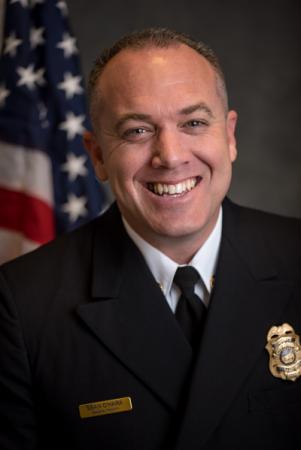
Shasta County Fire Chief Sean O’Hara.
Shasta County Fire Chief Sean O’Hara is the first person to tell you that the County Fire Department, for some inexplicable reason, isn’t classified as a “public safety” department even though massive wildfires remain the region’s most prominent threat. Nevertheless, his department kicked off the third day of last week’s budget hearings, which focused on public safety.
O’Hara wears two hats, Shasta County and CAL FIRE. He supervises 3 FTEs and 35 volunteer firefighters for the county and commands 600 CAL FIRE firefighters should they be needed. For this arrangement, he said Shasta County pays $11.4 million.
“So you get a $200 million fire department for $11.4 million,” O’Hara said.
It may be one of the best kept secrets in Shasta County. Like many other departments, O’Hara has difficulty filling some professional positions; a fire inspector position remains open. He’s also concerned that a new biannual fitness test he’s implementing could disqualify many of his volunteers, some of whom have been fighting fires longer than O’Hara has been alive.
“None of our volunteers are volunteers in air quotes, right?” O’Hara said. “The reason why I say that is every single time they do anything, they get paid. So I want to make sure that it’s a representation of the accurate role of how our volunteers are paid. Plus, I’m hoping that it actually allows our younger generation that’s coming that don’t tend to want to volunteer, that they see that they’re not just volunteering for the community, but they’re also getting paid as a fire department.”
O’Hara estimates that as many as 30 percent of the volunteers might not meet the new physical requirements,
“Unfortunately we will lose some of our paid call firefighters,” he said. “But at the same time, I would rather them be safe than to have a heart attack or have a stroke or any of those things while they’re out on the line and in the worst case scenario they pass away.”

Chief Probation Officer Tracie Neal.
Shasta County Chief Probation Officer Tracie Neal, who also heads Juvenile Rehabilitation, was one of the few county officials who didn’t complain about recruiting and retaining employees. Her primary concern, one shared by Chair Crye, is the so-called secure track drug treatment program, legislation passed in 2021 that prevents juvenile drug offenders from being placed in the adult jail and prison population after they turn 18.
“I do, Supervisor Crye, want to mention, you know, the secure track treatment population, being honest, has rocked our world,” Neal said. “Just like when realignment started, it rocked the jail’s world and continues, right? We didn’t plan to have these youth long-term. You know, we are raising young individuals. And it’s different. You know, our facility wasn’t built for that.”
Neal said that a 21-year-old male recently assaulted two staff in Juvenile Hall. The District Attorney is filing adult charges and the suspect has been moved to the adult jail.
Staffing issues continue to plague the Shasta Public Defender’s Office according to Public Defender Ashley Jones.
“Our staff works tirelessly to protect the constitutional rights of every person in this community,” Jones said. “Now, last year, the department had a severe staffing shortage losing nine attorneys and other key staff, including our chief investigator and our staff services manager. As this board is aware, that directly impacted our department’s ability to accept felony cases for an extended period of 10 months.”
As a result, Jones has been forced to do more with less, placing more responsibility on investigators, social workers and clerical staff to uncover critical information about each case, potential witnesses, evidence, relevant social background such as veteran status, mental health diagnosis, etc. Now Prop. 36, the unfunded mandate that makes drugs illegal again, is adding to the workload.
“This has resulted in a significant workload increase for our felony attorneys and social workers,” Jones said. “In response to these changes, we are working very closely with our justice and community partners and HHSA to create a streamlined process for how to deal with these cases and how to create a treatment referral process as mandated under the law.”
While Jones has filled most of the vacant attorney positions, pay remains relatively low and gaps remain. For many young attorneys with student loan debt to pay down, working for Shasta County Public Defender’s office just isn’t worth it.
“Your clients have experienced a lot of trauma,” Jones said. “It’s very difficult to go through this work in isolation. And so we are trying to create an environment where our attorneys and our whole staff feel supported. That can be silly, silly things. We did a lunchtime viewing of the new Sherry Papini documentary with popcorn. Just things to bring the community of our office together. We are small enough where it’s almost like a family.”
Culture Kampf at the Shasta County Sheriff’s Office
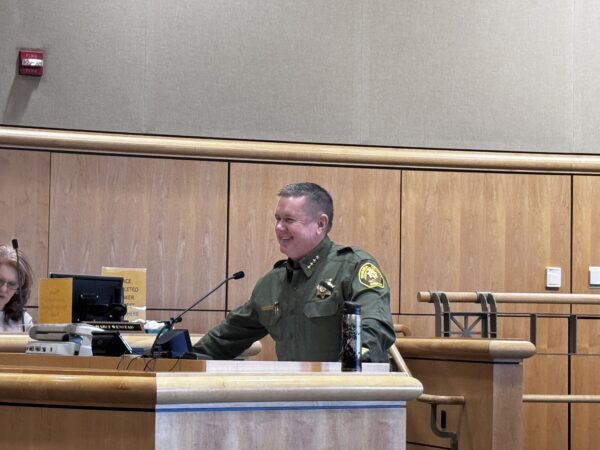
Shasta County Sheriff Mike Johnson.
Chair Crye, an apparent rabid consumer of motivational business manuals, loves to talk about workplace culture. He can’t stop gushing about the job Shasta County Sheriff Michael Johnson has done since being selected by the board for the job in 2021and winning election in 2022. Both Crye and Johnson are on the ballot next year.
It’s worthing noting the chaos that ensued at SCSO following former longtime Sheriff Tom Bosenko’s sudden retirement in late 2019 and the advent of the COVID pandemic in early 2020. That chaos resulted in a $2.4 million county payout to former Sheriff’s Capt. Patrick Kropholler last year and reverberates still with former Sheriff Eric Magrini’s pending lawsuit against the county this year.
All Johnson has had to do was be competent, and evidence so far indicates the former Anderson Police Chief is more than up to the job.
“I heard you talking about culture a little bit, Chair,” Johnson said. “We’ve changed the culture of our organization and we’ve got people wanting to come to us. We got a few from our PD who took pay cuts, very seasoned officers, 10- to 12-year officers who are now providing good leadership and experience in the middle ranks, which we were missing. We’ve had laterals come from Tehama, from Los Angeles, from Vegas. We’ve got a good group of people coming in. It’s going very well.”
Next month, Shasta County Sheriff’s deputies will begin wearing body camera’s funded by $1 million from the general fund.
“You have come up with the money for us to implement this program,” Johnson thanked the board. “We have secured the equipment, and we’ll have the first cameras rolled out here in July. And it’s a very extensive program, and that’s been put in the hands of the undersheriff, and he has been almost solely responsible for getting that together, implementing, mirroring off of RPD and getting that program going.”
More about those body cameras later.
Johnson oversees 234 full-time employees and roughly 400 search-and-rescue volunteers. Currently there are 29 total vacancies in the office, 12.3 percent, less than the county’s 14.5 percent average.
Yet Johnson is also tormented by the inability to retain professional staff, especially in the Coroner’s Office.
“We are on the verge of a staffing crisis at the coroner’s office,” Johnson said. “I want you to know that is not because of leadership there. That is because people moving on and career enhancement and finding other avenues now that they are very well tenured in the coroner’s field. It’s a very niche environment and it’s difficult to find people in there and we’re gonna be dealing with that one and talking with you board later as the year develops.”
Johnson also owned up to the failed deployment of a new $1 million records management system.
“The records management system is still a disaster in my assessment and my patrol deputies and staff at the jail and staff across the board will tell you the same that that system, the P1 system bought out by Motorola from Spillman is not going well,” Johnson said. “I don’t have very much good to say about it.”
The Most Patronizing Thing You’ll Hear This Week

Shasta County District Attorney Stephanie Bridgett.
For months, Shasta County District Attorney Stephanie Bridgett, her deputy DAs and attorneys from the Public Defender’s office have been pleading with the Board of Supervisor to provide them with funding to hire more attorneys, legal secretaries and investigators to relieve the crushing workloads that are driving current employees to leave and prospective future candidates to avoid Shasta County.
At Thursday’s budget meeting, Bridgett was the last presenter and she made her strongest case yet.
“First and foremost, public safety is a constitutional priority,” Bridgett said, reading the audience precisely. “The California Constitution has it written right in there. Public safety is the first priority of local government, and local officials have an obligation to give priority to the provisions of adequate public safety.”
Then she laid out the Shasta County’s numbers compared to other counties.
“We have 13 judicial officers, and other counties that have between 11 and 15 judicial officers, we have a 30 percent higher workload than they do. And even though we have a 30 percent higher workload, we still only have 28 prosecutors where on average they have 36.”
“The second comparison I did was counties with a similar workload, having the similar input from their justice partners. We, again, had 28 prosecutors where they had an average of 58 prosecutors handling the same workload that we have. Legal secretary equivalent, us having 10, and them having 26.”
“And we’ve got to start addressing that incrementally. I know we can’t, I know you can’t give me 58 prosecutors right now, or 26 legal secretaries, though that is potentially the level that we ultimately may need. But starting to chip away at that to promote public safety is what I’m asking for.”
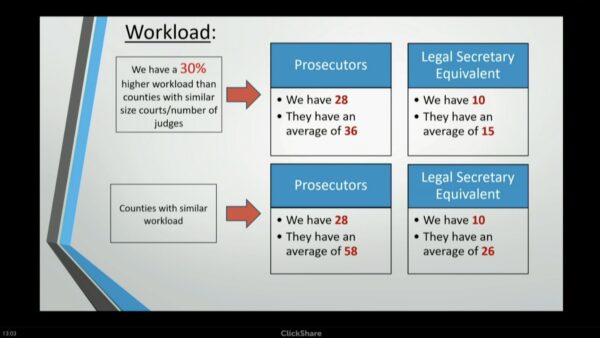
Bridgett described a literal trainwreck of colliding interests too large to enumerate here. Prop. 36’s unfunded mandate to make drugs illegal again is already eating away at staff time. Worst of all may be the advent of body cameras in the Redding Police Dept., the SCSO and the CHP. While she praises body cameras as a useful law enforcement tool, her attorneys must now spend two to three hours reviewing body camera video in addition to writing a 12-page incident report for each case. Between the three departments, there’s potentially 250 camera-wearing officers. That’s a lot of video.
In her budget appeal to the board, Bridgett attempted to claw back the $2.4 million CEO David Rickert cut from her proposed 2025-2026 budget, including $ 1 million for salaries and benefits for her overworked and underpaid deputy DAs. For two years Bridgett has requested a two-tier classification for legal secretaries, to provide a pathway to promotion, and she requested it once again last Thursday. She also requested funds for two new legal secretaries.
Without these budget requests, Bridgett said public safety would be endangered.
“When we’re not able to have the staffing levels that we need, we can’t hold those offenders accountable because it doesn’t matter how many cases or how many offenders are arrested by the Redding Police Department, the Sheriff’s Office, any of them,” Bridgett said. “Each of those offenders, they’ll get out of custody within 48 hours if we are not able to review the case, process the case, get it to court, and have the staffing to go there and handle those cases and fight to keep them in custody and fight for them to be held responsibility through the entire life of the case.”

Shasta County District 5 Supervisor Chris Kelstrom.
The good ole boys on the Board of Supervisors, Crye, Kelstrom and Harmon, the MAGA majority, don’t care for this kind of backtalk from a woman. The 6’ 9” Kelstrom evidentially prepared a response in advance. After first questioning her claim that her office is underpaid, overworked and understaffed he uncorked this gem.
“So I, you know, and looking at your budget, I mean, you know, you’re asking for a lot,” he began in his dulcet baritone. “There is a lot of changes. And I mean, I’ll be honest with you, my first thought that came to mind was going back 20 some years ago, I remember my daughter was about five and Christmas was coming.”
Yep, he really went there.
“And we had the catalog from Toys R Us with the wish list. And we told her, hey, can you, will you circle some things that you might want Santa Claus to bring you? Well, she circled everything in there, you know, and then we brought it back and we said, can you maybe take it the top 10 and circle what, you know, well, of course the first 10 items on the first two pages, she, you know, circled those again.”
“So much to her chagrin, she found out that not everything is free. So, and that’s why I was looking at this. I mean, I would love to just say, you know, hey, we want to give you everything we want, you know, I mean, but I would also love to give every county employee a $1 million bonus, you know, but 2000 county employees that’s, you’re okay with that, are you?”
What followed was not the Shasta County Board of Supervisors finest hour. The normally congenial Plummer joined Kelstrom in calling Bridgett’s request a wish list. When he asked if there was one thing she wanted on the list, Bridgett said the two-tier legal secretary classification, with tier 1 being entry level at the present wage and tier 2 requiring two years of experience with a 5 percent wage bump. CEO Ricket interrupted and said that wasn’t what Bridgett had originally proposed.

Shasta County District 2 Supervisor Allen Long.
While all this was going on, District 2 Supervisor Allen Long was looking at the 2024-2025 actual budget for the DA’s office and the approved 2025-2026 budget request, doing math in his head. Addressing Assistant CEO Erin Bertain, Long said that when he computed the 2025-2026 request with the cost of living increase, it seemed like the DA was actually receiving a budget reduction. After going over Long’s figures, Bertain agreed.
“So what a net zero general fund contribution means really is a reduction,” Bertain said.
“I appreciate that, Erin,” Long said. “Because I wanted to make sure the math was mathing. No, my whole point was that it appeared to me we’re going in reverse with the District Attorney’s office. Because we’re taking a hit to be net neutral, which is what we are. On paper, it looks like they’re getting more money. But in reality, they’re getting a reduction.”
The Board agreed to consider Bridgett’s requests after public comment. During public comment, speakers reminded the Board that they’d approved a staggering $240,000 salary for County Counsel Larmour last year and the board had also granted themselves a 60 percent raise.
Coming out of public comment, the Board continued to hem and haw. Finally Long broke the ice, proposing that the board create legal secretary one and two positions, the secretary two featuring a 5 percent bump up in pay. The total cost of this proposal across the County Counsel, Public Defender and the District Attorney offices would be approximately $69,000.
The motion passed 5-0.
Long proposed a second motion, that the Board approve the hiring of two new legal secretaries for the DA’s office. As he is prone to do, Crye killed the motion for lack of a second five seconds after Long made it. The veteran RPD detective was not having it.
“Well, it’s a reality that our community demands and wants public safety above pretty much everything else,” Long said. “I mean, that’s like a number one priority, and I heard it on the campaign trail.”
“We all did,” Crye complained.
“Yeah, we all did, and I think we need to put up or shut up, and we need to step up and help give some support to this department, and I think we’re gonna get a huge, tremendous bang for the buck by hiring secretaries versus more attorneys,” Long said. “We’re already facing a crisis with our attorneys because there are five positions understaffed and they can’t refill them. I think the thing that we’re missing is I’m actually probably the leading subject matter expert on this board, right, in the area of public safety because of my background.”
“Yeah, but does that mean maybe Mr. Harmon would be the subject matter expert on finances because he’s worth the most money?” Crye said.
Long scoffed at the non sequitur.
Plummer made a motion to hire one new legal secretary instead of two. Perhaps realizing they might get dinged for voting against public safety, Long, Harmon and Kelstrom supported it and It passed 5-0.
The unflappable DA Bridgett took it all in stride.
“The limitation to only one new legal secretary does not impact the new two-tiered system,” she told A News Café. “This position will be added at the beginning of the new fiscal year on July 1st and I will be able to recruit for a Legal Secretary I/II under our new two-tiered system. I am currently recruiting for all legal secretary vacancies and will continue to until they are filled.”
Good luck with that, DA Bridgett.
###


