


We chatted with James Santos last month about the ordeal he and his family suffered because of COVID-19.
James, his husband and their two children — all former Redding residents — now live in Las Vegas. Half their family fell ill; the other half remained healthy. There was confusion from the get-go. First, the daughter received a negative test result, which was cause for celebration. Next, it turned out the result was actually positive, after the office manager admitted she’d made a mistake. Oops. Sorry.
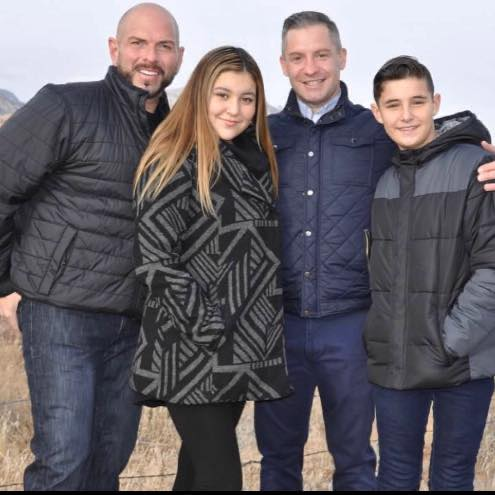
Soon afterward, James quickly found himself with symptoms similar to his daughter, already sick with a confirmed case of COVID-19. For James, it was a given that he was also infected with the coronavirus. Even so, just to be sure, he got tested for COVID-19.
He recuperated as he waited for his test results which still hadn’t arrived. Within a few more days, he and his daughter both fully recovered, although James does have some lingering effects to his sense of taste and smell.
Eventually, as father and daughter began feeling better, the whole family went about their daily lives and routines, as much as possible considering the pandemic.
Then came a surprise: 19 days after James had been tested for the novel coronavirus in mid-July, back when he and his daughter were both symptomatic, he received his results.
Positive.
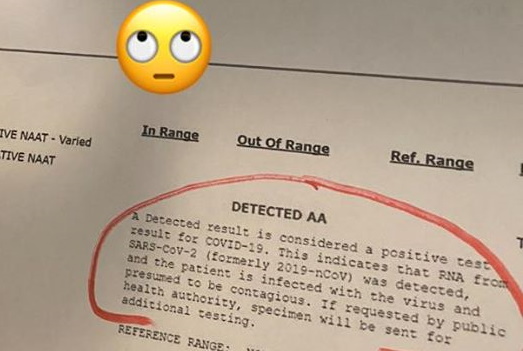
Image source: James Santos’ Facebook page.
In James’ case, because his daughter had already tested positive, when he became sick, he assumed he had COVID-19. He treated his symptoms and quarantined. His test was a formality, a way to confirm what they believed to be 99.9 percent true.
But for many people who don’t have a way to know for sure whether they are or are not infected, or for whom it’s impossible to quarantine for 19 days or more to wait for a result, the long wait times for COVID-19 results are are unacceptable. A few days to wait for results is one thing. But waiting for one, two and three weeks is pointless. The tardy results render the tests useless to fulfill their ultimate purpose to not just identify cases, but prevent further spread of the disease by contagious people who may not know they’re infected.
The technology exists for rapid-result COVID-19 tests. And rapid test results are crucial if the United States ever hopes to reduce the number of COVID cases and deaths, reopen our country, and ensure it’s as safe as possible for all students to return to school.
Test results that take two to three weeks leave health professionals constantly chasing old data. The long wait times make contact tracing a moot point, because by the time the results are in, the numbers of people exposed may have grown exponentially and beyond reach. Plus, in that period of time, some people may have unwittingly had COVID-19, infected others and recovered before they received their results.
This delayed COVID-results situation is personal. On July 6, I awoke with a dull headache and a sore throat. I’d celebrated July 4th with some people outside of my usual small circle of regular contacts. I thought I’d done a good job maintaining social distancing, but still, to put my mind at ease I got the soonest appointment for testing available at Shasta College; July 9. The next a available opening after that was July 19.
By the time I was heading to Shasta College for my test, the headache and sore throat intensified. I felt clammy. My muscles ached. I told myself that this was a good day for the test, because I was really feeling very sick, and if it was COVID-19, then it would surely register as positive.
Sidebar: Fairly early on in the shutdown, Shasta County Public Health and Human Services Agency experts were encouraging everyone to be tested.

Steve Gibson, a KQMS reporter, undergoes a COVID-19 test. Photo by Jon Lewis.
With that in mind, I went to Shasta College for a COVID-19 test, even though I lacked COVID symptoms. What the heck. Why not? Besides, as a journalist, I’m considered an essential worker. I was not ill in the least. Just curious about the process.
My experience was similar to Matt Grigsby’s. It was uncomfortable. In fact, I’d go as far as to say that that the nurse inserted the swab so high into my nasal cavity that I clenched my fists and tried counting in my head as a distraction. I later joked that it was as if the nurse were looking for lost car keys up there.
It took eight days before my results arrived: negative. Of course, since I was feeling fine at the time, that was the result I expected. Still, had I been sick, or had I been exposed to someone who’d been sick, it would have been helpful to have had those results sooner.
Fast forward to July 9 when I was at Shasta College getting tested for COVID-19 five days after my July 4th gathering. On testing day, I felt worse than I had the previous day. I dreaded the test; remembering my first experience with the swab that was inserted so high up my nose that I got an instant headache. But the test was worth it to rule out COVID-19.
This time the test was completely different, and by different, I mean extremely easy. There was no tipping my head back as I’d done last time, rather, the nurse asked me to face her and keep my chin level and look straight ahead. When I did, she quickly inserted the swab up my left nostril and swirled it around a bit, like a kindergartner might do with an index finger. Not deep in the least. A quickie little swipe and it was all over. 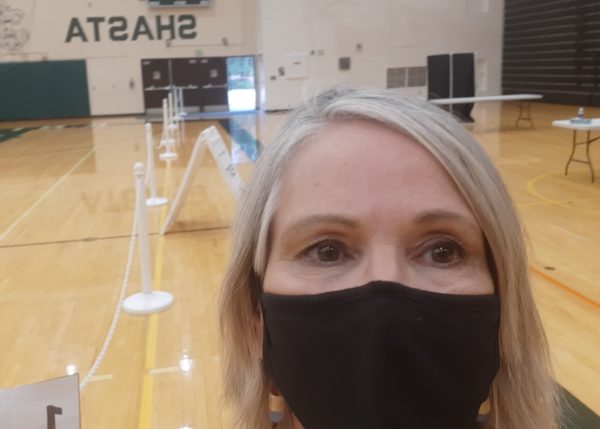 “That’s it?” I asked the nurse in surprise.
“That’s it,” she said.
I’m no masochist, but I left the testing site wondering if the nurse had inserted the swab high enough to get a sufficient sample.
In the following days, as I waited for my results, my symptoms worsened. I felt spacey and exhausted. I had a pounding headache and a blazing sore throat, both of which ebbed and flowed. I ached all over. But the thing that most alarmed me is I ran a temperature off and on for days in the 101.6 range.
Let me just say three things about that. 1. I rarely get sick. 2. When I do, I sleep it off like the dead and recover within a few days. 3. I NEVER run a fever. In fact, my typical temperature runs low, like 96 degrees. I cannot remember the last time as an adult when I had a fever.
I live alone, so quarantining was easy. I spent most days going from the couch, where I slept, and the computer, where I worked.
Seven days later, I received my results: negative again. I was surprised, but then I remembered the non-invasive test. Convinced that my test was a false negative, I filled out an application online for yest another test; this time at Rite Aid.
I arrived at the drive-up pharmacy window at my appointed time a few days later. There, under the pharmacist’s watchful eyes and instructions, I was instructed how to insert that very thin, very flexible swab up my nose. She instructed me to go as high as I possibly could go, and then swirl it, and then hold it inside the wall of each nostril for 15 to 20 seconds. Then, I carefully dropped the swab headfirst into a vial that has some kind of a solution, sealed the vial that had my information on it, put the vial in a small bag and finally, put everything in a plastic basket was passed through the window to the waiting pharmacist.
I liked the COVID test at the drive-up window better than going all the way out to Shasta College. The drive-though was fast and convenient and nobody cared (or knew) that I was still wearing my nightshirt.
I left the test and went home straight to bed, convinced I had COVID-19. Don’t think I’m morbid, but I made sure my will was in order, and I created a file with all my end-of-life wishes.
Once again, I quarantined so others wouldn’t catch my illness while I waited for the results. I waited. And waited. And waited.
Finally, 13 days after my Rite Aid test, I got my results: negative again.
I still felt sick. In fact, it hasn’t been until recently that I’ve felt my energy returning. Still, I find myself tiring easily.
I have no clue what I had. I do know that the absolute worst time to get sick is in the middle of a pandemic, because the first thing I thought of was I must have had COVID-19. I had to remind myself that before the novel coronaviurs came along, people got sick from all kinds of other ailments.
Either way, I spent most of July in quarantine.
After my disappointing experience with the long test-result delays, and after hearing about other people’s long waits for COVID-19 results, such as James Santos’ 19-day wait, I’m not so sure I’d bother with getting tested if I became sick again. Not until we have rapid tests here in the United States. Next time, I’d just quarantine and assume I was infected with COVID-19.
Back in April, the National Institute of Health pledged $1.5 billion to incentivize inventors to come up with rapid tests. Europe has rapid testing. And we know they’re available in some parts of the United States, such as for the president, who has daily tests, and for professional athletes and famous people.
When test results take many weeks, that delay defeats the purpose of the testing in the first place. With each day when a person awaits the results, it becomes more difficult to convince people to quarantine longer than the COVID-19’s typical illness window. Contact tracing pretty much becomes pointless when the result times last longer than the start-to-finish contamination-to recovery periods.
Here in Shasta County, it’s difficult enough to get the majority of citizens to wear masks, let alone successfully convince many people they need to quarantine to ensure they don’t infect the public with a disease they believe is a hoax any way.

Recent crowd Tuesday evening in Redding gathers outside the Shasta County Board of Supervisors meeting. No social distancing. Masks were a rarity. Photo source: Rally Sally Rapoza’s Facebook page.
The delay in results causes a delay in accurate data, and a delay in data causes a delay in public health’s ability to respond, track cases and do contact tracing to stem the tide of active transmission.
That’s why I feel a sense of exasperation when people gloat about not having seen an uptick in cases since any particular large event in two weeks. Whether it’s a rural rodeo or a Back the Blue rally or a worship service that attracted thousands beneath the Sundial Bridge – those taunters are jumping the gun. The uptick will come eventually, but the surge will be as delayed as the results. For a more accurate estimate of an increase in cases tied to a particular event, watch the calendar a total of four to five weeks after a potential super-spreader gala, and allow for two to three weeks for results on top of the two-to-14 day infection window.
Also, consider that many non-coronavirus believers who willfully gather maskless en masse aren’t inclined to voluntarily submit to getting tested in the first place.
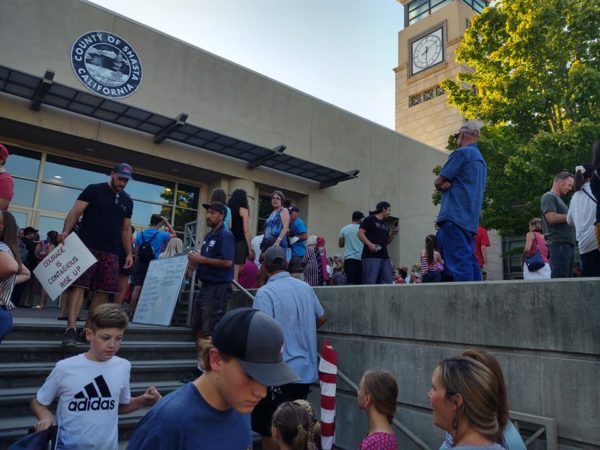
Outside Tuesday’ evening’s Shasta County Board of Supervisors meeting where citizens spoke out about the COVID-19 restrictions. Notice the lack of social distancing, minus masks. Photo source: Rally Sally Rapoza’s Facebook page.
Chances are pretty likely that those non-believers who are tested do so only when they’re extremely ill, considering the amount of pride-swallowing required to succumb to testing.
Meanwhile, the beat goes on, and public health officials do everything in their power to education the masses and convince us that the pandemic is a potential killer, and we should do our part to stop spreading the virus.
It’s the least we can do while we wait for better tests that produce more rapid results.
While we wait, read this story about a couple who learned lessons about the coronavirus the hard way.
Here in Shasta County, citizens are enthusiastically encouraged to get tested. And plenty of people do just that. Our public health agency devotes an entire page on its Shasta Ready website with testing locations and options.
Granted, the tests aren’t perfect. Some tests report false positives. Other tests report false negatives. But while the experts work on perfecting testing and finding a vaccine, we can do our part: Wear a mask. Commit to physical distancing. Avoid large gatherings. Wash hands frequently. The more we do all of those things, the more quickly we can return to some semblance of blessed, boring normalcy. And the more we do those things, the less reliant we’ll be upon testing, because we’ll have fewer sick people.
But we aren’t there yet, so right now, accurate, speedy testing is crucial for our well-being.
For the record, I don’t blame our local or state public health experts for the sluggish COVID test result returns, or even the recent data snafu that caused a log jam of cases. Those public health professionals are doing the best they can with the resources they have during an unprecedented historical public health crisis.
However, I do blame our president for not making rapid testing a nationwide priority.
If rapid testing is good enough for our president, and if rapid testing is good enough for professional athletes and celebrities, then it’s good enough for the rest of us.
During the 19 days it took for James Santos’ test results to arrive, 19,000 Americans lost their lives to the novel coronavirus.
Another day, another 1,000 deaths.
***
AUG. 20, 2020 UPDATE: Since publishing this column I’ve learned that because I was experiencing symptoms, rather than going to Shasta College for the test, I would have been a better candidate for mobile testing, which would have allowed me to stay in my car, and would have most likely had faster turnaround test-result times. Click here for the link that allows people who want COVID-19 testing to answer some questions that direct them to the best testing option.


