

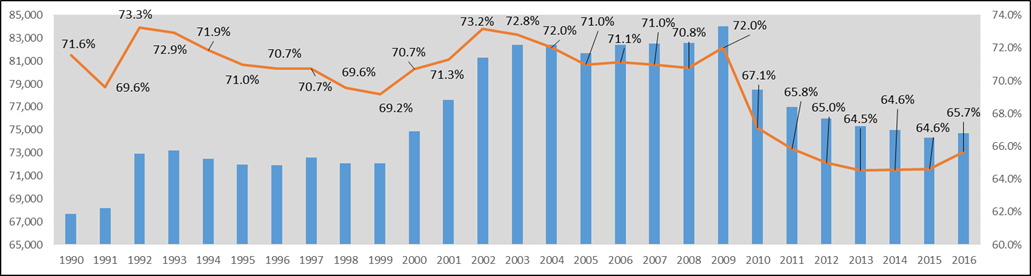
Labor Force Participation Rate, Shasta County. Note large dip 2009-2016. Graph by Sheila Stock, EDD.
It’s no secret that Shasta County, along with much of rural America, hasn’t snapped back from the Great Recession as vibrantly as the coastal cities, where the financial and technology sectors have been booming.
Not that the local economy hasn’t improved significantly since Shasta County’s unemployment rate peaked at 18.5 percent in February 2010. That number has come down steadily during the past eight years, reaching 5 percent last November, according to the California Employment and Development Department.
But a funny thing happened along the way during this sluggish recovery. Even though Shasta County’s unemployment rate has come down, the labor force participation rate, defined by the U.S. Bureau of Labor Statistics as the number of adults aged 16 and above who are either working or looking for work, has not bounced back from recessionary levels.
In 2008, Shasta County’s population was 116,720, with 82,600 adults 16 and over counted in the labor force, resulting in a labor force participation rate (LFPR) of 71 percent, near the historical rate going back to the 1990s, according to data provided by Sheila Stock, a research program specialist for the EDD’s labor market information division who is based in Redding.
By 2012, four years into the recession, the population had grown to 116,951, but the labor force had shrunk to 78,500, resulting in a LFPR of 65 percent, where it remains mired today. In 2016, there were 74,700 people participating in the labor force, 7,900 fewer than before the recession started, a 10 percent decline in the labor force.
Put another way, even though the unemployment rate is down, fewer people are working in Shasta County than before the recession.
This anomaly was first brought to my attention last summer in a Record Searchlight story on the declining unemployment rate in which the EDD’s Stock had mentioned Shasta County’s declining LFPR as a footnote. It’s an interesting statistic because it provides information about the economy that isn’t captured by the so-called headline unemployment number relied upon by most mainstream media.
I recently contacted Stock and asked her to elaborate on what appears to be Shasta County’s shrinking labor force. She responded by crunching data from the Census Bureau and the state Department of Finance and sending me the graph above, which is based on this spreadsheet. After reviewing the data, I asked Stock why Shasta County’s lowered LFPR concerns her.
“Generally in times of recessions LFPR are high as more people are entering the labor force,” Stock said. “This happens because one household member may have been the only one working. If that person lost their job, then it’s likely another household member would have to join the labor force. You can see this as true during the 2001 and 2002 dot com bust.”
But something different happened when the housing market imploded in 2007, taking the stock market down with it and ushering in the Great Recession. Instead of more people joining the labor force, less people joined.
“This does not seem to hold true during the housing bubble in Shasta County,” Stock said. “Although the recession hit from 2007-2009 nationally, it really did not affect our county until around 2009 and most definitely in 2010 and 2011. This is evident by the unemployment rates for those years.”
Stock says the county didn’t truly begin shedding jobs until 2009, 2010, and 2011, with the vast majority of them being in construction.
“Our peak year for construction was in 2006 with annual average jobs of 5,600,” she said. “By 2010, that number was at 2,700; a loss of nearly 2,900 jobs on an annual average basis.”
Unless the local housing industry comes roaring back, those jobs may be gone, permanently. Stock notes that many laid-off workers in the construction industry were on longterm unemployment benefits. While they receive benefits, which can last as long as two years, they must actively seek work and are counted in the workforce. If they fail to find work and exhaust their benefits, many of them become “discouraged workers” and are no longer counted in the headline unemployment number.
Thus, unemployment can go down while the number of people not participating in the workforce can go up.
“It is possible that many of the people in the construction industry were the only working household members and possibly pulled themselves out of the workforce knowing there were no jobs and their partner or spouse went back to work instead,” Stock said. “This last recession was really hard to pin down on why the labor force acted the way it did. It was unlike any recession we had ever experienced.”
Stock pointed me to research on discouraged workers done by Marianna Kudlyak, a senior economist in the economic research department of the Federal Reserve Bank of San Francisco. Kudlyak uses a “Non-Employment Index” developed by other researchers to account for discouraged workers. It’s similar to the LFPR, but focuses more directly on workers who aren’t participating in the labor force.
“Since the 2007–09 recession, the U.S. unemployment rate has declined from a high of 10.0 percent to 4.7 percent in February 2017,” Kudlyak notes. “During the same period, the share of the population that reported not working and not actively looking for work grew from 35 percent to 37 percent, continuing its increase since 2000.”
For a rough comparison locally, as measured by the LFRP, the percentage of adults 16 and above not participating in the workforce in Shasta County in 2009 was 29 percent; today it’s 35 percent.
While some of these people may be retired or disabled and thus unwilling or unable to return to work, Kudlyak believes a substantial number of them want to work and represent a potentially valuable untapped labor resource.
“In fact, on average, every month more than twice as many individuals transition to employment from outside of the labor force than do from unemployment,” Kudlyak notes. “The increase in the number of individuals joining the workforce from this group and the possibility that they represent an additional source of labor availability have raised questions about the accuracy of the unemployment rate as a gauge of underutilized labor resources.”
Kudlyak points out that during normal economic times, the unemployment rate and Non-Employment Index tend to parallel one another, but during the Great Recession, there was a spike in longterm unemployment that drove up the number of discouraged workers nationally. While the unemployment rate and Non-Employment Index have since returned to their historical relationship nationally, that’s not the case in Shasta County.
Stock thinks other demographic factors are in play locally.
“As for the continued decrease in LFPR for years 2010-2016, I would contribute that to less young people being in the labor force,” Stock said. “Historically kids entered the labor force at the age of 16 to get a job; however, this new generation find themselves not worried about finding a job.
“They are concentrating on their grades and/or volunteering. Getting into universities is not as easy as it once was. These kids are finding they need a better resume than generations past to get accepted into universities.”
Stock said now that the stock market has fully recovered, along with many a potential retiree’s pension fund, baby boomers who had previously put off retirement are now doing so, which also reduces the LFPR. Then there’s the well-known phenomenon of local high school kids going off to college in the big city and never coming back.
Despite the massive amount of research conducted and data collected, there’s still a lot about the economy that we just don’t know, at least at the present. Consider the impact of the so-called sharing economy, for example.
“We must take into consideration the new types of jobs people are now taking on,” Stock said. “Many people are working at jobs that are not counted in the labor force, such as dog walkers or Uber drivers. This underground economy has always been around; however, these jobs are more prevalent today as being the primary job for many people than being a secondary source of income. Many people have several of these types of jobs to pay or their daily expenses and bills.”
Given that, perhaps Shasta County’s labor force hasn’t shrunk as much as the available data indicate. Another silver lining despite our stubbornly low LFPR: If the construction industry returns or some other industry comes along to take its place, it appears that there are a substantial number of people who would be ready and willing to take good jobs, should they become available.


