
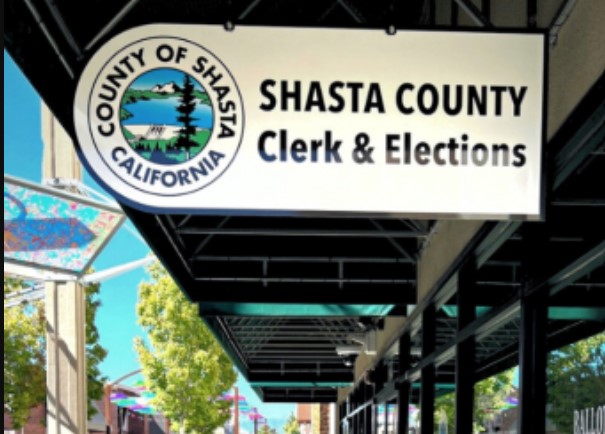
Has the dust finally settled from Shasta County’s exhausting Nov. 5 general election?
It depends upon who you ask.
“The election is certified,” Shasta County Registrar of Voters Tom Toller told the Board of Supervisors without mincing words during Tuesday’s meeting.
Toller said his Elections Department staff worked 12-hour days with overtime help from other county employees to finally finish counting ballots on Dec. 2, the day before certification with state officials.
The counting was plagued by an ink overspray issue on a good number of ballots that couldn’t be counted by voting machines. In a time-consuming process, the bad ballots had to be duplicated for accurate results.
Toller narrowly beat the deadline to certify the results with the state.
“Once the secretary of state receives those (results), it is a done deal. That ship has sailed,” Toller forcefully said in an impassioned speech before the five county supervisors.

Shasta County Registrar of Voters and County Clerk Tom Toller speaks to the Board of Supervisors during its meeting on Dec. 10, 2024. Photo by R.V. Scheide for A News Cafe.
The board’s agenda item was to declare that Toller had accurately certified the results – something that’s only become controversial with the spread of the election denial movement and false claims of voting fraud.
True to form, a faction of Shasta County residents – persistent election doubters – pressed the board to reject the results over unverified irregularities. Several were still insisting on a hand count.
Outgoing Supervisor Patrick Jones agreed with the election zealots, at one point calling Toller a failure. The supervisor said the election process wasn’t transparent as Toller had promised. Jones also told about an encounter he had with a county worker who called him “a vulture” while he was acting as an election observer.
In the end, the board voted 5-0 to agree with Toller’s certification declaration, although the far-right majority of Supervisors Kevin Crye, Chris Kelstrom and Jones begrudgingly did so “under duress.”
“I’ll ask you to follow the law,” Toller told the board. “And the law is to declare nominations, measures and persons elected based on my certification.”
However, the three supervisors were not ready to close the book on the November presidential general election. They faulted the county’s election handling and voted 3-2 – with Supervisors Tim Garman and Mary Rickert in the minority – to send critical letters to the U.S. Department of Justice.
One letter would be sent now, with an intent to mail the second letter after a possibly more sympathetic Trump Administration takes over in January. The motion by Jones requested an investigation into the ballot overspray and “other issues” from the Nov. 5 election.
While at the podium, Toller didn’t back down as the election deniers stared his way in the chambers. Toller noted that many of his critics urged the board to reject his certification.
“It’s been suggested that you ought not to (declare) because this particular election was so problematic or that somehow I failed to conduct it properly. I find that frankly unworthy of my comment and so I won’t,” Toller said.
Jones had joined other post-election observers and took Toller to task for them not being allowed closer to watch the ballot-tabulation process, especially at duplicating stations. Jones also complained about not being able to see all the ballot scanners.
“Part of the problem here, ROV Toller, is that we failed to have meaningful observation almost at every corner,” Jones said.

Out-going District 4 Supervisor Patrick Jones criticizes Shasta County Registrar of Voters Thomas Toller during the Shasta County Board of Supervisors meeting Tuesday.
“The one thing you promised us in the meetings before we appointed you to the ROV is that this would be the most transparent election ever, and I believe you failed,” Jones added.
Jones also was ticked off when an elections department worker called him a vulture while watching from afar.
“When I was looking through the observation window for the duplicating room, one of the elections workers walked behind me and called me a vulture because I was looking and monitoring, doing my civic job, and yet I was called a name. That is not the environment that we want in the elections department,” Jones said.
When Garman asked Toller if Shasta County’s election results would stand up to a court challenge, Toller replied, “Yes. Unequivocally.”
“Then I have no issues declaring this,” Garman said.
Toller’s post-election thoughts

ROV/County Clerk Thomas Toller. Photo by Doni Chamberlain for A News Cafe.
Toller gave an interview to A News Cafe on Dec. 6., four days after election workers finished tabulating ballots, but before his Tuesday appearance at the Board of Supervisors meeting. Here are some of his responses, which have been edited for brevity and clarity.
Prospect for a hand count of ballots:
“The process is already complete as far as Shasta County is concerned. We have provided our official report and my certification of that.
“Barring a court challenge or a request for a recount, which there are mechanisms for that to occur, then the idea of a hand count for the Nov. 5 election is already a moot point. It’s not going to happen,” Toller said.
Happy Valley school district race:
“That literally see-sawed back and forth by a handful of votes. In that one particular case, we actually did what amounts to a hand count. We basically manually tallied every ballot that had been processed by Nov. 22.”
No election impropriety:
“I’ve not seen any misconduct. When I hear the word misconduct, I feel that there’s an intentionality, a component of, ‘I want to do this action to undermine the fairness or the ability to have this voter’s vote count.’ But I see none of that.
“I’ve seen human error, certainly. Both on the part of outside actors. So this printing over-spray problem that we had encountered is not something that originated with our office or our people. It was something that fell into our laps, as it were.
“It’s going to take some time to figure that out. And believe me, the secretary of state is assuring that that is going to happen.
“I can’t tell you how embarrassing it was to find that there were misspellings in some of the ballot language because I, myself, proof-read some of that language and did not catch those misspellings.
“My second-grade teacher would probably be very disappointed in me. But the (misspellings) were not misleading. I don’t think any voter was unable to understand what the effect of the proposition was just because the word was misspelled. It was not what we call a substantial error.”
Misconduct claims:
“The election task force likes to make claims of misconduct. I think a lot of times what they’re really claiming is that it’s conduct that they just don’t understand well.
“And if you tell them that, they then say, ‘Well, we couldn’t understand it because we couldn’t get close enough to see it, or we weren’t allowed to have a materially effective observation, or our questions weren’t answered.’ ”
“The ground shifts under your feet with this claim. My position has always been, if you bring something to my attention and you have a concern, I will try to get to the bottom of it. I’ll try to find out why it occurred, and what the explanation might be.”
Election observers:
“In my experience, observers fall into three groups. One group, once you’ve answered their question, they’re generally satisfied and they kind of move on to what interests them next. There’s the middle group, where you give them this answer and they basically say, ‘OK. But really, I just have to take your word for it because I couldn’t see or I didn’t have a good vantage spot.’ ”
“Then there’s this third group, which I think represents the smallest number of people, but the most vocal. And they just have a larger objective, which is completely unconnected to the process of processing ballots as we do it here in Shasta County.
“They’re observing not because they’re truly interested in the work that my staff is doing – whether they’re doing it properly or how it’s being done, the mechanics of it.
“They’re just using anything they can glean as a pretext for this mantra, this drumbeat that the only way to have true transparency, the only way to have true fairness is with a manual hand count.
“I recognize that there’s a lot of passion behind that. But it’s just misdirected because there’s nothing that I or any other California election official can do. They really have to go to the legislature.
“They have to work through their Assembly person and their senator and write the governor. I recognize that the climate right now is not favorable for that probably, but that’s the appropriate avenue.”
Building limitations for observers:
“I understand that frustration. The outline of the building … the size and the layout and the number of processes that we have to put a ballot through — requires so much use of the floor space in the rooms that is not an ideal place to have a lot of observers with an ideal viewing platform.
“In a perfect world we could have an election headquarters like they have down in Los Angeles or Orange County that was purpose-built and has long areas separated by glass panels where the observers can see very clearly and at a much shorter distance.
“We certainly, right now, don’t have the money for that. I would say a jail is probably a higher priority than a new elections building. One can always hope.
“So at the end of the day, I asked those observers to trust me because I came into this job with a certain – I don’t want to say skepticism – but a certain inquisitiveness about the process.
“I just didn’t know what I didn’t know. But, because I’ve been so attentive to the process and the details and trying to satisfy my own lack of knowledge, I genuinely believe that I’m being a fair and accurate reporter of the things that are going on.
“To be questioned about my integrity in that regard, that rankles a bit.”
Ballot adjudication explained:
“You mentioned the claim that 50 percent of the ballots were adjudicated. I particularly want to stress that the word ‘adjudication’ is another term that has a sort of a precise meaning in elections. What it is, is that a human election official is comparing a ballot or looking at a printed ballot to determine what the voter’s intent was.
“So what will happen is that in the ordinary course, a ballot goes into the tabulator and it might be rejected, and it could be rejected for a number of reasons. It could have some type of foreign matter on it like a coffee stain or something like that. It could be rejected because it doesn’t recognize that the ballot has been marked.
“We put very clear instructions on the ballots to fill in the square a certain way with blue or black ink, and we put those instructions in the voter information guide.
“And (voters) will make a check mark or an X or a little circle. They do whatever they are kind of accustomed to doing.
“And many times the scanner will not pick that up. So you get the ballot and you’re looking at it, and it’s very clear that they voted for somebody. They’ve made a mark next to a name and we take that as an indication that that’s who they intended to vote for. So that’s an adjudication, that judgment.
“If we need to, we will duplicate that ballot by creating one that’s filled in fully that will scan. And all it does is it replaces their ballot, which was marked poorly with one that is marked mechanically, but in such a way that it will be scanned to reflect their intention.
“This is where it gets tricky. You would have situations where people will vote for something and then they’ll cross it off and they’ll vote for something else. And so the scanner will spit that out because it thinks, well, maybe they’ve overvoted. Maybe they voted for two people when they were only supposed to vote for one.
“But again, it’s very clear to the human person looking at it. No, they’ve crossed that off or they’ve circled the one they want or they’ve written ‘Don’t want this one, want this one.’ I mean, there’s lots of ways they indicate these things.
“The one thing that the adjudicator never does is if there’s any ambiguity, if they cannot tell, if there’s markings in two boxes, but no crossing off or no circling or no wordage, they just let that stand. They never try to insert their own mental judgment into the mind of the voter. They don’t take a guess at what the voter was trying to do. If it’s not absolutely clear, they just leave the ballot exactly as they found it. They duplicate it to replicate – both boxes will be checked or no boxes will be checked.
“So all that happened with the print overspray issue, was that we just had to engage in that duplication process with far more ballots than we ordinarily would. Usually, we’re talking like a couple thousand ballots in an election. This time, it was more on the magnitude of about 43,000 to 45,000. (A total of 90,162 ballots were cast.)
“That’s where the 50 percent comes from. This is why I say adjudication is one of those tricky words.
“Yes, it’s true that 50 percent of the ballots were looked at by human eyes and separated into, you know, this one scanned, this one didn’t scan. And then the ones that didn’t scan, they were then put through this duplication machinery provided by the printer. And then we would get the original ballot that the voter marked and the new ballot.”
Heading into 2025:
“Right now, there’s nothing scheduled for 2025 in terms of elections, so I’m hoping that it’s going to give me and my team a good solid year to kind of really plan for how we can improve things and strengthen the partnership with our public.
“I would like to see a restoration of civility and to try to give elections the opportunity to recede into the background a little bit and let some of these other issues (such as distribution of opioid settlement money) move to the foreground.”
Preaching to the choir:
Two days before Tuesday’s board meeting, representatives from the New California State (NCS) movement came to Redding on Sunday to hear complaints about the county’s elections operations.
NSC followers want to form a new government as a 51st state, believing the state of California isn’t adhering to the U.S. Constitution. They’ve studied an 1861 model when West Virginia split from Virginia.
A handful of residents appeared before the eight-person panel for a two-hour meeting inside the Redding Library’s Community Room.
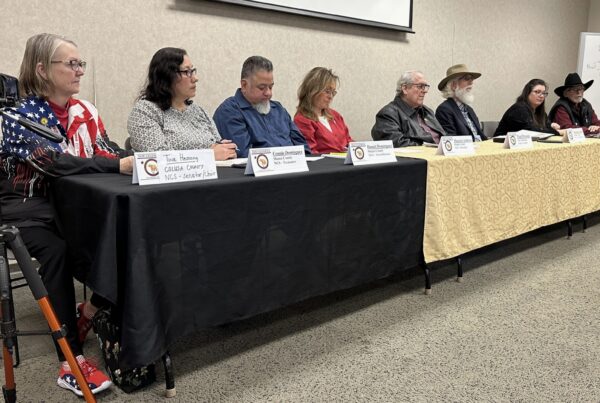
A panel of New California State representatives meets Dec. 8, 2024, to hear speakers describe what they assert was election fraud in Shasta County. The panelists are, left to right, Tina Hussong of Colusa County, Connie and Daniel Dominguez, Marjorie Andrews, all three of Shasta County, NCS President and governor pro tempore Paul Preston, Michael Kehoe of Tehama County, and Cassie Hale and Ron Plumb, both of Shasta County. Photo by Mike Chapman for A News Cafe.
Several speakers gave their first-hand accounts of suspected irregularities.
NCS President and Governor Pro Tempore Paul Preston said the speakers just needed to give their first name.
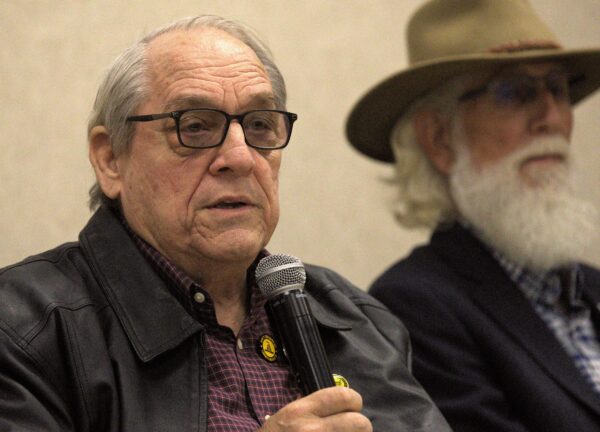
New California State President and governor pro tempore Paul Preston speaks during a NCS hearing on Dec. 8, 2024, about Shasta County elections. At right is panelist Michael Kehoe. Photo by Mike Chapman for A News Cafe.
A Redding resident named Mike, who called himself a citizen journalist, described what he felt was a suspicious outcome of the 2022 Shasta County Clerk election between challenger Bob Holsinger and incumbent Cathy Darling Allen, who was re-elected at the time, but since has retired for health reasons.
Mike said he was a poll worker and felt confident Holsinger would win because voters at his polling station favored Holsinger 60 percent to 40 percent. He said he went to two other polling places where the 60-40 split also was in Holsinger’s favor.
He was surprised when the final results showed Darling Allen winning with 68 percent of the vote.
Mike said the outcome “made me wonder.” He doubted the legitimacy of the Dominion voting machines that Shasta County used at the time.
Another speaker named Dan questioned what he saw as an election observer this year. He said he and several others were initially prevented from watching post-election activity at the elections office because they were told there was nothing to observe.
“Nothing going on should be an observable event,” he said.
A manager in the elections department later arrived and told the group that actually activities were going on.
He said they saw three workers at separate tables taking ballots out of envelopes and marking on them with pens.
“It makes no sense at all why they were marking on the ballots with black and blue pens,” he said.
Another speaker was frequent Board of Supervisors attendee and former county elections commissioner Bev Gray.
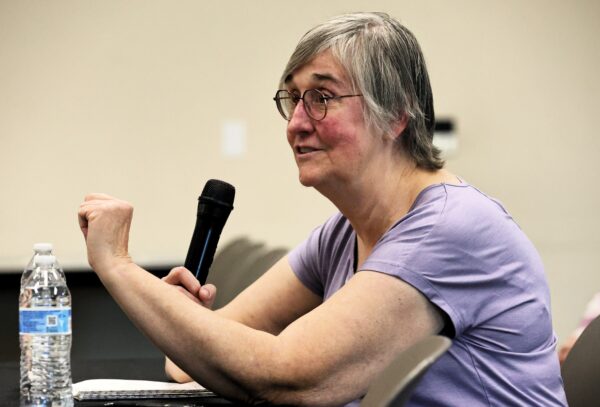
Bev Gray, former member of the Shasta County Elections Commission, speaks before a New California State panel on Dec. 8, 2024, in the Redding Library’s Community Room. Photo by Mike Chapman for A News Cafe.
She said she discovered 400 suspicious votes in 2020 election from people whose addresses didn’t exist. She said she took a closer look at 90 of the votes.
She said she found people who gave their residence as the post office and others who had no physical address. She said people who had moved 20 years ago still voted without proper addresses.
“What I found was they didn’t just vote in the 2020 election. They voted in the primary, they voted in the 2022 primary and the special election.”
Gray said she’s now looking into what she sees as irregularities from the 2024 election.
“The odds are pretty good that a lot of them voted if they’ve been voting in every other election,” Gray said.
She acknowledged that homeless people can vote but they’re “supposed to say where they live.”
“How are they getting their ballots?” she asked. “If you can find these addresses, let me know.”
“If they can find the guy that lives between McDonald’s and Taco Shop, he is still voting. There’s only driveways between those two,” she said.
Gray said she’s passed along her findings to a Shasta County sheriff’s detective and is waiting on his report.
“The people that say there’s nothing wrong with our elections, they are welcome to go with me and canvass these addresses.
“It would not surprise me if 25 percent of our voter rolls were garbage,” she said.
She said she came across a 900-square-foot house with nine people who voted there.
Gray said she’s tired of hearing there’s no evidence of voter fraud.
“People say, ‘Oh, there is no proof.’ Well once you see it, you’ve seen it,” she said.
Another speaker named Jeremiah said he changed the way he signed his name and the elections department didn’t question it until four years later.
“My vote was taken as is, put into the machine and that was it,” he said.
NSC representative Patty Plumb, who’s also on the county’s election commission, said the group will return for another meeting at 1 p.m. on Dec. 17 at the library.
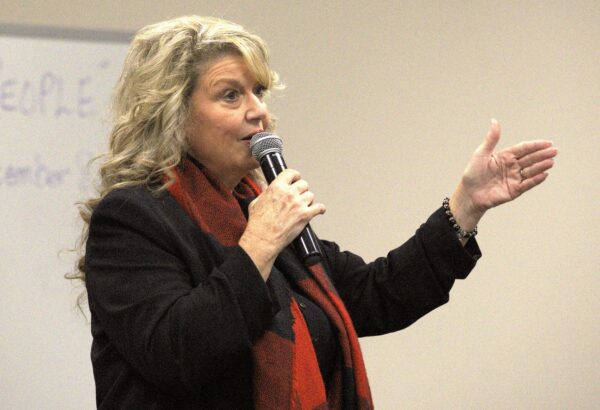
Patty Plumb, the Shasta County Chair and Assembly member of New California State, speaks Dec. 8, 2024, before introducing NCS panel members during a meeting in the Redding Library’s Community Room. Plumb is also a member of the Shasta County Elections Commission. She was appointed to the panel by outgoing Shasta County Supervisor Patrick Jones. Photo by Mike Chapman for A News Cafe.
Preston said the NSC movement is gaining traction in 57 of the state’s 58 counties and has already held 73 hearings throughout the state, not including town halls and constitutional conventions.
He described California under Gov. Gavin Newsom as a dictatorship.
“Who is following the Constitution? No one. And what do you get, you get chaos. And quite frankly, we’re really at the beginning of the chaos,” Preston said. “We ain’t seen nothing yet of what this chaos is going to look like.”
###


