

To Dad with love: His family called him Toots, the cowmen called him Mac, his given name was Leonard Daniel McCarty. He was an American Cowboy.
Click here to read An American Cowboy’s Ride of Passage – Part 1.
Continued ….

I am 12 years old. It is 1958. This is my second year of deer hunting. Last year, I came out a few times, but never pulled my rifle. This is the fourth ride this fall. However, this day is different. It feels as if it was made for me, the way the morning started with the men and the babbling creek including me in conversation, and the way we ride the narrow trail in silence, patiently intent on getting somewhere.
I’m again aware of all that surrounds me.
We follow our shadow into the wilderness; the landscape changes to rolling hills that are tanned to a golden brown by the summer sun. We have been riding for hours. There have been steep hills, open spaces, and fall colors, with little sign of man. This is land as it has been forever, left to change with seasons as nature allows.
We have only seen a few doe and fawn grazing along the creek bottom. Above, an occasional red tail hawk circles seeking a rodent breakfast, its shrill cry adding excitement to an envisioned moment not yet here.
We arrived at a predestined location. They ask me to ride up a little hill as they ride in another direction. I sit on Champ, waiting, listening to the silence for some time. Suddenly, Dad’s voice breaks the stillness from behind me. “He’s coming down the wash.” He means a buck. I roll off Champ while sliding my rifle out of the scabbard and run the short distance to see the gully floor 20 yards below. I jack a shell into the chamber and the world shrinks to a moment.
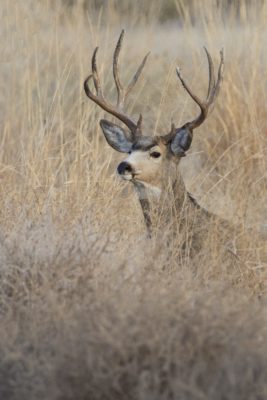
Mule deer photo by David Bogener.
He is moving from my right, a beautiful, forked horn mule deer. Elegantly confident, prancing into the clear, he looks up at me for what seems like minutes and is only a heartbeat. Our eyes meet for the last time in his life. His pace does not change as he exposes his side to me. I lift my rifle, focusing behind his left shoulder, holding my breath, and slowing my heart, aiming, to stop his. Gently moving only my index finger, the rifle sharply kicks my left shoulder as the quiet explodes. Quickly jacking in another shell as he falls, in slow motion, to earth.
Frozen, hypnotized by this powerful moment, then suddenly I’m running down the hill. This majestic animal that, only seconds before was wild and free, is dead. I release the hammer on my rifle, its job done. My ears ring in the silence as I fall to my knees sitting for some time stroking his side and unconsciously painting some of his warm blood on my left wrist. I was beginning to feel the impact of what has been done by me.
Animals are my teachers and friends, and I say goodbye to this teacher who has given his life. The men will be here soon. I pull a knife from my Levis. I cut this beautiful animal’s throat, letting his thick red blood flow into the dry sand. The spell is broken moments later when Dad appears on the bluff above. He is looking down from Skunk, his Pinto mare. Is it the light or is there a glow around him?
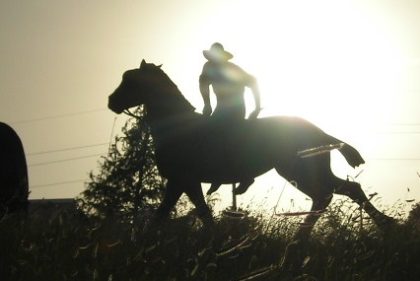
He dismounts, tying Skunk and Champ to nearby bushes, and descends the dusty hill as Carl rides down the gully. They had guided the deer to me. I feel their pride. They comment on my one shot and say the traditional, “nice buck.”
Dad begins to dress the deer. It seems we have been out all day. So much has happened, yet it is still morning. As I walk up the hill to Champ, I feel my connection with him deepen. Scratching his ears, again he rubs his head on my chest. Questioning the tears that spring to my eyes, I quickly wipe them away.
The dust sparkles in the sunlight as it follows Champ back down the slope. Carl and Dad talk quietly as they prepare the buck for our journey. I find the deer tags in my jacket and tie them to one forked horn.
Lifting the deer up onto the saddle, no one is concerned about the blood that will stain the seat for 50 years. Dad ties the head so it faces back and the horns will not poke Champ in the flank as he walks. He tells me, “Son, you and Champ take the deer back to the cabin, we are going to hunt a few more hours.”
This is easy to understand, and somehow, I like the idea of being alone. Everybody has great confidence in Champ’s ability to take me home. He will take good care of his closest friend. Dad reminds me of the two most dangerous places on the trail, telling me firmly to get off and walk behind Champ, holding his tail. I listen to his instructions, agreeing, wondering if he is worried.
We ride back to the trail and say, “See you later.” Carl and Dad turn west. Champ and I go east. Allowing the reins to hang loose, giving Champ “his head,” we begin the long walk home, confident my four-legged friend knows the way. My life is in his sure-footed hoofs for the next four hours. I’m with my thoughts. Riding along, I feel the power of this morning. I stop at stream crossings, so Champ can drink, and all the while I’m considering places, if lost, to build a fire, cook some venison, and sleep under that Indian saddle blanket with my 30-30 at my side.
Confident in Champ, the first few hours pass peacefully. We come to forks in the trail and my guide is decisive.
Dismounting as we traverse the first risky place in the journey my mood changes abruptly. I was stunned, stepping behind Champ, now face to face with what I had done. My eyes meet the black eyes of the buck, and for the next quarter mile, and the rest of my life, his gaze floats in front of me. I murdered this beautiful animal. For what? It is not for food. There’s a freezer full of beef at home. It is not to prove I can shoot. I am a good shot. Another tear wells up and gets wiped from my eye.
Animals are my teachers.
Again, these words come to me. They are my gift-givers. How could an incredible animal like this, be killed by me? What is the lesson? Sensing change since getting up, now it is more powerful. Remounting and stroking the deer’s thick coat, I thank him.
Getting off to walk the second dangerous section, once more the buck and I are eye to eye. The transformation continues as he watches from another world. Climbing behind my honored guest, something stirs deep inside me. The trail is familiar now. We made it.
I ride the last few miles that lead me from Billy to Bill, from child to young man. I open the same gate, and I go into the same corral, but I have changed. I sit taller in the saddle, feeling proud and sad at the same time.
Slim and Archie are there to help me hang up the deer under the pine trees that Billy woke under what now seems a lifetime ago. After thanking Champion, giving him some extra grain and alfalfa, I go back to lie in the pickup watching pines sway in the breeze until I fall asleep. Hours later I’m awakened by horses’ hoofs as Dad and Carl return, deerless.
Dad says, “Bill, good, you’re here.” There is rare emotion in his voice as he turns to ride to the corral.
Tonight there’s celebration with more grain for Champ and the men salute “Bill” with their distilled grains. I have my first shot of whiskey.
Leaving the men telling stories in the lantern’s light, I go to bed and reverse the morning’s ritual. I wet another M on the pine, I jump up on the tailgate to remove my boots and clothes. I crawl into the pickup bed and set my Stetson aside as my head hits the pillow. My fingers find the crusty dried blood on my wrist and I wonder, who is Bill? Taking one last lazy look at the stars through the pines, my eyes slowly close to dream new dreams.
This is the last day I hunt a deer, and my first day seeking a deeper meaning in life.
Thirty-three years later, while reading a book by Robert Bly, this powerful day came to mind. He wrote how young men of the west have lost the ritual that takes them into puberty, their Rite of Passage. His work inspired these memories, which led me to write this story of my Ride of Passage. Reliving this story has filled me with gratitude. Dad, and the other cowmen, gave me such a gift that day. With these reminders, I committed to sharing with my father how important these experiences were.
After all these years, Carl, Slim and Archie had all died. My father’s health was poor since a cow had gotten him down, gored him and put him in the hospital earlier that year. There is urgency to tell him this realization, thinking it would lift his spirits. I was moved to drive 900 miles to see him and Mom on the ranch to tell of this reading, and the importance of my ‘Ride of Passage’ into manhood. Sitting beside him my first morning on the Mojo ranch, I reminded him of that powerful day so many years before in the Yolla Bolly Mountains.
He listened without comment until I was finished, solemnly nodding his understanding. His next comment shook me in my boots. “That was the worst day of my life.”
He evidently had argued with Carl about the decision.
“You were 12 years old and I let you go by yourself in the middle of a wilderness.” As he spoke, I recalled the emotion in his voice as he turned to ride back to the corral that night, his words distant, reminding me of the dream-like voices from the creek that morning. Only now I understood that he had been mad at himself. Again he said, “Should have never let you go alone. You could have been killed on those steep trails above Salt Creek.”
In fact, a 12-year-old girl and her horse lost their lives falling from that same trail to the rocks below 10 years after my solo journey. Each time we rode above the bleached bones of that horse, Dad’s decision must have haunted him.
In an attempt to explain my feelings, I said, “Dad, it was a turning point in my life. I did not die; it let me live more fully. It was your trust in Champ and me that gave me strength.”
Dad felt guilty, unable to come to terms with his decision in all those years. Yet, with the help of three other cowboys, he gave me the exact lesson that empowers the man in me this day. Despite our conversation at the time, I don’t believe Dad fully understood his gift or my gratitude.
In less than a year, Dad was gone. Having thanked him in meditation since his passing, he now understands.
It was writing this story that finally answered the long unanswered question of why my father never hunted anything, after that day.
Writing these last paragraphs, tears again fall from my eyes. This time, I do not wipe them away.
 Willy McCarty, 72, of Redding, is a notable character who has enjoyed an eclectic life, including stints as a commercial model for such products as Pepsi and Marlboro. A lifelong personal trainer, at his former gym in Sun Valley, Idaho, he trained such celebrities as Bette Midler,Cher and Brooke Shields, as well as baseball professional Don Mattingly. McCarty, who still boasts washboard abs, and cannot stand the concept of boot camp workouts, visits a Redding gym once a week where he has gained an enviable reputation for his “Easy Workouts With Willy” technique, popular among clients who want impressive results with little effort. Born in Los Angeles, as a child McCarty moved with his family to Widow Spring in Siskiyou County, and eventually settled on a 50-acre ranch on Churn Creek Bottom in Redding. He lives with his wife, Deborah McCarty, and a menagerie of many animals. For the final chapter of McCarty’s life, the couple will soon return to the old McCarty ranch on Churn Creek Bottom, coming full circle to the place where McCarty recalls some of his fondest memories, such as raising Shasta County’s prize champion bull in 1962. Although officially retired, McCarty is still available as a model for photo shoots.


