

An election year is a fun time where one is likely to hear “a lot of great one-liners,” Redding Vice Mayor Brent Weaver said Tuesday, but he cautioned that nobody should be chuckling over the notion of spending down the city’s General Fund reserves to pay for additional police.
Weaver’s comments were a less than subtle jab at fellow councilor Gary Cadd, who is seeking re-election and has taken to saying that the city’s rainy-day reserve fund should be tapped for more police “because it’s raining bad guys.”
Cadd and fellow candidate Adam McElvain have both suggested the reserve—currently at 9.6 percent, well above the 5 percent minimum prescribed by council policy—can be used to bolster public safety instead of increasing the city’s sales tax rate by a half-cent.
The tax rate hike (Measure D) and a nonbinding advisory measure directing that the tax proceeds be spent on new police officer positions, increased jail space and mental health services (Measure E) will both be on the Nov. 8 ballot, as well as the four candidates for two council seats. Joining Cadd and McElvain are Julie Winter and Lea Tate, who have both expressed support for the two measures.
Mayor Missy McArthur asked that the General Fund reserve be addressed at Tuesday’s City Council meeting. She said she’s had constituents ask why the tax hike is needed if an ample reserve is available. “We have to have a transparent discussion about that and why we aren’t spending that money,” McArthur said.
City Manager Kurt Starman said the General Fund reserve, currently projected to be about $7 million when the fiscal year ends next June, is essentially off-limits based on a longstanding city policy of not spending one-time monies on ongoing expenses like personnel costs.
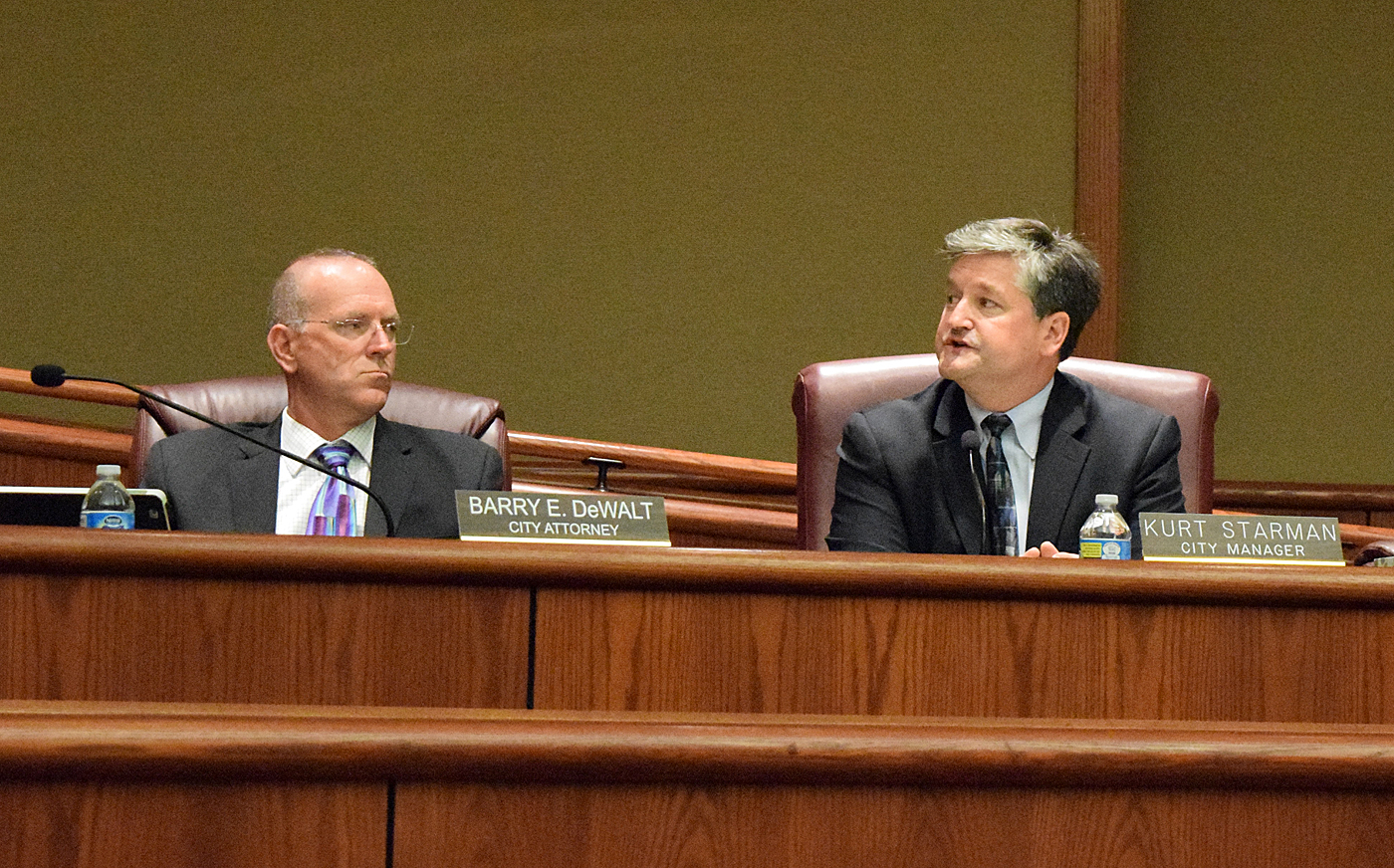
City Attorney Barry DeWalt, left, listens as City Manager Kurt Starman discusses the reserve fund.
The city did make some well-documented exceptions in an effort to address the community’s growing exasperation with property crimes and vagrancy. Most notably, Starman said the council dipped into the reserves to temporarily retain four police officers and nine firefighters whose positions had been funded by grants, and it beefed up the city’s code enforcement unit by re-hiring some retired inspectors.
“I think it’s safe to say we got an excellent return on that investment,” Starman said. However, continuing to raid the reserve fund to cover additional personnel costs “would deplete our reserves within a matter of months, and even go into the red.”
Just retaining the four police officers who make up the well-received Neighborhood Policing Unit “would take us below 5 percent in short order,” Starman said, let alone spending the $10 to $11 million a year that’s envisioned in the Blueprint for Public Safety. (If Measure D is successful, it is expected to generate $11 million a year during its 10-year lifespan.)
Increased pension costs and other factors are expected to reduce the General Fund reserve to 5 percent by the end of the 2021 fiscal year, Starman noted.
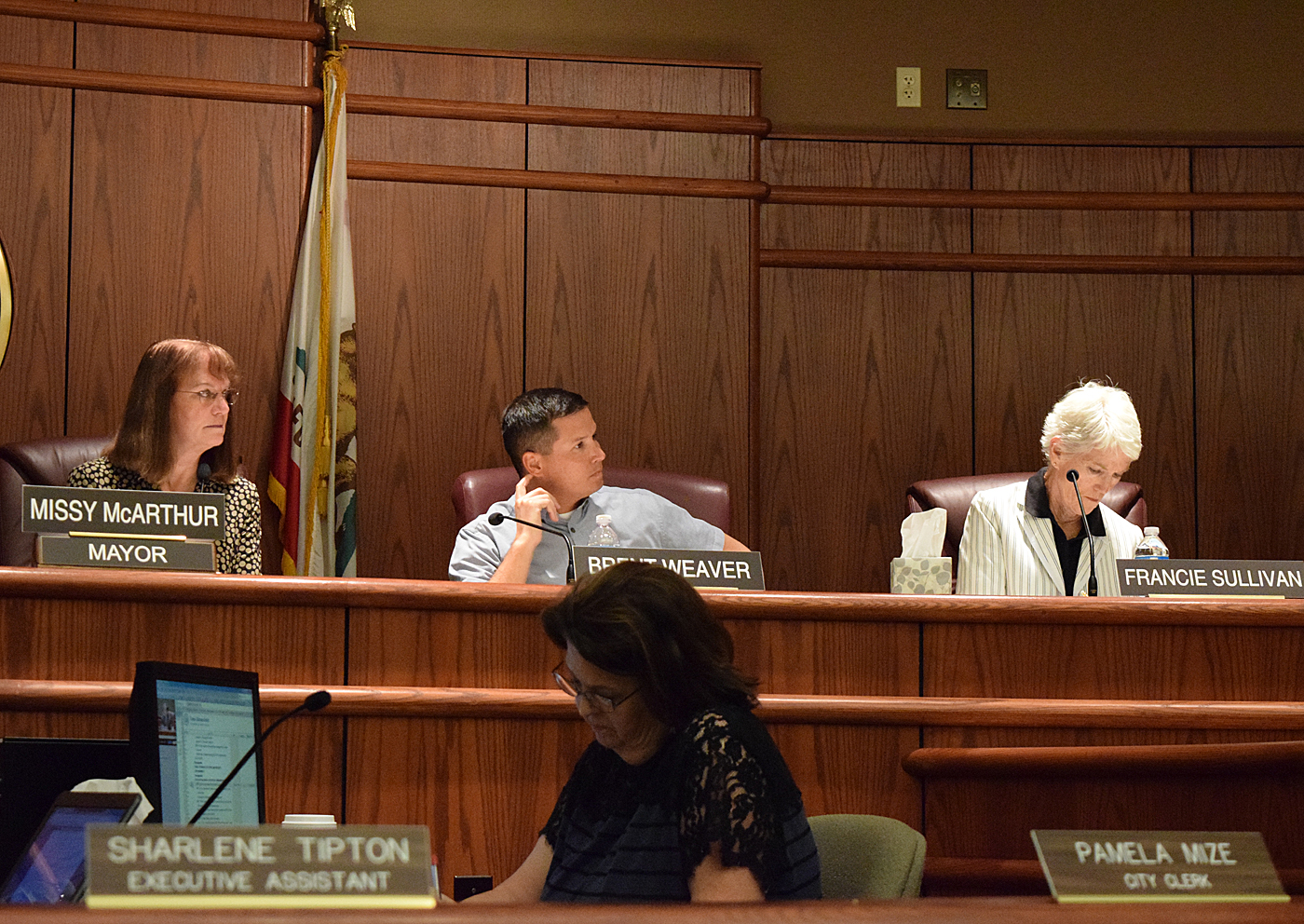
Mayor Missy McArthur, left, Vice Mayor Brent Weaver and Councilwoman Francie Sullivan.
Cadd wasn’t convinced, complaining that the city could have used the reserve fund, as well as money in a risk management fund, some 18 to 24 months ago to begin addressing the city’s crime issues. “There would be plenty we could have done already,” Cadd said, adding that “the city can find money when it wants.”
Weaver, a business owner and developer, said his background has taught him that “cash is king—you have to have enough on hand to keep the wheels moving.” Weaver advocated prudence over campaign slogans, noting “at the end of the day, we’re managing a complex budget for 90,000 constituents … it troubles me to hear that we haven’t done anything in the last year and a half. We’ve done a lot of great things.”
Councilwoman Kristen Schreder said she campaigned on the idea of not spending one-time funds on personnel costs but reversed herself once she was seated on the council. She said she has no regrets over retaining the police and firefighter positions, “but going forward I don’t support using one-time money for ongoing costs.”
Water, garbage and sewer rate hikes
In other action Tuesday, the council voted unanimously to set a public hearing on Nov. 15 to consider a series of rate hikes for water, wastewater and solid waste utilities. As explained by Public Works Director Brian Crane, a typical household currently paying $103.43 a month would see an $11.22 increase in December, followed by hikes of $4.49 in July of 2017 and $4.70 in July of 2018.
Ratepayers who opt to use smaller, 45-gallon garbage cans would pay $21.49 a month for garbage pickup, while those 64-gallon carts would pay $22.46 and those using the current 96-gallon size carts would pay $24.04. The smaller carts are intended to encourage more recycling, Crane said.
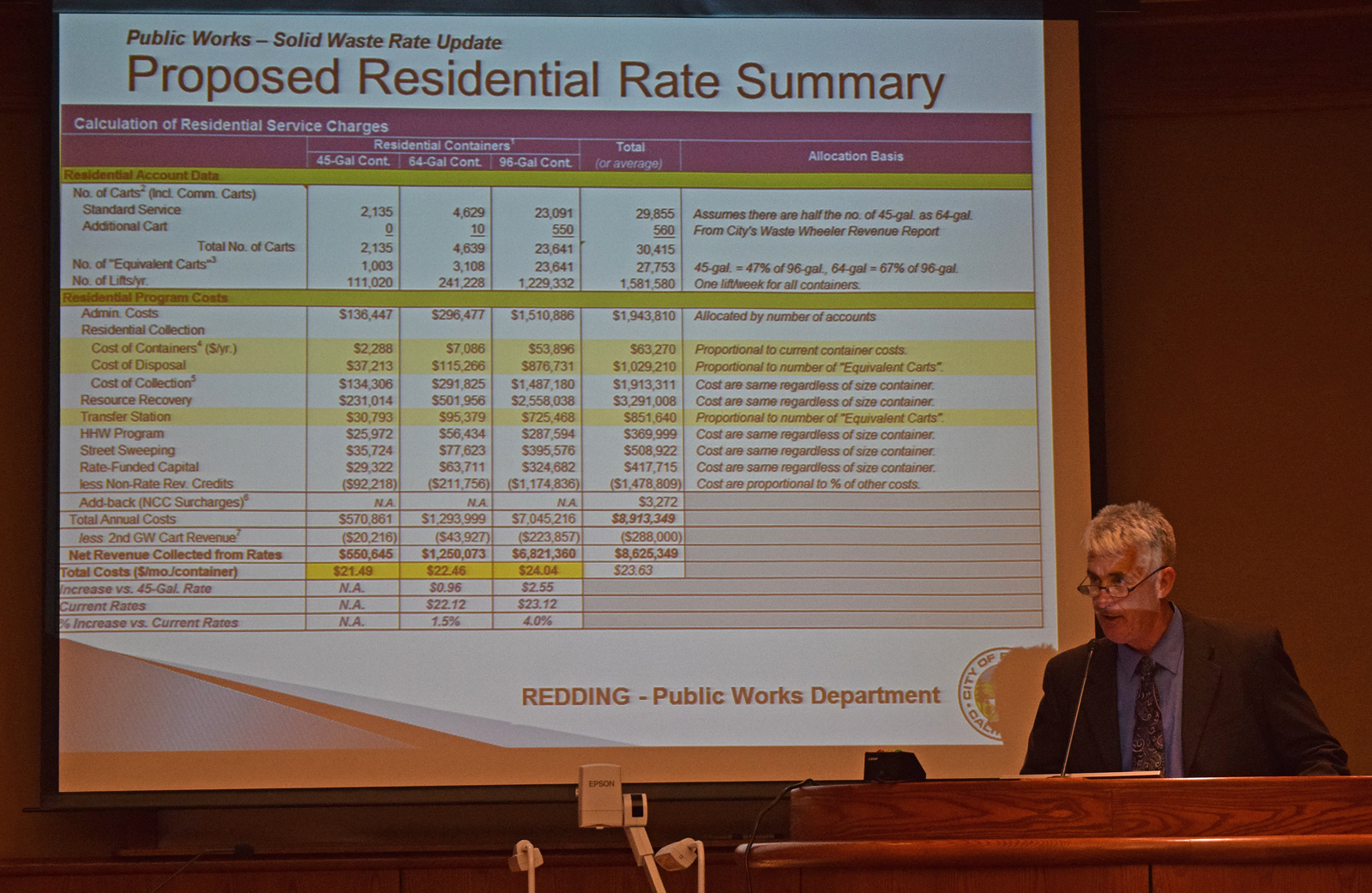
Public Works Director Brian Crane outlines proposed utility rate increases.
The utility rate hikes are needed to adjust for inflation and cover the costs of an assortment of improvements and repairs to the city’s water treatment, wastewater treatment and solid waste collection equipment and facilities, Crane said.
Ratepayers will be receiving protest ballots in the mail during the next month. If ratepayers from a majority of the registered properties sign and return the protest ballots, the council will be prohibited from enacting the rate increases under terms of Proposition 218.
For more information, visit www.reddingutilities.com
Photos by Jon Lewis.


