
What’s the definition of a homeless person? How many are there? How can an individual or agency deliver services to somebody who doesn’t want them? Does helping simply exacerbate the problem?

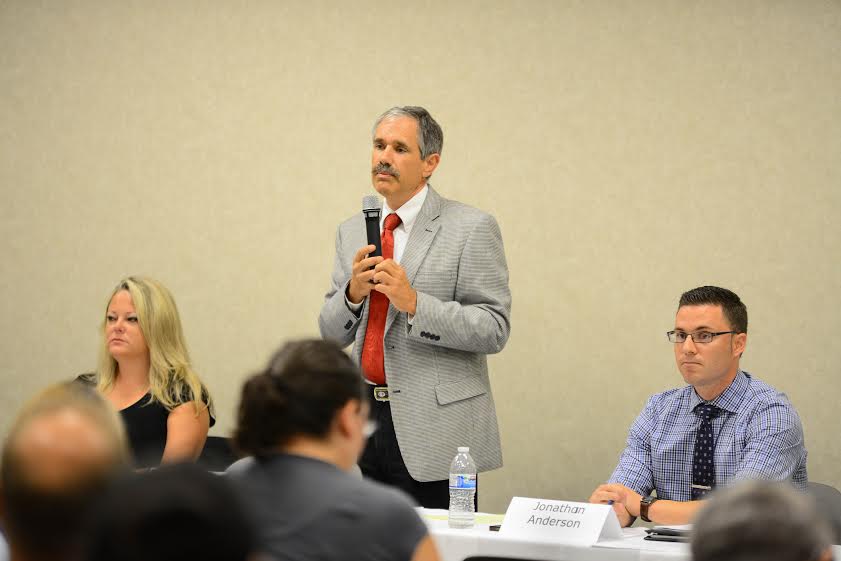
Those were some of the questions asked this week at “Homeless: A Plan of Action,” a forum organized by Kristen Schreder that brought together experts and community members to answer those questions, discuss issues tied to Shasta County’s homeless population and look for solutions.

Jessica Delaney, coordinator of the Redding/Shasta County Homeless Continuum of Care Council, said she was pleased at the turnout Tuesday at the Redding Library’s Community Room. “I’m excited to see the passion and people talking. Talking turns into money and money turns into programs,” Delaney said.
The Continuum of Care Council is a group of service providers, government agencies, faith-based organizations and community members that works on homeless issues. In her introductory remarks, Delaney said there’s more to homelessness than what meets the eye.
Delaney said one of the big challenges is connecting homeless people with what resources are available. Panelists agreed that coordinating services across government agencies and nonprofit organizations remains a hurdle.
The definition of a homeless person is mercurial and depends on which local, state or federal agency is doing the defining, Delaney said. In general, she said it includes somebody without a permanent home, somebody who will lose that permanent home within two weeks, people living in hotels and people couch surfing at the homes of friends or family.
“The local data is interesting. There’s been a little increase (in homelessness) but not a huge increase, but there’s been a huge hit to our local resources, mostly with drug and alcohol services and next it’s going to be mental health,” Delaney said.
Delaney said there are currently 3,527 homeless people in Shasta County, including 787 children under the age of 18.
She said visits to homeless encampments in Redding, conducted by outreach teams composed of herself, Redding police, social service and mental health workers, indicated that 64 percent of those contacted self-disclosed alcohol, drug and/or mental health issues as factors in their homelessness.
Donnell Ewert, director of Shasta County Health and Human Services, said many in the county’s homeless population report a history of trauma (abuse, neglect, drug abuse, etc.) that, in turn, leads to changes in brain function. These impaired individuals drop out of school, which diminishes employment prospects and segues into criminal behavior.
Now sporting arrest records, they have even less chance for employment “and they end up in a tent, self-medicating,” Ewert said. “Certainly, not all fit into that category,” he said, adding that a surprising number of homeless people are victims of crimes.
Ewert said services provided by his agency include drug and alcohol treatment, mental health services and public assistance in the form of food stamps, welfare and job training.
Jonathan Anderson, the new executive director of the Good News Rescue Mission, said his faith-based operation—Shasta County’s only homeless shelter—provides a full-time counseling center, a residential drug and alcohol addiction recovery program and classroom teaching.
At its core, Anderson said the mission staff seeks to identify the root causes that prevent clients from being responsible and productive citizens. “Once identified, we have programs in place to deal with those root issues,” he said.
Services at the mission include free meals, showers, laundry, a clothes exchange and chiropractic, dental and medical services. Drugs and alcohol are prohibited. Mission guests who decline to participate in any programs are subject to a 30-day-in, 30-day-out policy, Anderson said.

From the law enforcement perspective, Redding Police Chief Robert Paoletti said he’s identified three groups within the homeless population: those who will accept help, those who won’t and those who can’t.
“We’re trying to get Social Services out front on this. Frankly, I don’t want to be the homeless chief. If they commit a crime, I’ll deal with it,” said Paoletti, adding that he’s been encouraged by results from a “more holistic” and softer style of enforcement led by Officer Teddy Snyder.
Cleaning up illegal encampments is a daunting job, the chief said. In 2013, his officers removed 137,000 pounds of garbage just from camps on public lands. Clearing camps on private property, like the Linden Canyon just south of Mercy Medical Center, is such a monumental headache that Paoletti said he had to tell his officers to stop.
 Jon Lewis is a freelance writer living in Redding. He has more than 30 years experience writing for newspapers and magazines. Contact him at jonpaullewis@gmail.com.


