

Injured Women After Reform (iWAR), is a statewide group, led by women lawyers and the injured women they represent. We are working to raise funds and educate both the public and politicians about the current crises in the state’s workers’ compensation system.
We’ve seen the effects that lack of prompt and effective medical care, and inadequate disability benefits, have had on those injured while working, and on their families.
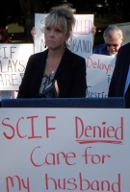
Desi Baker of Chico is an iWar leader who shares the story of her husband, Joe Baker.
Joe was a welder and a machinist. For several decades, he lifted and worked with heavy steel. In 2003, two discs in his back wore out. The insurance company denied responsibility. Treatment was delayed, pain medications were denied. For five years, the pain was constant. Joe became very depressed. He could barely sleep. He could no longer provide for his family. No anti-depressants were approved for his depression. The insurance company also denied Joe’s pain medication and Joe could not live with the pain anymore.
In 2008, Joe shot himself in despair. His widow Desi Baker has enrolled in law school, to be Joe’s voice in seeking a return to fairness and justice in the workers’ compensation system.
Sadly, since the overhaul of workers’ compensation in California, many injured workers suffer repeated delays and denials of medical care, as Joe did.
How does this happen? We are a people who value and care for our workers and their families. Our Constitution requires a workers’ compensation system that provides effective medical care. But the 2003-2004 reforms have failed the seriously injured among us. Change is badly needed to speed up the provision of reasonable and necessary medical care. Here in northern California, many doctors refuse to accept workers’ compensation patients because the doctors find the system too difficult.
Injured workers are turning to group health policies, social security, state disability and other public providers – because they can’t get adequate and prompt medical care through the work comp system. Delayed care causes more time off work, increasing the economic costs for both the injured employee and the employer.
In some cases, insurance companies have spent more money on denying or limiting medical treatment than on the cost of the treatment or medication that they deny.
Another consequence of the 2004 workers’ compensation overhaul is a systemic problem in the revised “apportionment” law, which allows reduction of a worker’s permanent disability award on account of gender-linked medical conditions that are more common to women than men, even when the condition (such as osteoporosis) has no effect on the woman’s ability to do her job. Injured Women After Reform (iWAR) focuses on the elimination of gender bias and other bias in the determination of permanent disability awards.
iWar is working to raise funds to elect a Democratic governor in 2010 who will address these problems. California’s legislators are sharply divided along party lines on workers’ compensation issues. Republican legislators who are aware of the current crisis have not supported the needed changes. Many Democratic legislators claim they will support needed change, but they want to protect the employers as well.
iWAR believes that solutions can be implemented that are fair for both employers and employees, as long as insurance companies and claims administrators are required to act fairly to their policyholders (the employers), and to adjust claims fairly and competently for the injured workers.

Marguerite Sweeney is a workers’ compensation attorney from Redding.
Desi Baker is a widow from Chico.


