

And now – German traffic! It’s all about staying awake – every split second!
If you haven’t experienced driving on a highway at 70 mph, and seeing headlights in the far distance behind you, suddenly flash by at 120 mph, you’ve never been in an auto race. It’s illegal now to drive that fast or to flash headlights, but on the open road away from peering eyes, 120 mph (190 km/h) is not unusual. There is no low speed limit, either. So it is quite common to be surrounded by a huddle of cars and trucks going anywhere between 50 and 100 mph.
See what I mean about staying awake? Autobahn “philosophy” quickly teaches something that has never caught on in the U.S., namely, “Never Dawdle in The Fast Lane.” There simply isn’t time for a 100 mph vehicle to slow down fast enough to avoid hitting you.
Incidentally, there is still a slight social rift between Eastern and Western Europe. Often when a tiny ancient little gray car is seen valiantly plodding along at 50 mph (80 km/h) on a 120 km/h autobahn, the derogatory comment often is: “They’re from the “East”.
But a present-day trip to the “East” will soon dispel the general myth. Observe the magnificent restorations such as that of the Frauwenkirche (Church of Our Lady) in Dresden or the restored old as well as the new museums of “East” Berlin. The Frauwenkirche was so badly destroyed the only original building stones that could be reused show up now as small dark squares, alongside the newly cut white.
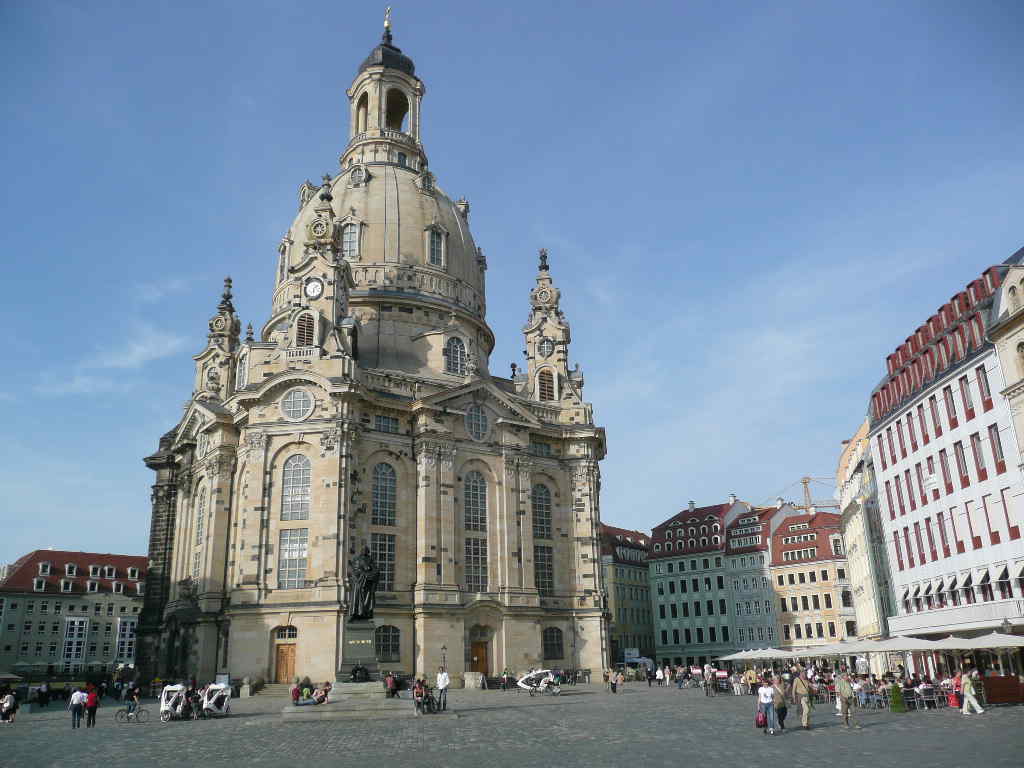
But going back to life-on-the-autobahn; it’s child’s play compared to driving in cities like Berlin or Hamburg. Here you have not only the other cars to contend with, but bicycles, bicycle lanes, pedestrians, street cars and street car lanes, street signs that change names multiple times, trucks, buses and bus lanes, speed traps that take a flash photo of you and your car and your license plate – directly connected to the local police station. Expect a letter in the mail in about a week. And fines are the usual German high-quality, too. Failing to put your turn signal on is about $300.
Here is another of those unwritten German laws – you better be as good a driver as they expect themselves to be. You better know where you’re going, and get there the fastest way. You must be able to squeeze between parked trucks, little old ladies with shopping bags, a thousand bicycles and hordes of pedestrians at what feels like 50 mph. One false move by anyone, and there’s a disaster. And you don’t want disasters, especially on a vacation trip. The involvement with police, magistrates, offended people, fines, paper work – can be horrendous. But a day spent successfully navigating these traffic obstacles can leave one with a feeling of elation and fulfillment at the end of the day: “I did it again.” Especially so, being an out-of-towner.
Near the end of our trip I was asked who had driven for us. My response was met with looks of surprise and admiration.
Just this week, we received a call from one of our friends in Hamburg who casually mentioned it was a “no-auto” day. It seems this city of almost 4,000,000 announces occasionally that no autos are to be used this day. Some will appear, but the incentive to save fuel and quiet the city comes in the form of free bus and rail service anywhere in the city for these 24 hours. And here’s another thing worthy of mention: With few exceptions, young and old have only to walk a few short blocks from their homes to get on public transportation which links them to the entire world. Transit systems of buses, street cars, U-bans (underground railroads) and S-bans (Surface railroads), are and have been for a long time linked together not only geographically, but time-wise as well. For many people it is unnecessary to have an automobile in Germany’s cities except for an occasional special trip. Compare this to the buy-up and destruction of Los Angeles’ comparable public transportation network in the 1940s-50s by our automobile and tire manufacturers, Goodyear, Firestone, GM, etc.
I’d like to say more about quality and humility. What does it mean that every hotel we were in employed pleasant, alert, genuinely friendly, well-groomed and well-trained and well-dressed personnel?
To me it meant jobs were hard to get, and one had to be exceptionally good to get and to keep one. Surprising it was to find older mature men and women doing menial tasks, and charming, well-mannered young people, too. It wasn’t menial to them – or didn’t appear to be. Each person did the best they could, and apparently without any visible feeling of regret.
How to explain this, I don’t know. Is it due to the national practice of separating people at early age into those who will go into the trades, and those who will go to higher education? There seems to be this division of labor among the population that is respected and expected. After all, anyone who does his or her job well is an asset to their society and to themselves.
Again, this characteristic of German quality is encountered every where. Another example is public rest rooms. There is always a man or a woman attending them. They stay there all day long, cleaning up, replenishing needed goods, some in chatty groups working together. It can be a pleasant experience to go into a public toilet. Someone is always there – to see or to speak to. The place is clean and clean smelling. And the expected small tip is small indeed for what you get.
Air and water
First, air. Living in the dry air of Redding, California, we enjoy but also suffer from its low humidity. Wet towels will dry crisp in half a day. Temperatures of over 100 degrees do not feel all that uncomfortable at 15 percent humidity.
I remember 90 degrees in St. Petersburg Florida at 100 percent humidity striking my body. It felt like being hit with an invisible physical force. I decided never to live there.
In Redding, wooden items, like hammer and rake handles shrink in this hot, dry environment, requiring constant tightening, especially if brought in from say, the San Francisco Bay area. The wooden sliding weight-adjuster on the pendulum of my German cuckoo clock shrank and suddenly slide down one day, changing the time dramatically. Pianos need tuning when moving into the area. And skin can feel very dry in Redding, and hair misbehaves.
This is why in Germany we were suddenly reminded after a few days of this big difference. Hair felt soft and manageable, and skin felt more comfortable. Towels stayed limp longer.
On the subject of Hamburg air and daylight in June-July, the sky lights up at 3 a.m, awakening a light sleeper. And it stays bright up to 11 at night. This effects eating habits. We often ate dinner at 9 or 10 at night. And with so few dark hours, somehow five or six hours of sleep was enough.
Now, moving onto water. At least in northern Germany, it is everywhere: lakes, rivers, harbors, rain, boats, ships – everything related to an abundance of water exists there. To my surprise there is a Venice-like canal system throughout Hamburg in which one can catch water taxis all over town. I don’t know the combined length of the canals but I would guess it to be well over 30 miles. Quite pleasant and quiet, away from all the traffic.
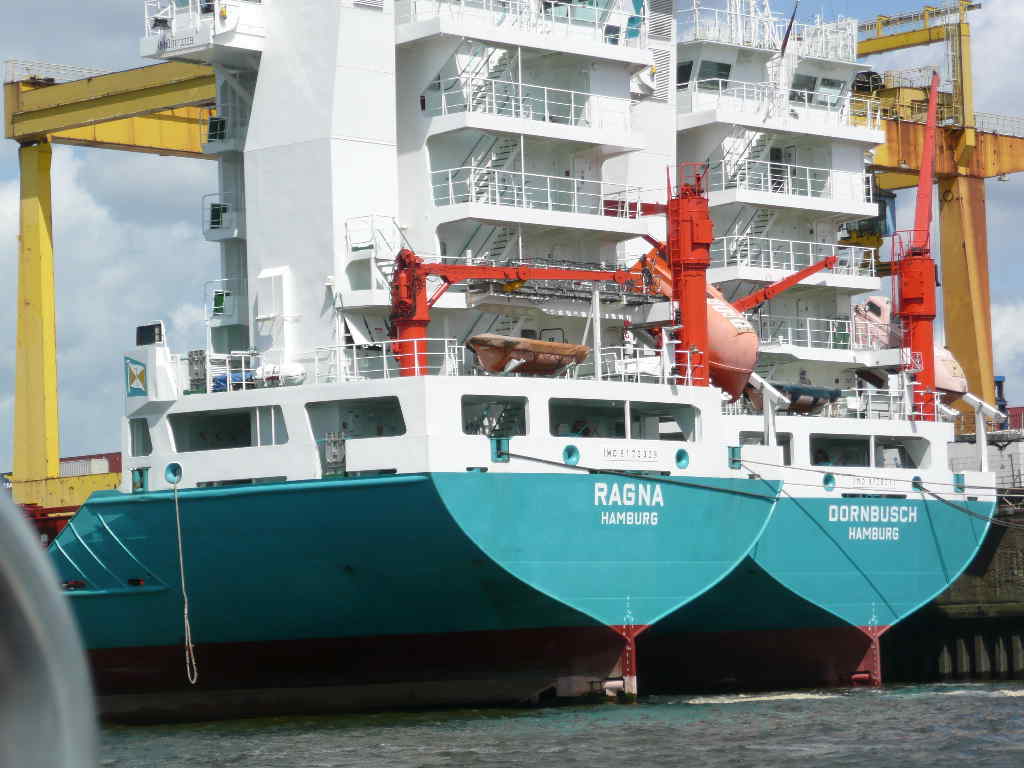
Hamburg Hafen (Port) is one of the largest in the world. Because of this it received some of the most intense bombing in WW II, destroying not only the piers and berths and ships, but the city itself. One of the most enjoyable tours one can take is on one of the many small craft that ply the waters of the harbor. We did this first in 1950, and again on this trip. It never ceases to amaze – to rumble up alongside a huge tanker or container ship that towers thirty stories above our heads. And like an iceberg, if that high above water, how far beneath.
Our harbor tour this time took us to Ballinstadt Island, which is the equivalent of, but opposite to our Ellis Island. It is one of two major places where Europe’s emigrants gathered to find ships to America.
It’s an interesting story. I don’t know what started the mass emigration, but the first few to travel to this small island-port to book passage had to wait a relatively short time to catch their ship. But when word got out and families began to arrive by the thousands, there were insufficient ships to take them, so unexpectedly these thousands found themselves packed together, stuck on this island, in need of food, medical care, sleeping quarters, finances etc, for months. No one had told them. It got ugly, until a shipping business man, Herr Ballin, realized an opportunity to provide humanitarian aid and benefit financially as well. He began by erecting tents, charging a small fee for “room and board” and medical service, and eventually built three architecturally impressive fine brick buildings to house, feed, and process these masses of people, carrying whatever worldly possessions they could bear.
It worked, but not without continued suffering, especially aboard the crowded ships that carried them for weeks across the Atlantic. My own family from Yugoslavia (Austria-Hungary then) was among these, although they departed not from Hamburg but from Bremen, aboard a vessel named the Travemunda, an ancient steamer on its last voyage. The sea broke in to my family’s sleeping area in steerage, and began to flood the ship. The torrent was stopped well enough to reach an American port, but the ship went no further. My mother relates the story that panic was averted to a considerable degree by the spectacle of the children’s’ bright blue potty, riding merrily back and forth on the waves inside the “cabin”.
This entire Ballinstadt (“stadt” means city) facility is now a large museum consisting of the three fine red-brick buildings, with photos, movies and artifacts of the emigrants, together with a computer room devoted to visitors on which (again for a small fee) one can trace the records of their families. We found ours, since regardless of the port of embarkation, records have been assembled in all these ports, including Ellis Island. You can Google these on the Internet. In doing so I found some differences in the records between one port and another.
But finishing up on the discussion of water, I must mention that if you go into a German restaurant and order “water”, you will be served a bottle of fizzy mineral water. You can be more specific and order “Wasser Mit gahs”, or “Ohne (no) Gahs” (also known as “Stille Wasser”) and get fizz-free water – but it will still be mineral water and still in a bottle. I was told that restaurants do not want to risk liability by serving water from the tap.
I was also told Germany’s public water supplies are now treated well enough that you can drink safely from the tap. Many do in their homes. But now that I’ve experienced what is also called “Spritz Wasser” (“wasser mit gahs”), I keep a bottle in the frig on hot days. Having been to India and having had to refuse ice cubes because you don’t know what kind of water was used to make the cubes leads me to wonder where Germans get their ice cubes.
Now to finish up with the subject of air. It was encouraging to drive through the German countryside and see so many wind farms high on surrounding hills. Their use of alternative energy is far ahead of ours. And again – on the subject of “visual quality” – these groupings of slow-turning propellers are not offensive since they appear in small gatherings and seem to blend in rather than defile the landscape. I don’t know if the aesthetics of these installations is designed intentionally, or if it simply happens that the rolling hills don’t accommodate large numbers of “windmills”.
But compared to the thousands that fill the view in places like the valleys just west of Palm Springs, CA, German wind power is an enhancement to the eyes rather than an offence. I didn’t see any solar arrays on our trip, but I understand Germany is leading the world in that practice as well.
In closing, I’d like to mention the stories I didn’t include here. One was about the young conductors’ examination, totally unplanned – we just happened to run across a poster in the town of Quidlenburg and slowly migrated to a little two-story music school in the evening, in a wooded area of town. Here a small but unique version of a fine symphony orchestra had been assembled at the disposal of five new conductor graduates. What they did, how they did it, and how the orchestra performed was one of the most memorable events of our trip.
And by the way, a few hundred years ago this beautiful little town of Quidlenburg was the center of the entire Holy Roman Empire for a little over a year when the Pope had to relocate his offices (for whatever reason I don’t recall).
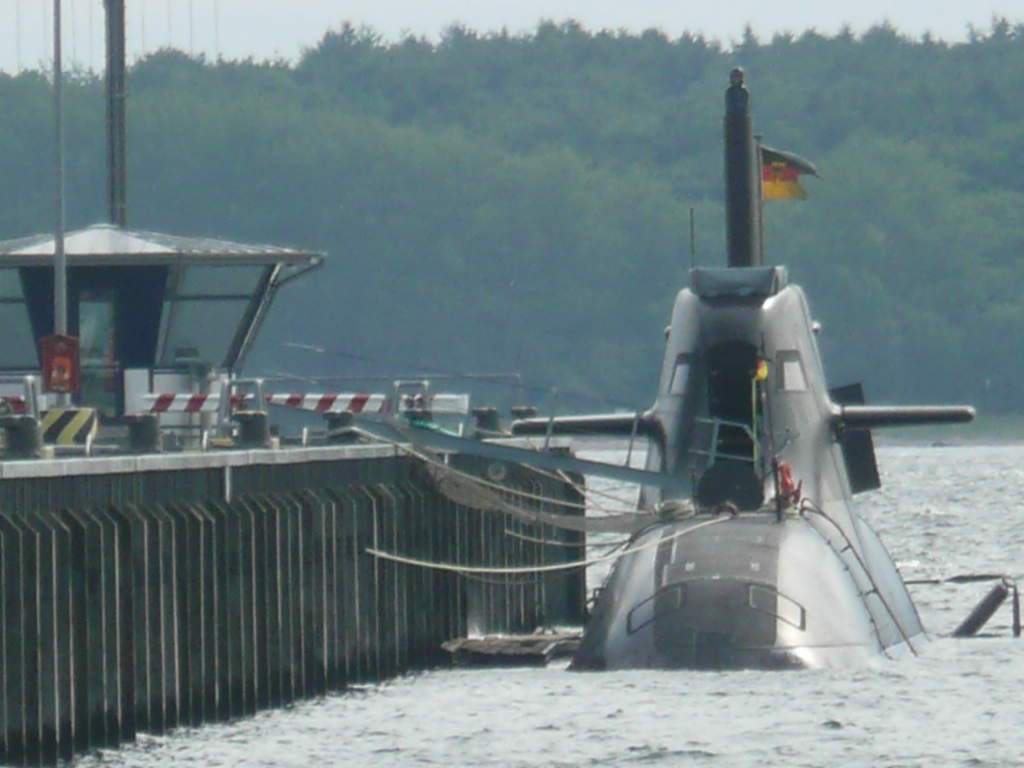
Another story was an earlier visit to the German WW II submarine base in Kiel.
If you can imagine living (under water) with other humans in an eight-foot diameter tube whose surrounding walls are only gray metal, gages, colored pipes, wires, dials, handles, wheels, buttons, and high intensity explosives – that’s what it was like to climb down into one of these. And on the shore was a submarine museum – a large round building whose interior walls were covered with small sketches of all the thousands German subs lost in WW II – together with the names of the crews and dates of loss.
I ‘ve never been hit with the realization of the horror of war like I was there. Here in this room was the reminder of the finest, most intelligent, young, vital men on earth – of all nations – engaging their intellects, their expertise, all their manly drive and energies toward one goal – that of killing each other.
My God, what a waste!
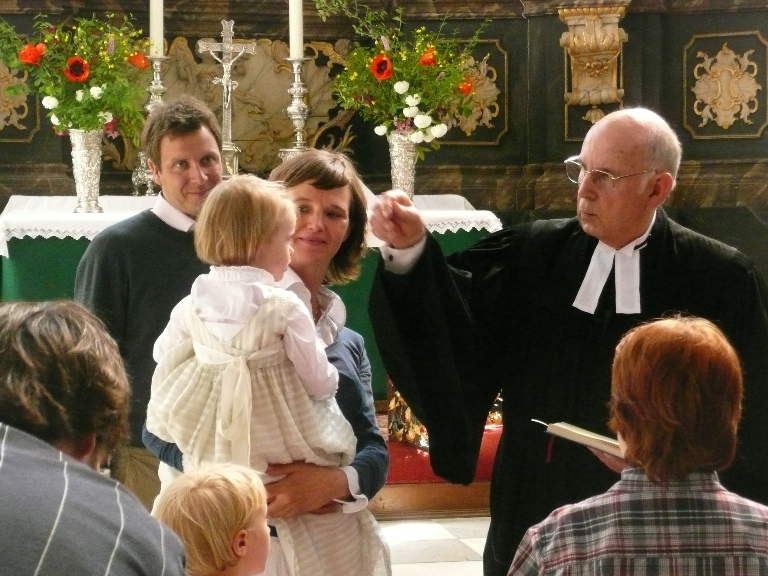
The other non-story was about the christening of 3-year-old Rebecca – a bright young “lady” from Berlin – a grand niece, in an unusually beautiful, centuries-old nunnery that totally escaped the destruction of WW II. It is a true gem, as was the ceremony in “Kloster Preetz” (The Cloister in the town of Preetz). If you read German, look it up on Google.
Finally, if it sounds as though I have exaggerated with too eloquent a description of what we experienced in Germany, I can only say this is what I saw. And the best way to check up on my credibility is simply to go see for yourself.
Incidentally, in these difficult financial times we received half-price fares on air travel as well as in some four-star and five-star hotels.
For all these reasons, we thoroughly enjoyed our trip to Germany in 2009.
 Robert Rock moved to Redding from Santa Rosa in 2000, soon found the local Writers Forum, and became its President for four years. Was a former Technical Writer for McDonnell Aircraft Corp., published environmental engineering articles as a professional engineer, public interest articles for newspapers and periodicals, and a book of short stories which covers the 1920s to 2001, including WW II. Is presently secretary of the local Chapter of the Military Officers Association of America (MOAA), and assists students at the Good News Rescue Mission in earning their GEDs.


