
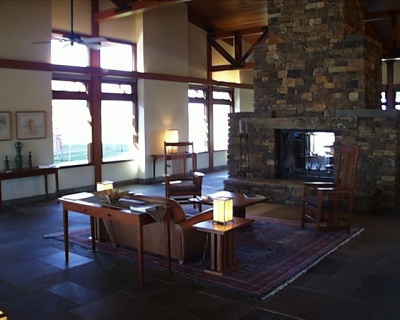
Q&A with Sue Ralston of the foundation…
Q: I have so many questions about the McConnell Foundation hosting the May 9 ArtHop reception, but first, for those who’ve never been to the Foundation, can you give a brief description about it?
For those who wonder what the McConnell Foundation is, we are a philanthropic organization.
For those who are still wondering what we do, that means we make grants to non-profits. We’re a broad-based funder and over the years we’ve done some major funding in the areas of education, including college scholarships and sending high-schoolers to Yosemite each spring; the environment, including extensive efforts to secure open space and build trails; the arts, such as funding the Sundial Bridge and helping with the restoration of the Cascade Theatre; funding Turtle Bay, and much more.
One key thing we’d like people to be aware of as we open our building up is that Leah McConnell, before she passed away in 1995, quite intentionally set up funding from her personal resources, separate from the Foundation’s assets, for the building and all of its contents, including the furnishings and art work.
Q: McConnell Foundation will host the May 9 ArtHop reception, which is quite generous. What’s the basic information the public should know about the evening?
We’re just one of the many stops of the evening. We’ll be open during the regular ArtHop hours of 6 – 9 pm. Our address is 800 Shasta View Drive. Maps are available on our website and in the May issue of Enjoy. People should look for signs and park where directed.
Q: The McConnell Foundation building is an art piece in itself, but its interior objects have been just as tastefully and carefully chosen. What’s the process for a piece of artwork to find its way into the McConnell collection?
As the building was being completed in 1997, individual pieces such as blown glass, ceramics, turned wood bowls, and sculptures were chosen informally by a few staff members. Separately, we have many art objects, ceramic vases, and treasured mementos we inherited from both of the McConnells. We also have a collection on display of jewelry Leah McConnell owned, some of which she inherited from Carl’s family. The interesting thing is, anyone who personally knew Leah might be surprised to see all of these jewels. She owned them, she enjoyed them, but she didn’t often wear them in her later years. Carl McConnell owned a pawn shop in San Francisco and a few pieces made their way into Leah’s life through the pawn shop. They’re displayed in a custom-designed, lighted jewelry case made by Redding furniture artist Alice Porembski. The jewelry case, made of Honduran mahogany, is a beautiful piece and there’s an interesting back story to how Alice conceived and designed it. It’s too much to tell here, so if people are curious, they’ll just have to come out and learn about it.
About five years ago, an art committee was formed so that a more formal process could be put in place to acquire art. Three of our five directors formed the committee, met several times to discuss their values in relationship to acquiring and exhibiting art, and decided to work with a professional art consultant to help them define these values. The committee decided to purchase California landscapes, mostly by California artists, and viewed innumerable different paintings and other pieces. As a result, we have a beautiful collection of art by such artists as Dorothy Morgan and Jim McVicker.
Q: What’s behind McConnell’s interest in art?
When Leah McConnell was still alive, her wish was for the Foundation’s permanent headquarters to be a place of lasting beauty. The building was designed to integrate very organically with its pastoral setting, making extensive use of natural materials such as various kinds of wood and stone. To complement the building, we acquired objects of art that would be ideally showcased in this setting: wood, glass, and ceramics, primarily purchased from Northern California artists. In addition, we have installations of art screens and gates made by craftspeople specially commissioned to create these pieces. Our entrance gates, the gates to our guest house, two gates we have inside the building, and an art screen were all designed by Bryan Tedrick, who is from Glen Ellen (in Sonoma County) and refers to what he does as “architectural sculpture.” (Bryan Tedrick also designed and fabricated the “Dancer” sculpture in front of Old City Hall.) Of our other two art screens, one was designed by Elizabeth Devereaux of Chico, who specializes in architectural glass. Her installations are found in churches, public institutions, and commercial and residential buildings throughout the U.S. Her work, and the work of our other commissioned artists, is site-specific, designed to perfectly harmonize with the surroundings. Our other art screen is by Dick Weiss of Seattle. It’s a leaded glass screen that catches and reflects the light in different ways throughout the day. There’s a rather strange tidbit of a story that goes with this art glass screen, too, but people will just have to come out and find that out for themselves.
Q: Who selects the pieces for the collection? Is McConnell still in the acquiring mode?
As we talked about, our first objects of art were selected rather informally, but with a definite emphasis on work by California artists. After the very carefully thought-out process of acquiring the California landscapes, we’re not in a collecting mode right now.
Q: McConnell’s walking trails are open to the public all the time, but isn’t the McConnell ArtHop reception a fairly unique event? What was McConnell staff’s motivation to be part of ArtHop?
We really enjoy doing an open house now and then, and taking advantage of the growing momentum of this monthly event to promote the arts seemed like a perfect opportunity to allow people to come and look around. We won’t be participating in the ArtHop monthly, but probably will again sometime next year.
Q: Are there any must-see pieces we won’t want to miss?
I think all of our art is “must-see” – but people seem to find our gates and art screens really memorable. We also have a pre-1910 Asian embroidered textile that Carl McConnell’s parents had in their Chicago home in the early part of the 1900s. This piece depicting two peacocks was painstakingly restored in the late 1990s by the Textile Conservation Lab of the M.H. deYoung Museum in San Francisco after deteriorating because of exposure to light and dust. It’s quite beautiful.
Q: Anything else you’d like ArtHoppers to know about the May 9 event at McConnell?
The opportunity to come in and enjoy the building and the art work probably won’t come around again for another year, so seize the day!
Websites for art screen artists:
Bryan Tedrick of Glen Ellen, CA: http://www.bryantedrick.com/general.html
Dick Weiss of Seattle: https://www.artfulhome.com/artist/4505.html
Elizabeth Devereaux of Chico: http://www.devglas.com/
Sue Ralston is The McConnell Foundation’s Communications Associate, which she says is a catch-all title that covers event-planning, keeping the Foundation’s external and internal website up, working on publications, and a lot of other fun stuff, like helping organize and welcome people to this ArtHop open house.
Photo provided by The McConnell Foundation


