

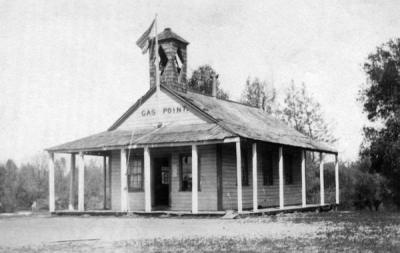
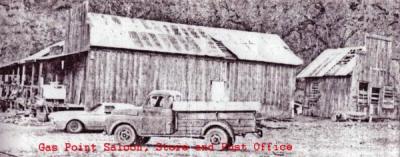
The historic town of Gas Point burned to the ground late Monday night on Lower Gas Point Road in north-west Cottonwood. During its prime in the mid-1800s, Gas Point was a booming, bustling place. Gold mining was big business.
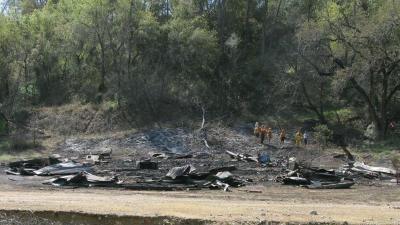
By Tuesday morning all that remained of Gas Point were ashes, small hunks, chunks and planks of charred metal and the surrounding giant oaks, some of which were felled because of smoldering upper branches.
It was one of those places Bruce and I liked to take our visiting city friends as an example of the Real Old West; the little town that time forgot.
Monday night, someone whose home has a ridge-top view of Gas Point saw flames and called 911. After that, phone calls spread like summer grass fire as the news traveled from neighbor to neighbor throughout this fairly remote, sparsely populated area of Shasta County.
Doug Barber, who lives down the road from Gas Point, said he got the call at about 11:30 p.m. The 63-year-old drove to Gas Point as fast as he could. It was too late.
“I thought when I went tearing out there that maybe I could help put the fire out,” Barber said.
“By the time I got there the outside walls were burning. No way could anyone save it. I’m really upset about it. I think somebody set it on purpose.”
Barber’s hunch – that the Gas Point fire was deliberate – is shared by a number of the area’s Igo/Cottonwood boundary residents, many of whom are still rattled by a suspicious tire fire last month about a mile from Gas Point.
Chic Miller, who owns and operates Bella Vista Farms on Lower Gas Point Road with her husband Bob, is one of those residents, as well as Barber’s neighbor.
The Miller’s animal sanctuary is near enough to Gas Point that Monday’s late-night blaze spooked one of the couple’s huge bulls so badly that the frightened animal trampled a fence.
Chic, who once enjoyed taking hayride guests past Gas Point as a site of local pride and interest, said she was “devastated” by the loss of such a beloved community gem. She also felt particularly angry about the senseless way in which the town was destroyed.
“Whether it was intentional or not, that fire had to be man-made,” she said. “That’s the only reasonable explanation. The fire was set in the middle of the buildings, and there was no fire near the road.”
Tuesday morning, Terry Stinson, battalion chief for Battalion 5, California Department of Forestry/Fire Protection and Shasta County Fire Department, supervised crews who mopped up lingering embers and downed smoldering trees.
Although Stinson said the Gas Point fire’s official cause was still “undetermined,” she said one possible cause had already been ruled out.
“There was no power to the buildings,” she said. “So that eliminates that.”
A few miles north on Lower Gas Point Road, Mike Morõn, a ranch caretaker who grows hay for the man who owns the destroyed Gas Point property, said he rushed to the fire around 12:20 a.m. after he got a neighbor’s call. Morõn, who declined to name the property’s owner, said he e-mailed news of the Gas Point fire to his boss, who lives elsewhere. As of late Tuesday morning, Morõn hadn’t received a reply from his employer.
“Gas Point is gone, and that’s pretty sad,” Morõn said. “In my opinion, it was probably arson. And if that’s true, that’s a malicious thing.”
For people like Dottie Smith, a Shasta County historian who often took her guided tours past the old Gas Point ghost town, it’s hard to believe Gas Point no longer exists.
“Historically, it’s absolutely heartbreaking,” she said Tuesday afternoon.
“It was one of my favorite places to tell about history. And I’d always read a poem written by a schoolteacher, Laura Moore, from 1920.”
Smith said she also liked to tell about Henrietta Leschinsky, a rich, spunky Gold Rush-era widow who used inheritance money after her first husband’s death to build Gas Point’s structures, most of which survived for nearly 100 years – until Monday’s fire.
Smith said Leschinsky later remarried, and outlived that second husband, Henry Heinz, which explains why Henrietta is buried in the nearby Pinckney Cemetery between both former husbands.
Smith said that the last she heard, the old Gas Point town acreage was owned by Mark McMahan, who lives outside the area.
While Smith said her guided historical tours didn’t venture onto the Gas Point property, her groups often stood outside the fence as Smith described Gas Point’s main buildings, which Smith guessed consisted of a saloon, a general merchandise store, a rooming house, a feed store and perhaps a post office.
“It was one heck of a booming place,” Smith said. “Up until about 10 years ago there was even a piano still inside. In fact, Marie Carr used to teach music there.”
I spoke with that very Marie Carr-Fitzgerald Tuesday afternoon when I called the Shasta Historical Society where she volunteers a few days a week. I told her about Gas Point.
Carr-Fitzgerald, 90, was shocked to hear what happened to the town that held so many fond memories for her nearly 60 years ago. Then, she worked as county traveling music teacher. That job took her to such tiny rural towns as Gas Point, Castella, Kennett, Copper City, Big Bend and Indian Springs, the latter of which required a 1-mile uphill hike to reach.
Regarding Gas Point, Carr-Fitzgerald recalled that when she taught there in 1950, the original schoolhouse was already long gone, so classes were held in what was once the general store/gas station.
“It wasn’t much of a town by then,” she said. “But what was there was treasured.”
Carr-Fitzgerald spoke highly of Laura Moore, a Gas Point teacher. She also recalled a “poorly furnished” building that had a few desks and some books for about 12 students, whose ages ranged from from nursery school to high school.
“They didn’t have any music or instruments to speak of,” she said. “But those children were like sponges. They just ate the music up, and the folk dancing, too. Even the big boys. Sometimes the dads and mothers would wander in and sit in class. It was a very casual setting. But a lot of learning went on.”
Meanwhile, there’s Barber, the man who spent part of his childhood in Gas Point during the late ’50s. Monday night turned to Tuesday morning as he watched his old town destroyed by fire, helpless to stop it.
For people like Barber, Gas Point’s rickety structures were more than a ghost town. It was his memory-keeper from a time when he was the only child there for many miles around. It was a rustic, but functional place with running water, a propane stove and lots of elderly folks who told funny stories. It was where little-boy Barber fashioned walnuts into imaginary figures that eventually landed in the creek.
In fact, if you look closely, you’ll notice some black walnut trees near Gas Point’s creekbed. The trees are just a few years younger than Barber.
“I get upset talking about,” he said.
“It’s a loss – you know? To me, it’s more than just an old place burning. And it’s more than the fact that I used to live there. It’s like all these old people’s memories are gone. My mom lived there. We had a lot of company. We had big picnics there. So many old-timers lived there. They’re all gone. Now, so is Gas Point.”
Click here to view slide show of Gas Point on Tuesday, after the fire.
Copyright Doni Greenberg, 2008.
Historical Gas Point photos courtesy of the Shasta Historical Society.
Current Gas Point photos by Bruce Greenberg.
Slideshow by Joseph Domke.
Circa 1920 poem, “History of Gas Point” by Laura Moore, courtesy of Dottie Smith, historian.
A history of Gas Point made for fun
That you may read as you run
Our products great and small
Which we wish to interest all
Gas Point was settled first by miners
And Forty-Niners
They met and spinned yarns at this joint
On account of, it was named Gas Point.
Much gold was mined here in early days
By sluicing, hydraulicizing, and many ways
Pioneers, Indians and Chinese worked
Times were good and no one tried to shirk.
Then an awful law was passed
Hydraulic mining must stop, alas
On the miners it had a bad effect
So they must go to farming.
They soon went to work on farming and grazing
What they produced was truly amazing
Now fruit, vegetables, alfalfa and grain
Grow very well when they have plenty of rain.
Cattle, hogs, and sheep so fine
Grow so fat they shine
Grow to perfection
In this wonderful Gas Point Section.
Now we have another boom in mining
Metal shining
Dredgers, doodle bugs and bucket lines
Are awashing gold out all the time
Stately pine and many kinds of oak
Make for us much wood and smoke
Pretty flowers of many kinds
Grow for us at different times.
To educate both rich and poor
A schoolhouse was built by subscription in 1864
So our present school building, you see
Is one of the oldest in Shasta County.
It was later moved to Crow Creek
A more central site to seek
Not being satisfied with that situation
It was moved to its present location.
Here it has been since 1892
Occupied by teachers quite a few
The pupils from here graduating
Into the third generation.
Our school colors are green and gold
Represent the mines of gold
Pastures of great clover green
Grow on our hills, as fine as can be seen.
We like this section very much
Because we can never find another such
For of it we will always boast
As long as the chick goes to roost.
Goodbye folks. Goodbye all
Old and young, large and small
Hoping you may see us sometime
In our Gas Point country fine.


