

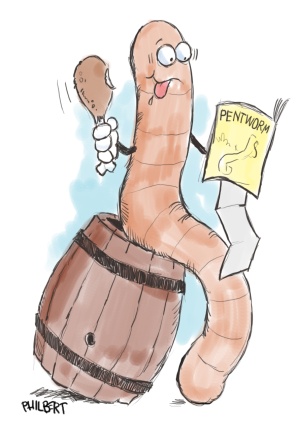
Good morning, Alice. Thank you for agreeing to answer a few questions. I’m completely fascinated by your worm barrel. In fact, you’re the only person I know with her very own worm barrel. Perhaps others have worm barrels, but they’re not saying. Let’s blow the lid off this worm barrel story, shall we?
Q: What is a worm barrel, and why should we want one?
A: In my case, it is a 30-gallon plastic garbage can. You should want one because it is the most practical way to recycle kitchen scraps (no meat) and you receive wonderful worm castings which make your veggies and other plants grow beautifully.
Q: How long have you had a worm barrel?
A: Probably five years.
Q: How did you make your worm barrel?
A: We followed directions that we found in a gardening magazine. You drill holes on the sides of the bottom 2/3 of the can. The holes are approximately 3/4-inches in diameter. The bottom 2/3 is then put into a hole (mine is in the vegetable garden.) You are essentially planting it. If you use a garbage can, and it is outside and raccoons are part of your life, be sure the can has a locking lid.
Q: You give and give and give. How long does it take before a worm barrel starts giving back?
A: Hmmm, not sure. I empty mine once a year. There is a technique for doing this whereby you empty the contents on a tarp or other smooth surface and build a pyramid shape out of the worm castings. This should be done on a sunny day. Throughout the day, you scrape off the outer layer and put the casting in a separate pail. The worms do not like light, so they continue to move toward the center and down. At the end of this process, you have a pile of worms which resembles raw ground beef. You return the worms to the barrel to a bed of shredded, moist newspaper, or other moist paper, and start feeding them again.
Q: I may never eat hamburger again.
A: Sorry.
Q: Wait, back up. Newspapers? That’s rich! Sorry, got sidetracked. Back on topic, will animals get into the worm barrel?
A: Yes, raccoons, if you don’t have a locking lid.
Q: Any cautionary worm-barrel tales?
A: Don’t overfeed the worms. If you notice the vegetable scraps getting moldy, slow down the feeding.
Q: Does the worm barrel give off an odor? Seems like it would get pretty stinky.
A: No odor.
Q: Any worm resources you’d recommend?
A: There is a book called “Worms Eat My Garbage” by Mary Appelhof that has everything you need to know about worm composting. She does not describe the garbage can container method in it, but shows other containers instead. Since our summers are so hot, I put a section of a 55-gallon drum around the top 1/3 of the barrel and covered it with two old cabinet doors to shade it.
Q: Any worm-barrel care tips we should know about?
A: Buy a small amount of red wrigglers for your barrel. The wonderful thing about worms is that their lives are spent eating and having sex. So a small number of worms will make a large number of worms rather quickly.
Q: A lifetime of just eating and having sex. Wow.
A: I know. Pretty amazing creatures, aren’t they?
Alice Wilkenson is a retired educator who lives, gardens and feeds worms in Happy Valley with her husband, Tom O’Mara.


