
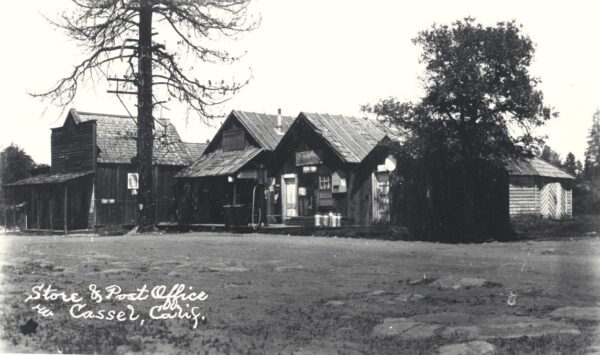
H. E. Williams General Merchandise and the Cassel Post Office, photographed in the early history of the Hat Creek Valley community. Williams was a prominent local merchant and postmaster. Courtesy of the Shasta Historical Society.
Along the cold waters of Hat Creek in northeastern Shasta County, the quiet community of Cassel occupies a landscape of open ranch country, volcanic terrain, and spring-fed waters. Today, the area is closely associated with Crystal Lake and Baum Lake, but during the late nineteenth century, its residents imagined something considerably larger. They called their settlement Cassel City and envisioned a growing town of farms, businesses, hotels, tourists, and, most importantly, a railroad.
The railroad never came, but Cassel endured. Its history became one of ranchers and merchants, schools and stagecoaches, dairying and tourism, volcanic disaster and hydroelectric development. What began as an ambitious frontier settlement gradually became the small Hat Creek Valley community known today.
Building Cassel City
By March 1888, Cassel City was showing the unmistakable signs of a growing settlement. Snow had disappeared from the level ground, farmers were plowing and planting, and new houses and improvements were appearing throughout the area. Covie’s sawmill was running from early morning until late in the evening and was reportedly struggling to keep up with the demand for lumber.
Businesses followed the settlers. Robert Cruse of Burney Valley purchased property and planned to establish a dry goods and grocery store, while two members of the Fagg family from Chico intended to open a saloon and billiard hall. William Eddy cleared land for vegetables, Louie Gibins cultivated his ranch, and attorney S. A. Landes built a residence and practiced law in the settlement.
J. W. Lippincott served as Cassel’s postmaster while also working as a carpenter. Construction was active enough that a local correspondent believed additional carpenters could find employment. William H. Brownlee owned the Baker toll road and offered town lots for sale, while Charles Brown operated a hotel before selling it to Brownlee and preparing to move to his farm. Another hotel was already nearing completion.
The surrounding country was also being promoted for its recreational possibilities. Hat Creek offered fishing, wildlife was abundant, and the mountain scenery attracted attention. One enthusiastic correspondent predicted that Cassel would eventually become headquarters for tourists and pleasure seekers visiting the region.
Waiting for the Railroad
Much of Cassel City’s optimism centered on the possibility of a railroad. Surveyors examined a route crossing Hatchet Creek Mountain by way of Carberry Pass and Little Tamarack before descending toward Burney Valley. The proposed line continued across the divide toward Cassel, passing approximately two hundred yards north of the town limits before following Hat Creek.
Residents understood what a railroad could mean. Agricultural land surrounded the settlement, timber resources lay within reach, and dairying and wheat production offered economic possibilities. One correspondent described railroads, public schools, and churches as important forces in the development of a community. The hopes of Cassel’s residents could be summarized in one simple declaration printed in the local newspaper: “All we want now is a railroad.” The railroad never arrived. Cassel City would not become the transportation center its promoters imagined, but the settlement continued developing without it.
A Community Takes Root
Families established homes, children were born, and institutions began taking shape. Mr. and Mrs. Al. Ayris welcomed a daughter, while Mr. and Mrs. George Fagg celebrated the birth of a son. On January 30, 1889, a son was born to S. A. Landes and his wife, and on December 3 of that year, a daughter was born to W. W. Brown and his wife.
Education quickly became important. Cassel’s school district at one point lacked sufficient money to employ a teacher, prompting discussion of a special tax and the need for additional seating. Mrs. Landes taught a music class, while her husband served as superintendent of the Sunday school. Reverend James Campbell also helped organize religious instruction in the community.
Life in the isolated valley carried risks. The residence of D. N. Van Normar was destroyed by fire after a defective flue ignited the building. The family escaped but reportedly saved nothing, and the loss was estimated at approximately $1,500.
Cassel’s economy revolved around ranching, farming, dairying, lumber, freight traffic, and cattle. Frank Rowlee became associated with its agricultural life and was recognized for his butter making. A Mr. Wilcox of Hat Creek later purchased Rowlee’s cattle, including approximately thirty-seven milk cows, as he expanded his own dairy operation.
Dairying remained part of Cassel’s economy into the twentieth century. By 1914, a creamery was operating in the community, where Martin Karpie had been in business for two years before selling the operation to Herman Geissner, who planned to expand it. The work carried risks of its own. That year, Geissner suffered a broken arm when it became caught in the creamery machinery, forcing him to travel to Redding for medical treatment. A surviving photograph in the Shasta Historical Society archives, cataloged as the “Cassel Creamery Plant,” preserves a view of the operation and its wood-sided creamery buildings.
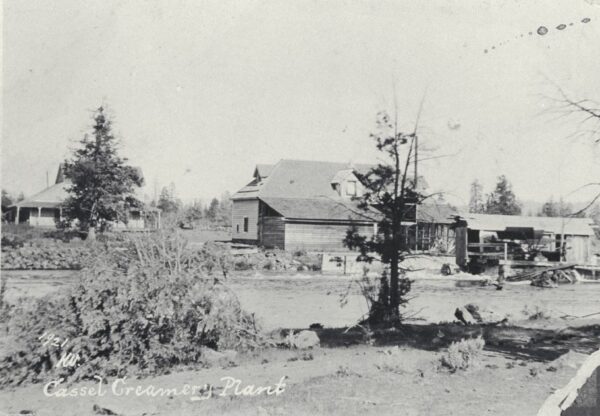
The Cassel Creamery Plant, where dairy products were processed during the community’s early history. In 1914, Martin Karpie sold the creamery operation to Herman Geissner, who planned to expand the business. Courtesy of the Shasta Historical Society.
Life and Loss at Cassel
The same newspapers that celebrated Cassel’s growth also recorded its tragedies. During the summer of 1893, Tom Stacey was hauling hay for the Brown boys when the neckyoke dropped and the team ran away. Stacey was thrown from the wagon and struck his head on a rock. He lingered for approximately two days before dying from his injuries.
That same year, another familiar Cassel resident died suddenly. J. W. Lippincott, who had served as postmaster and worked as a carpenter, died at his home without any preceding illness. The Free Press of August 5, 1893, identified him as a justice of the peace and suggested that his death resulted from heart disease or apoplexy. His service as justice of the peace also explains why he was sometimes referred to as “Judge Lippincott.”
Other notices captured the mixture of sorrow and renewal characteristic of frontier communities. The wife of August Geissner died in childbirth at Cassel, after which Mrs. Lippincott was expected to care for the infant. On September 20, 1893, a son was born to A. E. Tyrill and his wife. Such brief newspaper notices documented something larger than individual family events: Cassel had become a permanent community where generations were being born, living, and dying.
Business and “The Beautiful Lake”
Commerce expanded as the settlement matured. Martin Frahm owned a toll road and operated a public house at Cassel, while H. E. Williams became one of the community’s recognizable businessmen. The Shasta Historical Society identifies Williams as a Cassel merchant and postmaster who also served the community as a doctor, dentist, and photographer. A surviving photograph in the Shasta Historical Society archives identifies his business as H. E. Williams General Merchandise and shows the store and Cassel post office.
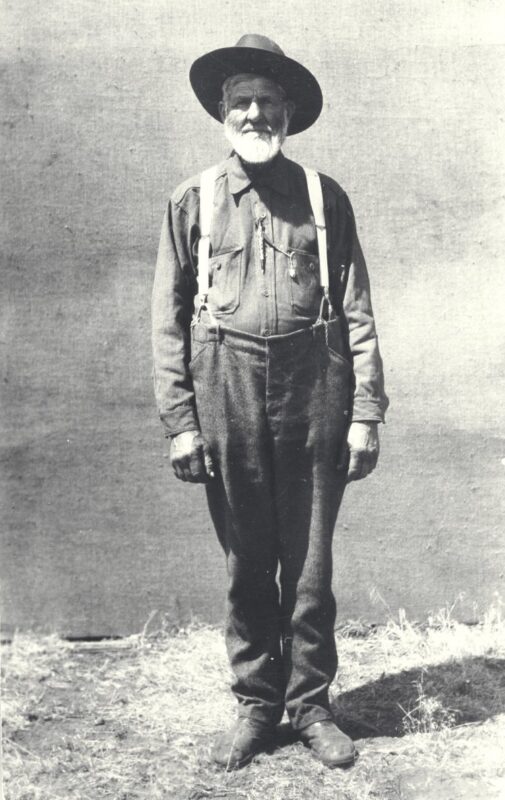
H. E. Williams, a Cassel merchant and postmaster who also served the community as a doctor, dentist, and photographer. His first name was possibly Henry. Courtesy of the Shasta Historical Society.
Williams also became involved in improving communication between Cassel and the outside world. He worked to extend telephone service toward Redding by way of Whitmore and Millville, helping connect the Hat Creek country more closely with communities to the west.
By October 1894, August Geissner was erecting a brewery at Cassel. A newspaper correction specifically identified Geissner—not Joe Kahny—as the man behind the enterprise and described him as an experienced brewer. The brewery, general merchandise store, post office, creamery, hotels, ranches, and other enterprises that appeared over the years reflected a community that continued developing even without the railroad its founders had anticipated.
Transportation nevertheless remained difficult. Cassel was connected with Burney Valley, Fall River Mills, Adin, Redding, and other communities through stages, freight wagons, toll roads, and horseback travel. An April 5, 1890, Free Press article titled “Postoffice Business” documented Cassel’s place in the regional postal network. Mail distributed through the Redding post office for stages traveling the Redding and Bieber route served numerous settlements, including Millville, Whitmore, Oak Run, Round Mountain, Montgomery Creek, Burney Valley, Cayton, Carbon, Cassel, Pitville, Fall River Mills, Bieber, and Adin. The report demonstrated how Cassel remained connected to northeastern Shasta County and communities beyond through the stage and mail system. At one point, a daily stage served the area, with four-horse coaches carrying passengers through the northeastern part of Shasta County.
Cassel’s scenery continued attracting outsiders as well. In June 1893, the Free Press reported that magazine writer Annota Eames was visiting Shasta County while preparing an article about its rivers. Her proposed journey included Burney Valley, Burney Falls, and what the newspaper called “the beautiful lake at Cassel.” The article was expected to be illustrated, although whether the proposed feature was ultimately published remains uncertain. The episode nevertheless demonstrates that Cassel’s residents had been correct about one thing: the area’s scenery and water possessed genuine appeal beyond the immediate community.
When Lassen Peak Struck the Valley
Nature dramatically interrupted life in the Hat Creek country in May 1915, when eruptive activity from Lassen Peak sent mud and floodwaters into the valley. The disaster altered the course of Hat Creek in places and buried portions of the lowlands beneath mud while damaging roads, bridges, irrigation works, fences, and crops.
T. L. Rahm, manager of the Dawson ranch at Cassel, reported that lowlands extending from the Harvey Wilcox property at the head of the valley to the David Doyel place, approximately two miles from Cassel, had been covered by mud ranging from about a foot to several feet deep. Hat Creek itself became muddy, and residents were warned against drinking the water.
Families were temporarily stranded, and roads became impassable. For a community dependent upon agriculture, livestock, transportation, and the waters of Hat Creek, the eruption demonstrated how quickly the surrounding landscape could become a threat. Cassel recovered, but the disaster became another chapter in the community’s relationship with the volcanic country surrounding it.
Harnessing the Water
The same water that supported ranches, fishing, and recreation eventually became important to northern California’s developing hydroelectric industry. In 1908, engineer Frank G. Baum acquired the approximately 1,600-acre Crystal Lake Ranch at Cassel from W. W. Brown. Brown remained on the property as ranch foreman. Baum became closely associated with hydroelectric development in northern California, including work connected with the Pit River system and the Hat Creek powerhouses near Cassel.
The Cassel property also became a place where Baum could experiment with mechanical and electrical ideas. He held numerous patents and developed inventions inspired partly by problems he observed around the ranch. After watching the labor required to handle hay, for example, he developed a mechanical hay loader. Baum established his home near the outlet of Crystal Lake into Hat Creek, tying his personal life to the same waters that increasingly shaped the area’s industrial future.
He died in 1932 following an accident in Redding. Four years later, in 1936, the Baum residence at Cassel was destroyed by fire. His widow, Mary, continued operating the ranch until 1939, when the property was sold to Pacific Gas and Electric Company. Baum’s name nevertheless remained attached to the landscape. Baum Lake, near Cassel, preserves the name of the engineer whose work helped connect the Hat Creek country with the development of hydroelectric power.
The Community That Endured
Cassel never became the railroad town envisioned during the optimistic days of Cassel City. The toll roads, stagecoaches, freight wagons, early hotels, brewery, and other enterprises of the nineteenth century gradually passed into history. The community adapted instead to changing transportation, telephone service, automobiles, hydroelectric development, fishing, and recreation.
By the twentieth century, community life at Cassel extended beyond work and school. Baseball provided recreation and friendly competition. In June 1933, the Cassel baseball club defeated the Hemstreet & Bell team, 20–10, on the Cassel diamond, with a return game scheduled for the following Sunday. Among the players receiving attention was 15-year-old third baseman John Hanna, whose performance earned praise in the local newspaper. The community itself survived even as the ambitions surrounding it changed. The name “Cassel City” faded, but Cassel remained on the map.
In one important respect, Cassel’s earliest residents saw the future remarkably well. Their railroad never came, but their belief that people would be drawn to the water, fishing, open country, and mountain scenery proved lasting. Cassel’s history is therefore not the story of a town that failed to fulfill its ambitions. It is the story of a community that changed with the landscape around it. Families settled there, children attended its schools, ranchers worked its fields, merchants opened businesses, and engineers harnessed its waters.
More than a century after a newspaper writer described “the beautiful lake at Cassel,” the community remains along Hat Creek—a surviving piece of northeastern Shasta County whose history turned out differently than its founders imagined, but endured all the same.
 Jeremy M. Tuggle, a native of Redding and descendant of 11 pioneer families who settled Shasta County between 1849 and 1889, has researched Shasta County history and genealogy since 2003. He is the author of Rooted in Shasta County (2003) and A Journey Through Time: Ono and the Bald Hills (2008), and maintains the local-history blog Exploring Shasta County History, and maintains a YouTube channel called @jeremytuggle6424. Tuggle served for twelve years as the Education and Community Engagement Manager at the Shasta Historical Society and received a 2017 Community Service Award for historic preservation from the Major Pierson B. Reading Chapter of the National Society of the Daughters of the American Revolution.

