

In the early 1900s a young woman, her husband and baby boy left their Greek homeland for passage to the United States to start a new life. Inside her coat she’d sewn a generational secret; a small bundle of oregano with some roots attached.
The couple eventually put down their human roots in San Francisco, and later, Redding. No matter where they went, the oregano followed. The couple welcomed a few more babies to the family, this time in America, where the children grew as strong and healthy as the relocated oregano plant that was periodically uprooted and joined the family each time they moved.
One of those children was an adorable little brown-eyed boy named George Economou, someone I encountered two times in my life. First, he was Mr. Economou. Later, he was George.
My first exposure to Mr. Economou was when I was a Shasta High School student in Mr. Economou’s P.E. classes, as well as drivers education. In those days, “driver’s ed” was part of the school curriculum for every student. We started out in trailers with simulators where students pretended that the movie screen was an actual scene through a windshield. Students progressed from the trailers to outdoors to a big car loaded with three inexperienced teenage drivers in the back, one in the driver’s seat, and Mr. Economo in the passenger seat with his own brake, in the event things got dicey.

In the ’60s and ’70s schools provided drivers training, complete with driving simulators. Photo source, reddit.
I still marvel at the liability the school risked with those programs. Anyway, Mr. Economou taught me to drive.
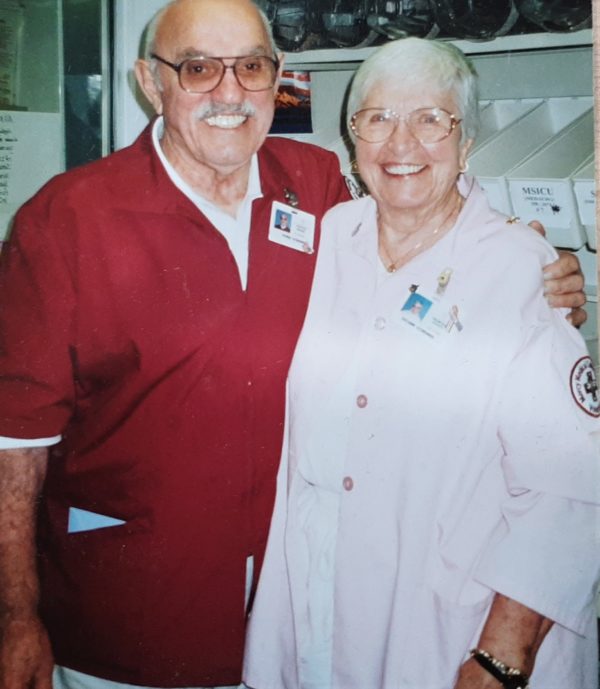
George and Suzanne Economou, retired educators, and Mercy Medical Center volunteers for 40 years. George died in May of 2011 at age 86 . Sue died in September of 2019 at 98.
The second time I met up with Mr. Economou was when I worked at the paper and wrote a story that featured Mr. Economou making baklava, which I’ve also covered here on A News Cafe. After that, Georoge Economou and his wife Sue pretty much adopted me and Shelly, my twin sister. We were the daughters they’d never had. They became surrogate parents for us after we’d lost our mother when we were 12, and our dad when we were in our 30s.
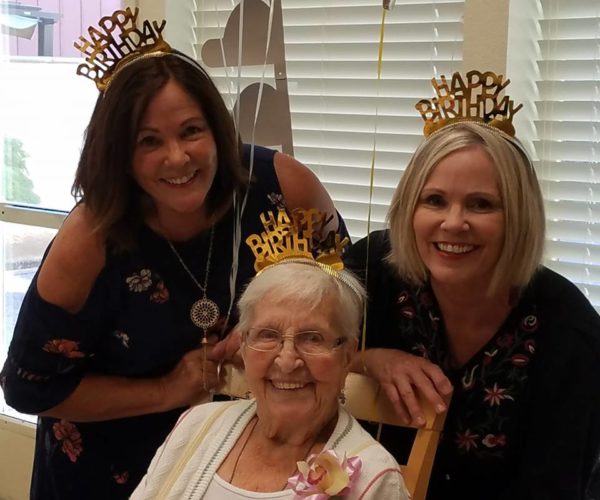
From left, Shelly Shively, “Mama Sue” Economou and Doni Chamberlain celebrate their July birthdays.
We enjoyed many years together and ate many Greek meals with George and Sue. We never tired of hearing George proudly tell how his mother smuggled oregano into the lining of her coat so she could bring her culinary Greek staple to America. Sometimes he was inspired to retell the story as he prepared a simple Greek salad of tomatoes, Kalamata olives, olive oil, cucumbers and oregano — lots and lots of oregano — that he’d grown and dried in his basement in paper bags. He removed the tiny dried leaves from the brittle stems by methodically rubbing the dried cuttings between his palms. He’d toss the sticks and stems, and keep the dried leaves. He said the oregano flowers were especially flavorful.
George often invited visitors to his back yard to a patch of gravel where his mother’s oregano plant dominated a flower bed and had claimed some of the lawn. He’d grab a small clump of oregano, pull, and up would pop a little plant, roots and all. He’d shake off the gravel and dirt, wrap the roots in a damp paper towel and present the plant to the recipient, like the precious gift it was. He liked giving away oregano starts as it meant the expansion of his mother’s Greek legacy. I was honored to have an Economou oregano. When I divorced and moved from Igo to Redding I yanked up a number of oregano plants for the journey; just in case one didn’t survive. They all survived, and so did I.
I’ve moved three times since then, and each time, I’ve dug up some oregano for my new home. I’m not a monster. I always leave a little behind.
Now, oregano grows in abundance throughout my backyard.
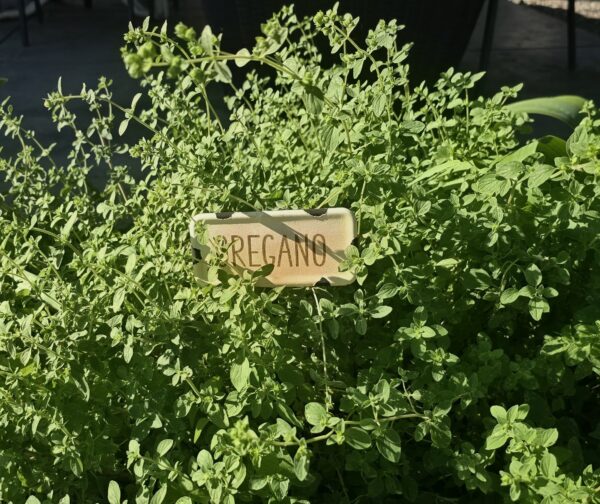
This story is supposed to be about sturdy herbs, and I am getting there. The reason I mentioned the Economou oregano is to illustrate the plant’s resilience. Just think: the oregano in my back yard is from a mother plant — George Economou’s mother’s plant, to be exact — that’s more than 120 years old. That’s something.
Herbs love the North State’s Mediterranean climate
Yes, we (rightfully) complain about the North State’s heat, but we are fortunate to live in what the United States Department of Agriculture classifies as Zone 9, characterized as a warm-climate agricultural region that features relatively mild winters and long, hot growing seasons. Zone 9 is known for its fairly temperate extreme minimum winter temperatures of between 20 to and 30 degrees Fahrenheit. Technically, Zone 9 is divided into Zone 9a and Zone 9b to allow for about a 5-degree difference in minimum temperatures, but we don’t need to get picky about it. Another feature of Zone 9 is that the winters are so mild that gardeners can take advantage of a second growing season by raising such cool-weather crops as carrots, kale, lettuce and broccoli, all of which can be planted in the fall and harvested in the winter.
Generally speaking, a long list of plants thrive in Zone 9: For starters, Zone 9 is ideal for nut trees and fruit trees — including citrus — olives, pomegranates and figs. Lots of vegetables also love Zone 9’s high temperatures, such as melons, squash, peppers, eggplants, and tomatoes. Lots of flowers flourish in Zone 9, such as lavender, agapanthus, iris, black-eyed Susan, yarrow, Shasta daisy and gaura. Don’t get me started on gaura.
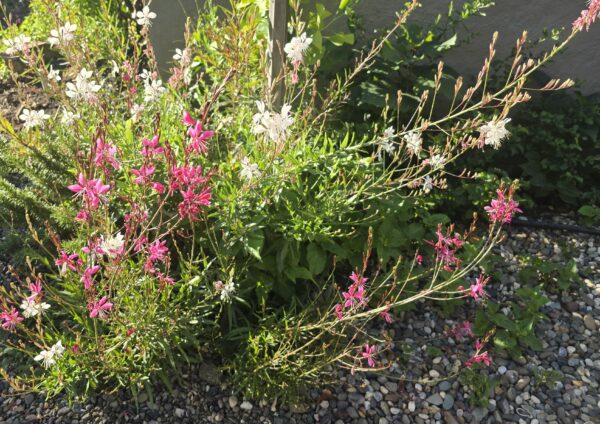
This is guara. It’s a volunteer, an offshoot from a plant more than 15 feet away. Plant at your own risk.
At this point I consider it an invasive specimen that I regret planting, but that’s a conversation for another day. Let me just say that the first two years were gorgeous, and now they are leggy and out of control. Baby gaura volunteers have popped up everywhere.
Back to the herbs. I feel sad when I look at the price of fresh herbs in produce departments. Royal ripoff! I tell anyone who’ll listen that there is absolutely zero reason to purchase those herbs I consider the stars of the Zone-9 growing show, specifically, sage, thyme, oregano, and rosemary. Take the first letter of each herb and it will spell STOR, and there’s your memory prompt of herbs you should not purchase at the store.
You can plant herbs nearly anywhere, as long as there’s ample sun exposure. I usually plant herbs in the ground, but I’ve also planted them in containers other than pots, like galvanized buckets, and most recently my rusty little wheel barrow (it’s lined so the rust won’t leach up).
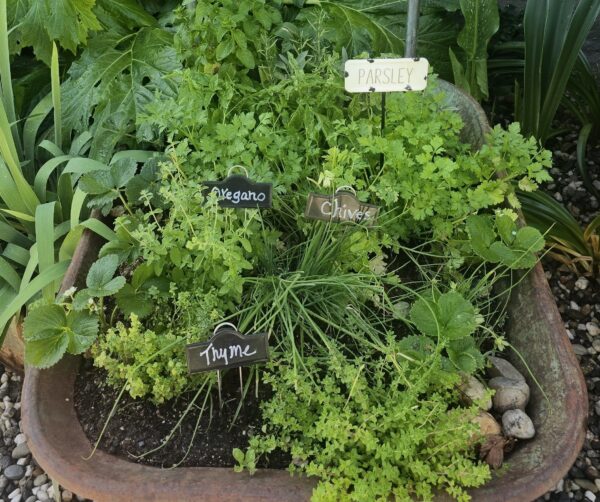
Many herbs come in several varieties. Sage, for example, can be as fat-leafed as a soup spoon or as skinny-leafed as a birthday candle.
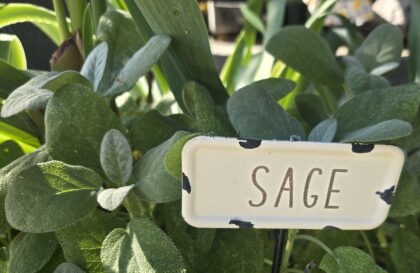
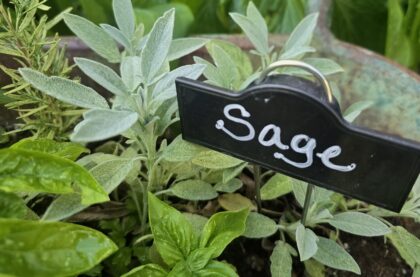
By the way, a delicious use for the large-leafed sage is to pat the leaves with a little egg wash (water and beaten egg) dredge the leaves with a dusting of seasoned flour, and gently fry them until crispy in butter or olive oil, then serve on top of pasta. Try it! If you want to really take it up a notch, serve it over butternut squash ravioli covered in a sauce made from chopped, sautéed herbs and garlic, simmered in chicken broth. Truly a memorable meal, and the sauce is surprisingly light.
Please forgive this rude interruption, but if you’re enjoying this story about North State herbs, I hope you are a subscriber of A News Cafe. If you’re not a subscriber (yet), won’t you please consider supporting ANC to help us continue providing informative, interesting and worthwhile content? Thank you! Carry on.
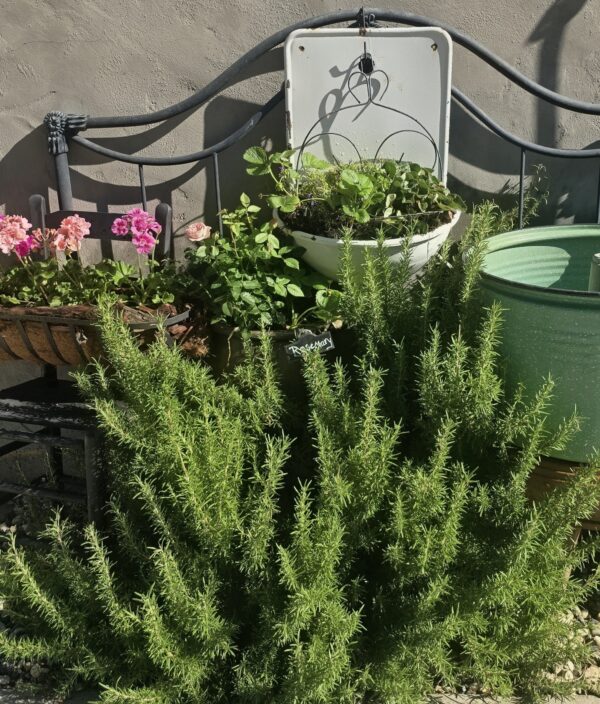
Rosemary, front and center, basks in Redding’s blistering sun. This plant started as a infant rosemary in a 3-inch pot.
But even if you don’t cook with fresh herbs, they make for interesting, beautiful, drought-tolerant no-fuss landscapes. Rosemary, for example, can grow to a massive size and is nearly indestructible. Bees love the purple flowers. And it’s fun to take the thick woody stems, pull off the rosemary leaves and use the sticks as barbecue skewers.
Something I’ve noticed about growing herbs is that much as it’s nearly impossible to say “spiral staircase” without illustrating it with a twisty finger movement, or it’s difficult to describe a “handlebar mustache” without pantomiming touching the up curl of a mustache, it’s impossible to cut fresh herbs, or touch herbs as you pass by, without smelling the scent left behind on your hands. Dare you. Try it.
Each herb has its own distinct scent, and I can’t help but smile when I remember my departed father-in-law saying that weeding the herb garden always made him hungry for a savory meatloaf.
Herbs like oregano, rosemary, thyme and sage are extremely strong, and can survive even our coldest winters. Other herbs, like chives, are more fragile, and will die back in the winter, but will reappear like clockwork in the spring. Mint will die back in the winter, too, but it’s a trick, because it comes roaring back with a vengeance come spring. By the way, regarding mint, keep it in containers, or planted in an area where it cannot escape, or believe me when I say it will take over. I love mint, but a girl can only drink so many mojitos.
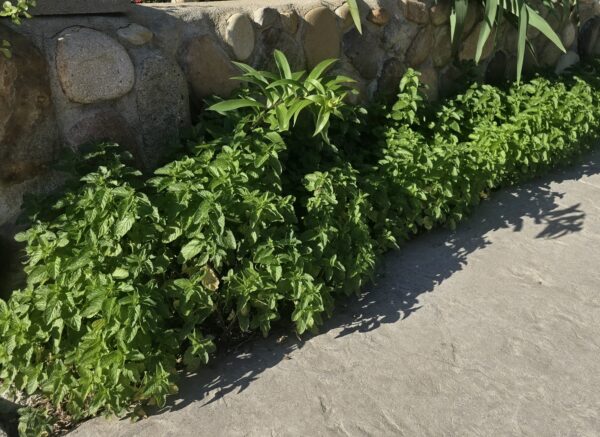
The only thing that keeps this mint from taking over Doni’s backyard is that she’s literally planted it between a rock and a hard place; a rock wall and a concrete driveway. The lone outlier plant there is a Stargazer Lily trying to fight its way through the mint jungle.
Basil is another herb that although it does great in the North State’s blistering summers, it perishes in the cold. Unlike mint, I’ve yet to have a frozen basil plant to self-resurrect in the spring, which means that if we want basil, we must replant it each spring. The same is also true for French tarragon, which peters out when the heat gets the best of it. Side note, I planted a Mexican tarragon last year and it survived winter just fine. The Mexican tarragon leaves are not as delicate as a French tarragon, but it shares the familiar licoricey flavor, perfect for Tarragon Chicken Salad. Parsley tends to die in the cold, and I’ve had minimal success with healthy spring regrowth.
By the way, if you are a subscriber of ANC, and you are ever in need sage, thyme, oregano or rosemary, please don’t buy any. Contact me, come to my yard and I will give you some. Of course, after that, you’ll want to plant your very own. They’re so easy to grow that even those who consider themselves failed gardeners will have great success with them.
In fact, many herbs are so easy to grow that I currently discovered a volunteer oregano plant that took root somehow in the middle of gravel, not even close to where my oregano grows, not a drop of water in sight. It’s in full hot sun, surrounded by gravel, and it’s doing great.
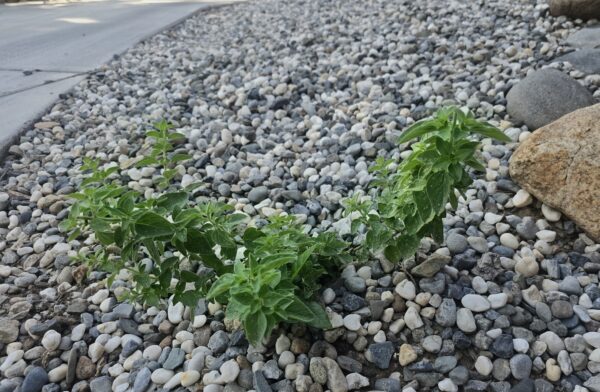
I’m pleased, but not surprised. I’d expect nothing less from a descendant of Mrs. Economou’s 125-year-old stowaway oregano.
###
As A News Cafe continues its pivot toward more uplifting, informative and interesting features, commentary, profiles and food stories, we rely, now more than ever upon the support of distinguished readers like you who appreciate this local online news magazine. Thank you!


