

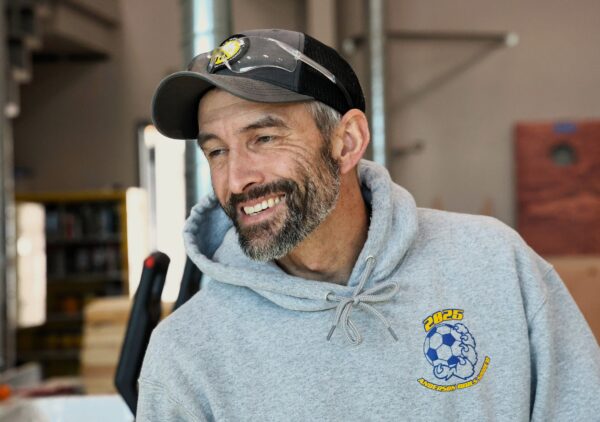
Derrick Jones teaches woodshop classes at both West Valley Early College High School and Anderson High School. Photo by Mike Chapman for A News Cafe.
A few hours each school day, an industrial-level high-decibel racket emerges from the school’s cavernous woodshop in the 700 building that dominates a portion of West Valley Early College High School’s Cottonwood campus.
If you dare, open the door and step inside. Prepare for an auditory onslaught of a cacophony of mechanical whirrs, hums, and ear-piercing metallic screeches produced by a variety of power tools, hand tools, high-powered vacuums and machinery. The sounds are produced simultaneously by woodworking tools operated by a roomful of teenagers decked out in safety glasses as they concentrate on various projects underway during the school’s new class, Building and Construction Trades, known in previous generations as simply, “woodshop”.
Welcome to the 2026 version of woodshop, aka Building and Construction Trades, at West Valley and Anderson high schools. Here, students who successfully complete the 2-year program will earn transferable college credits in Butte Community College’s ITEC55 construction program.

From left, Landon Mason, Jagger Johnson and Jonah Bjorgan work on projects at Anderson High School’s Building and Trade Construction class. Photo by Doni Chamberlain.
The students are closely supervised and expertly instructed by 39-year-old Derrick Jones, who starts each school day at West Valley, and then teaches the same course after lunch at Anderson High School, about 9 miles from West Valley.

Building and Construction Trades high school student John Henry Mollath makes sure he has the wood needed for his project. Photo by Doni Chamberlain.
Jones has a deeply personal history at Anderson High School. The woodshop in particular is especially familiar to Jones, as he was once a student in the very woodshop where he’s now a teacher. One generation earlier his own father — a lifelong woodworker who owns Mandina’s Custom Cabinets — also attended Anderson High, where the elder Jones was enrolled in the woodshop class. In fact, Jones’ parents met at Anderson High. Jones smiles as he explains that his parents married following his mother’s early graduation at age 16 from Anderson Union High School District’s continuation school. Jones jokes that technically, he attended his mother’s graduation, as he was born not long afterward.
And yet here he is, back at Anderson High School, this time as an adult, teaching what was once one of his favorite classes.

Remington Hart, an Anderson High School Building and Construction Trades student, selects wood for his project. Photo by Doni Chamberlain.
Jones, who could easily pass as a body double for actor Hugh Jackman, moves around his classrooms with the air of confidence of someone who trusts his students’ abilities. Nevertheless, he’s always on guard. Jones never stops roving, watching, and talking, as if he has eyes in the back of his head to accurately monitor 360-degree views as students collectively operate potentially deadly machinery.
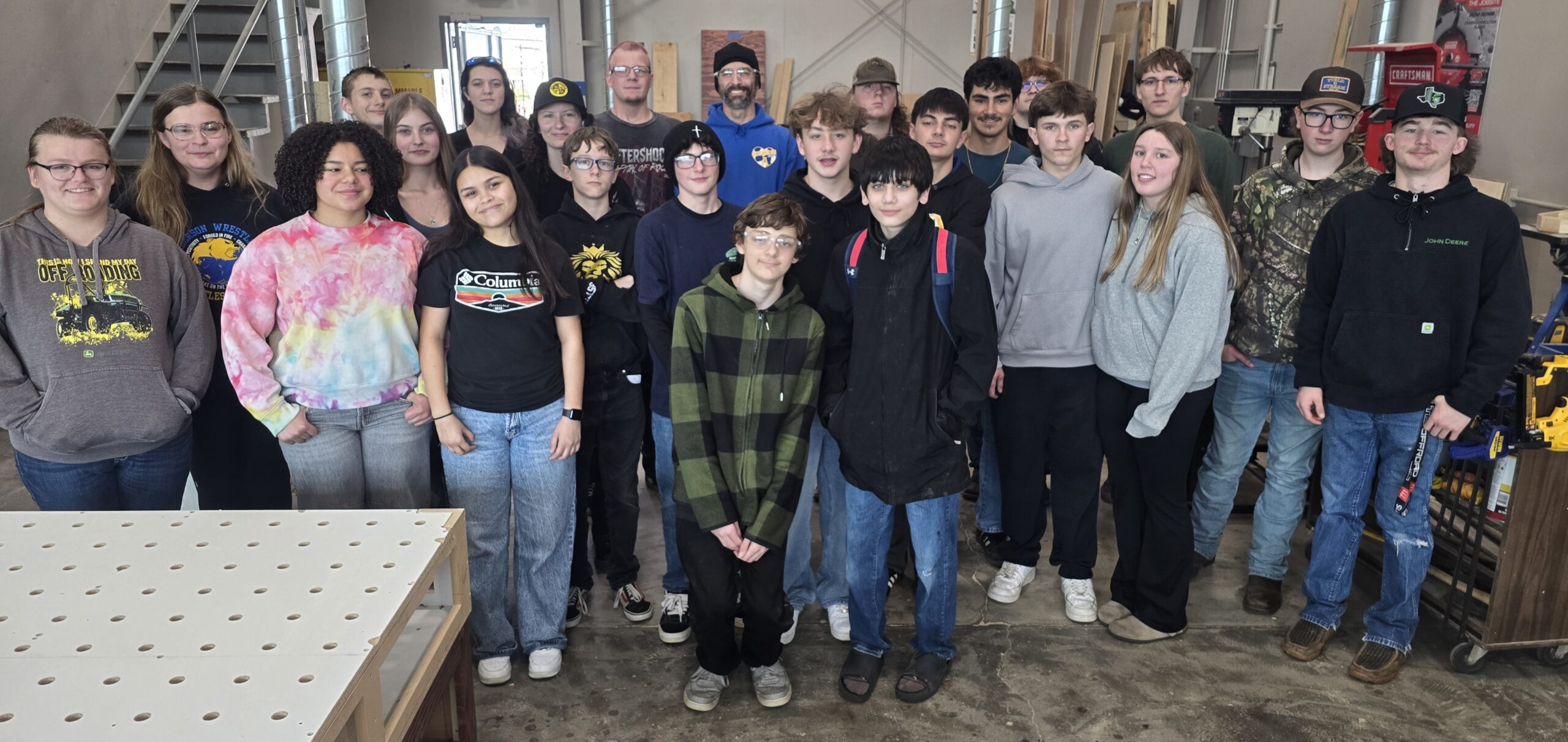
Instructor Derrick Jones — royal blue sweatshirt, center, back row – joins students from 4th and 5th period Anderson High School woodshop classes. Active students — not necessarily photographed – include: Jonah Bjorgan, Durkyra Davis, Liam Davis, Justice Devor, Dustin Donnelly, Israel Garcia-Gomez, MyLinda Gomez, Remington Hart, Kayden Jeide, Jagger Johnson, Victor Lopez-Patino, Landen Ohmer, Mariano Rivera Gutierrez, Jayden Cornwell, Lucas Craven, Jorden Dunlap, Maximillion Farrare , Michael Harris, Jayden James, Kelsi Juvenal, Landon Mason, Christopher May, Jeanie McCracken, Andrea Shoemate, Samantha Shoemate, Jase Singleton, Rustin Sturges and Lucas Young.

West Valley High School student Colton Diggle, a 15-year-old West Valley freshman, says this first year in Jones’ class is good fit for him for a few reasons, one of which is that the class “knocks out an elective.” Photo by Doni Chamberlain.
Both schools’ routines are similar. There are no desks, and just a few chairs. Actually, chairs would only get in the way, as the classroom is a hive of activity where students buzz about, back and forth, constantly on the move. Upon entering the class, some students approach Jones and casually shake his hand in greeting. Others shake his hand as they leave the class. Yet others yell out hello or goodbye as they come and go, or simply nod, or wave.
So many whirring blades! Table saws, circular saws and jigsaws effortlessly glide through wood as electric hand-held sanders produce rhythmic hums under students’ able hands who expertly smooth down rough edges, leaving flecks of sawdust on students’ clothing that will later be removed with small electric blowers. Also in operation are routers, drills, dust-collectors and all kinds of other woodworking tools, as well as woodworking supplies, like adhesives, nails, screws, varnishes, stains and hardware.
On one recent winter day at West Valley, a small plastic speaker stood optimistically on a stack of lumber and soon, music — country — valiantly attempted to compete with the roar of machinery. Sometimes — during occasional rare lulls in activity — the music successfully broke through, but mostly, the tools’ sounds dominated the air waves.

Derrick Jones, in royal blue sweatshirt, hams it up in the West Valley High School Woodshop class surrounded by his 1st and 2nd period students. Active students — not necessarily photographed — include: Zeth Bates, Emily Huddleston, Maveryck Bradford, Chloe Ellis, Cameron Feusi, Cale Harrison, Jayden Hoban, Eduardo Machuca, Mason McDougal, Jason Pennington, Riley Smith, Ethan Summers, Thomas Webb, Carter Williams, Aiden Clay, Dani Beeson, Colton Diggle, Michael Forsythe, Zackary Griffin, Adam Hazelwood, Atticus Hilburn, Daden Massaro, James McDermott, Austin Morris, Atreyu Morrissey, Morgan Mueller, Drake Munson, Conner Murphy, Levi Naegele, Carmelo Ragona-Guy, Lane Robbins, Kevin Rosales-Ramirez, Ernie Simmons, Devin Stansberry, Danny Verdugo, Luna Villa and Daniel Yingling.

On that recent school day at both West Valley and Anderson high schools, students were in their creative element as they went straight to work, independently and also cooperatively, as they operated a variety of tools to complete projects to take home, give as gifts, or contribute to the shop, like shelves with hooks for students’ backpacks. Students from both schools disclosed many reasons for choosing Jones’ Building and Construction Trades class.
At Anderson High, junior Jagger Johnson, 17, said he took the class, “so I could learn about the real world.”
Jonah Bjorgan, a 14-year-old freshman, said he’d been thinking about going into the construction trades.
Liam Davis, a senior, said the class provided real-world practical help for a project he’s working on in preparation for moving out of his parents’ house, conveniently located on the same piece of property.
“I’m currently renovating a trailer that I can move into,” he said. “It’ll be perfect, because I get to move out, but technically I’ll still be home for dinners from mom.”
Remington Hart also has a specific project in mind: a sturdy coffee table for his stepdad.
For 17-year-old senior Landon Ohmer, a nudge from his grandfather encouraged him to enroll in Jones’ class to learn woodworking. “I’ve done an ice box, and all kinds of things in this class,” he said “But my grandpa does woodworking and we’ve built things together, too.”
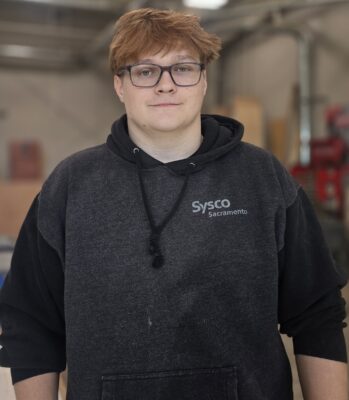
Landon Ohmer, 17-year-old Anderson High School senior. Photo by Doni Chamberlain
Ohmer said he’s noticed a change in Jones’ style since the beginning of the first semester. “I think he didn’t want us to know it, but he definitely had a learning curve,” he said with a smile. “At first, he was more about showing us, and after awhile, he was more hands-on, and he made us do the work.”
Sometimes students work on projects that benefit the school, such as 15-year-old Anderson freshman Andrea Shoemate, who worked on shelf trim for the school’s student store.

Andrea Shoemate of Anderson High School puts the final finishes on shelf trim. Photo by Doni Chamberlain.
At West Valley, as Maveryck Bradford, 14, a freshman, drilled pilot holes, he said the class appealed to him because his dad does construction, and Bradford has always liked to build things.

West Valley High School student Atreyu Morrissey listens to instructor Derrick Jones explain a technique. Photo by Mike Chapman for A News Cafe.
In each class, students learn which tools do what, and along the way they inevitably develop favorites. One girl said she likes the jigsaw. A West Valley classmate said he likes sanders. Yet another, Austin Morris, prefers table saws. Morris just finished making a shelf, and was pleased with how it turned out.
“I really like woodworking,” Morris said. “I would like to build my own house some day, and I’m learning things that can help me do that.”
During the winter break Jones led students in a special fundraising project, the mass production of wood food-carrying caddies, specifically designed to hold jumbo foil casserole pans.

Students crafted the caddies from donated, reclaimed wood. The fundraiser earned $500 for the girls varsity soccer team, which Jones coaches. The money helped purchase team sweaters for the girls.
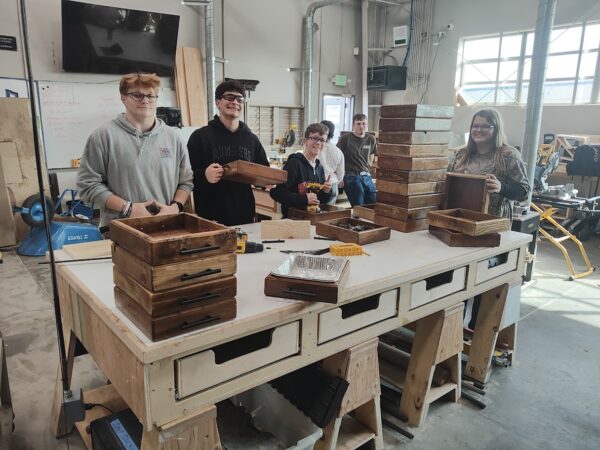
Anderson High School woodshop students work on casserole caddies made from donated reclaimed wood for a fundraiser. Photo courtesy of Derrick Jones.
Jones also teaches students about some of the less-glamorous aspects of woodworking, too, such as correcting mistakes — measure twice cut once — and the tedious task of pulling out nails and staples, as was the case for 14-year-old West Valley freshman Conner Murphy, who methodically yanked staples from a piece of wood.
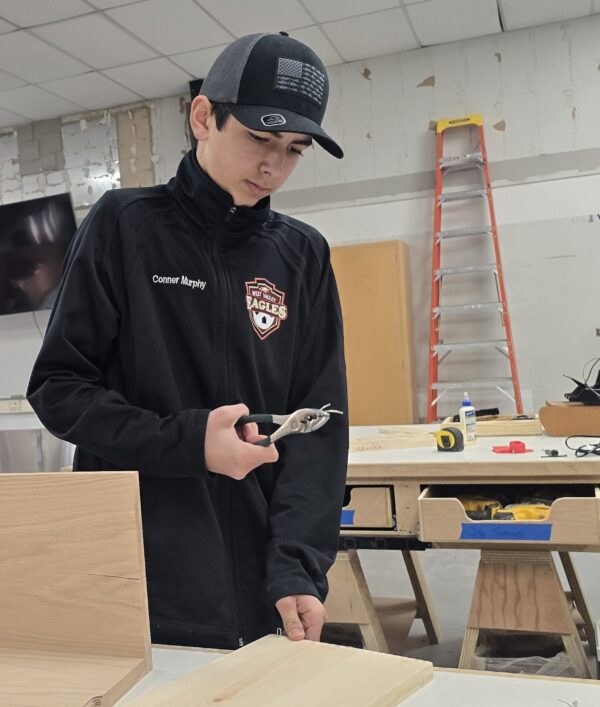
West Valley student Conner Murphy uses pilers to remove staples from a piece of wood. Photo by Doni Chamberlain
Across the room, 16-year-old West Valley junior Danny Verdugo concentrated on following templates to build a small oak icebox. Verdugo said he’s always liked building things, starting when he was a little kid playing with Legos. But yesterday’s Legos have given way to grown-up projects and an eye on his future.
“I’m thinking about construction as a career path,” he said. “Maybe I could do construction in the Air Force.”

Danny Verdugo, 16, works on his oak icebox project. Photo by Doni Chamberlain.
Emily Huddleston, an 18-year-old West Valley student — a fan of the jigsaw — likes that the class allows students to select their own projects, such as her recent heart-shaped shelf. Speaking of hearts, she has her heart set on being an architect one day, and believes that the Building and Construction Trades class will look impressive on college applications.

West Valley student Emily Huddleston sands a heart-shaped piece of wood. She’s one of the few young women in the class, which she says it’s no big deal. “I’m used to it,” she said. Photo by Mike Chapman for A News Cafe.
Between projects, Atticus Hilburn, a 17-year-old West Valley senior, reflected upon his time in Jones’ class. “He teaches us stuff about life, not just woodworking.”
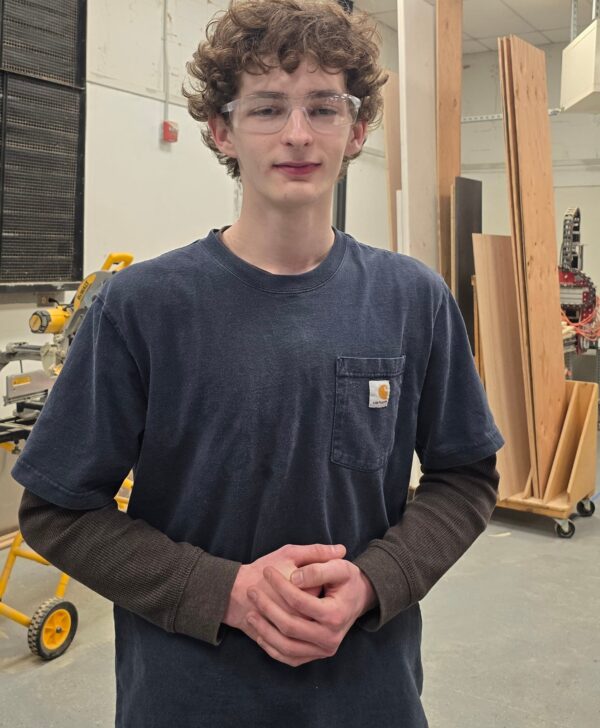
Atticus Hilburn, 17, is a West Valley senior.
Not all work is noisy. Some students silently double-check tape measurements, and follow specific templates for everything from shelves to casserole carriers. Other students, like Dominic Humistan, work on large, ambitious personal projects, such as a video-game racing car Humistan designed to cheer up a friend recovering from a broken leg.
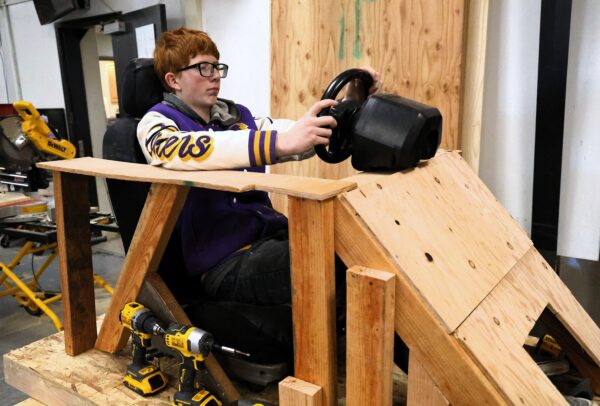
Dominic Humistan, 15, of West Valley High School, checks out the steering wheel for the video-game racing frame he’s making for a friend with a broken leg. Photo by Mike Chapman for A News Cafe.
Overall, Jones strives to make the class both fun and interesting as he instructs students how to safely operate adult tools, and navigate potentially dangerous equipment on their quest to making functional, quality objects from wood; things that can serve as a source of pride for years to come.
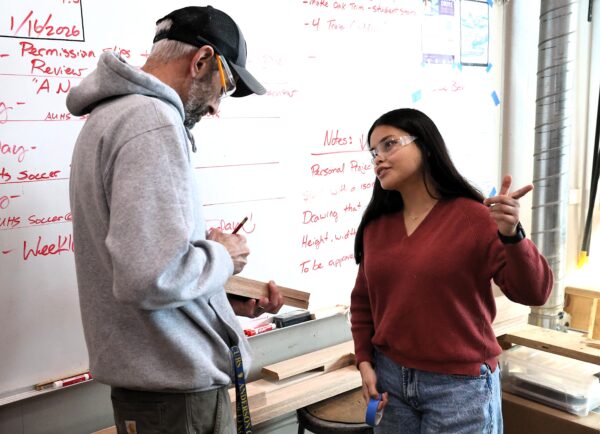
Woodshop teacher Derrick Jones chats with student Mylinda Gomez at Anderson High School. Photo by Mike Chapman for A News Cafe.
While class is in session, Jones wanders the room and checks on students. He offers reminders, instruction, and words of caution and guidance about everything from safety glasses to shop clean-up.

Instructor Derrick Jones explains a wood-working technique to West Valley High School students. Photo by Doni Chamberlain.
Although Jones has an easy-going rapport with students, he’s dead serious about safety. He once expelled a flip-flop-wearing student for breaking the rule against open-toed shoes. Jones said the student begged to return, which Jones allowed, but the punishment was a cautionary tale for not just the student, but the entire class.
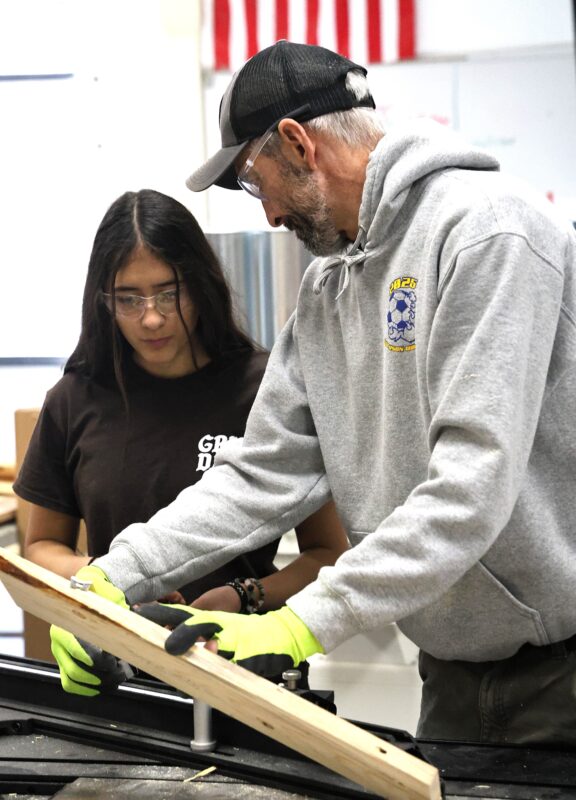
Derrick Jones instructs West Valley student Luna Villa on the table saw. Photo by Mike Chapman for A News Cafe.
It’s not unusual for a few random non-woodshop students to sometimes wander into Jones’ classes, not because they’re officially enrolled, but because they received permission to come watch friends work on everything from hat racks and shelves to a classic oak icebox.
“We get that a lot,” Jones said with a grin. “It’s fine.”

West Valley student Ernie Simmons gets ready to cut a board to make a key holder and hat rack under the supervision of teacher Derrick Jones. Photo by Mike Chapman for A News Cafe.
“Please remember to cut off a bad edge first,” Jones called out to some boys gathered around a table saw.
“And when you make a cut, please don’t stand directly behind the board, because you could get hit if it kicks back,” Jones said to a student who’d just positioned a board near the still-waiting table-saw blade.

From left West Valley High School students Austin Morris, Ethan Summers, and Jayden Hoban watch Jones demonstrate a woodworking technique. Photo by Doni Chamberlain.
The student asked Jones if he’d ever been hit by a flying board.
“Yeah,” Jones said with a smile. “And I have a scar to prove it.”
A few students laughed, but they only need a quick glance at their teacher’s damaged left hand to know Jones speaks literally from first-hand experience. Every one of Jones’ students know the story of how their teacher ended up having two fingers amputated.
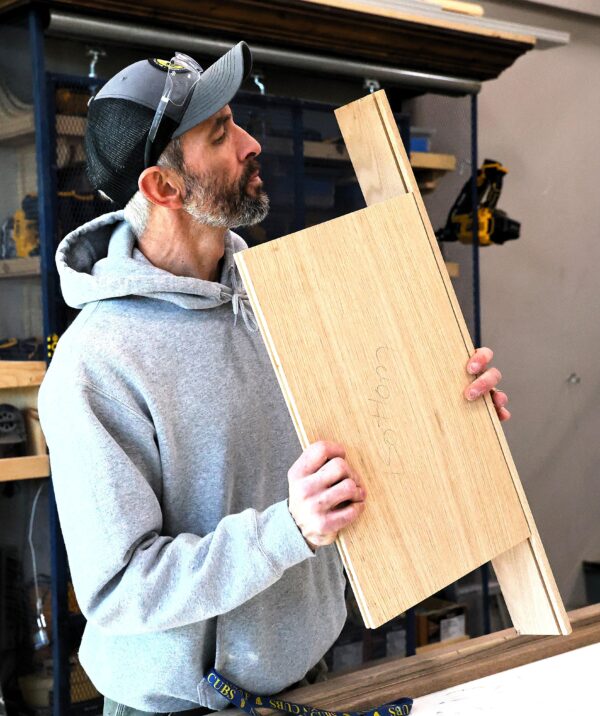
Woodshop teacher Derrick Jones holds an unassembled pan holder that will be used to carry food and casseroles. Photo by Mike Chapman for A News Cafe.
‘Good things happen slow’
Jones’ amputation occurred on April 1, 2015, shortly after getting his contractors license for his own business, Jones’ Woodworking. He was operating a large industrial machine that shapes door parts. It was early in the morning. He was working alone. He was tired from staying up all the previous night arguing with his former wife over something he can’t recall now.
“It was a tool I’ve used for thousands of hours in the past,” Jones said. “But I’m distracted, and I’m just working, and not thinking about the task at hand, and it was just that fast. The board kicked back and my hand skipped over a detail knife on the shaper.”
The fingers weren’t cut off completely, but the damage was significant.
“It was my pinky and ring finger on my left hand,” he said. “Those fingers were still there, but completely shattered.”
The shop was off Highway 273, and Jones knew he couldn’t just leave the shop without first closing the rolling doors to secure the building and equipment from possible theft. He was bleeding badly, so he reached into one of the rag boxes and grabbed a towel to mop up the blood with his foot, and rummaged around to find something else to wrap around his gushing hand. He called 911, and then noticed the words on the T-shirt around his bloody hand.
“It says ‘Drama Queen’ — which struck me as funny,” he said. “So the dispatcher is telling me to not panic, and I’m feeling faint, so I sit down on the floor and call my wife at work. She thinks it’s a joke because it’s April Fool’s Day. She arrives the same time the ambulance arrives, but the reality is I don’t have insurance, and I don’t know how much the ambulance will cost, so my wife drives me to the hospital.”
At the hospital, doctors describe for Jones some of his options, including flying to San Francisco and undergoing a sophisticated surgical procedure that involves sewing his injured hand to his chest and utilizing stem cells to grow new fingers.
His decision to decline that procedure boiled down to a few realities: First, he lacked health insurance. Second, he was experiencing excruciating pain. Third, there was no guarantee that his fingers would regain full function and mobility. With that, he asked the doctors to amputate the damaged fingers, which they did that day.
He lost two fingers, but he gained a story to tell his students as an illustration about safety.
“They take one look at my hand and they don’t want to join my club,” Jones said with a laugh. “I tell them, ‘This is the thing: ‘Good things happen slow. Bad things happen fast.’ That’s just the way it is, and I think it’s true for many things.”

The scene of the accident.
Looking ahead
Attendance in each of Jones’ Building and Construction Trades classes averages about 20 students per period. He’s pleased with the enrollment numbers, especially for such a relatively new course offering, but Jones has high expectations. He’s doing everything in his power to grow the program in attendance, as students and parents become increasingly aware of the elective that’s not just fun, and just not just useful, but a course that provides practical skills for advanced education, or potential jobs in construction and carpentry.
At both West Valley and Anderson high schools, the shops contain an inventory similar to a professional cabinet-making business, but Jones is constantly on the lookout for more tools, and better equipment with improved safety features. Jones gladly accepts wood donations, sometimes provided by companies like Sierra Pacific. Occasionally lumber and tools find their way to Jones’ classes from the estates of former woodworkers.
For all that, Jones is grateful, but he has some loftier wishes, too.
“I am looking for industry partners who I can meet with twice a year to discuss industry trends and keep my curriculum in line with what is needed today in our economy,” he said. “Of course, donations are always accepted and appreciated; materials, tools, anything a person might want to give to a good cause.”
New teacher, old skills
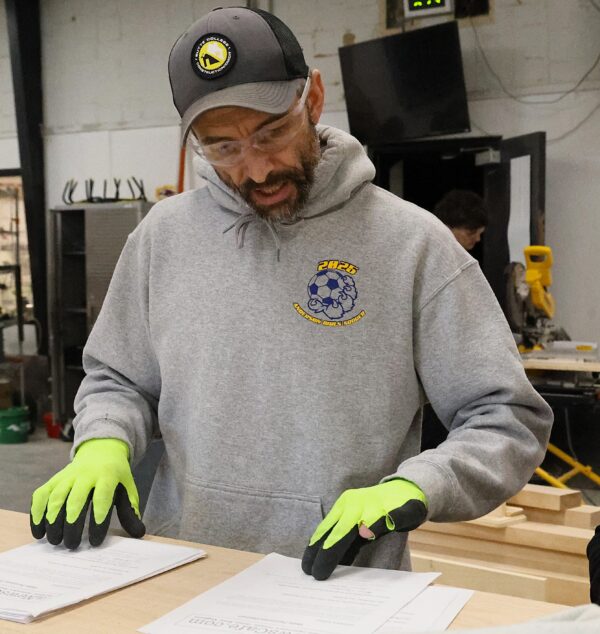
Building and Construction Trades instructor Derrick Jones checks the day’s plans. Photo by Mike Chapman for A News Cafe.
As confident and successful as Jones appears as he teaches both classes, some may be surprised to learn he’s only had this position since the start of the 2024/2025 school year. In fact, it was a bit of serendipity that led Jones to the pair of job openings he hadn’t known existed before. But even if he had known, although he was an accomplished woodworker and expert cabinet maker who had attended various trade schools, he wasn’t a certified high school teacher. Even so, in early 2024, his career planets lined up unexpectedly when he, his daughter and stepson attended Anderson High School’s annual 8th Grade Invasion, an event that introduces incoming freshman to their future campus, to ease young students’ transitions between middle and high school.
That evening, Jones decided to arrive early enough to stop by his old Anderson woodshop stomping grounds and say hi to George Wold, a longtime Anderson High Ag science instructor who also taught welding. Instead of seeing a fully functional woodshop, to Jones’ dismay he found a space used for storage, crammed with boxes. When Jones asked Wold what had happened to the woodshop, Jones learned that the principal had wanted to resurrect the woodshop program, but they needed an instructor. Almost as a joke, Jones, who was already known on campus as the girls soccer coach, said, “Well, shoot, you should let them know I’ll take the job!”
In reality, Jones assumed that for him, becoming a high school teacher was out of reach.
“I really didn’t think it was a possibility,” he said later. “I’d gone to trade schools, but I didn’t have a college education.”
Within about 15 minutes Wold had talked with Anderson High School principal Tom Safford, who quickly tracked down Jones and asked if he was serious about his interest in teaching the school’s Building and Construction Trades courses. When Jones said sure, but he lacked a teaching credential, Safford explained that California has a unique pathway CTE — Career Technical Education — for people who possess specific areas of skilled expertise, who could follow a program to become certified teachers in those fields.
Little could Jones have guessed that by March of 2024, the Building and Construction Trades teaching position would be posted, and he’d soon be accepted into the CTE program where he would complete the requisite CTE training with flying colors. When the 2024/2025 school year began, Jones was simultaneously working within the two-year teacher induction program with a preliminary credential.
He received encouragement, and letters of recommendation from people like Erin Stuart, retired University Preparatory School, Superintendent, and her husband Mike Stuart, retired Shasta Union High School District Superintendent. They originally met Jones as customers when he was the designer and cabinet-maker for the couple’s extensive remodeling project.
“… Derrick has the qualities we look for in educators,” wrote the Stuarts in their letter of recommendation. “He is creative and flexible — a problem solver. Derrick is also intelligent, a self-starter who looks for solutions, not problems.”
That’s how Jones came to teach the Building and Construction Trades program at not just Anderson High School, but also at West Valley Early College High School in Cottonwood, where, technically, he’s now a Butte College instructor; teaching at Anderson and West Valley high schools. The CTE credential process started with Jones’ acceptance letter after Tehama County Office of Education reviewed and accepted his application. After that, he was granted a preliminary two-year credential and his two-year teacher induction program. After the end of his second year of teaching, and after completing the teacher induction program, he will then receive an accredited teaching credential.
The course curriculum covers basic safety, construction math, hand tools, power tools, construction drawings, employability skills and introduction to material handling.
“So in our classes, we go over all those things, and I get to bring viable examples from Mandina’s to the classroom on a regular basis,” he said. “But what I quickly learned as a new teacher is that doing cabinetry is one thing, but having to teach in classroom, and considering the psychology of working with kids who can sometimes be squirrely, is another. Luckily, it helped that I had 18 years of preparation from being a parent.”
The certification process was one part, but both high schools’ shops were not ready for students. There were no tools, no equipment, no tables, no infrastructure, no nothing. Luckily for Jones, the administrators at both schools, in anticipation of restarting the woodshop program, had secured a grant via a state proposition. Even so, Jones laughs when he recalls that West Valley Early College High School’s principal Justin Byxbe told Jones, “Looks like you’ve got your work cut out for you,” but added that Byxbe came through and made it possible for Jones to be paid while he was setting up the shops for what was then considered a start-up program.
Jones made two lists, one for each school, then bought multiples of the the basic tools. He bought table saws that have a safety feature where the blades will stop before cutting human flesh.
“I tell the kids, ‘honestly, you guys, you are getting the best version of this class!’ They got to experience the first couple of years of this program’s infancy. They get a perspective on it that no other students will have in the future.”
With many a winding turn …

Katee and Derrick Jones. Photo courtesy of Derrick Jones.
From the outside looking in at Jones, he presents as a handsome, accomplished, intelligent and highly engaged guy living a full, wonderful life with a loving wife, adoring kids and a dream career. While that’s all true, the other truth is that he traveled many dark roads over many decades before he found peace, and arrived at his current place of discernment and contentment.
Take school, for example. It’s an understatement to say that school was difficult for Jones. It wasn’t as if Jones’ greatest desire was to one day return to Anderson High School and teach in his former woodshop class. Far from it. In fact, when Jones graduated from Anderson High School in 2004, he was relieved to put that frustrating academic chapter in his rearview mirror and move on. He quickly set out into the world and put as many miles, experiences and years as possible between himself and the institution where he’d felt he’d fallen short of achieving the kind of grades that could have catapulted him into his dream opportunities, like West Point or becoming a pilot.
As an Anderson High School student, Jones had the brain power, the ambition, and the vision, but so many academic parts of school were like actual torture for him, which were reflected in his mediocre grades that limited his eventual opportunities. It wasn’t until a few years ago that Jones was diagnosed with ADHD, which explained in retrospect so many reasons why he’d often struggled in school.
“The message from adults was that I just needed to try harder,” he said.
“But it was literally painful for me to sit down in a classroom and be expected to take notes; take notes and not let my mind wander and daydream. It wasn’t that I intended to be a bad student, because essentially, I was doing the best I could do. In my sophomore to senior years I got B’s and C’s, but for me, those were like A’s. My father was pushing for college, but I knew I was not cut out to write 5,000-word essays.”
In addition to attempting to succeed in school, despite his then-undiagnosed ADHD, some searing watershed moments in Jones’ formative years included the trauma of his parents’ divorce when he was in middle school, which resulted in Jones going back and forth between his mother and father. In his senior one of Jones’ good friends committed suicide. When he faced the possibility that he was incompatible with classic classroom learning, he briefly turned his attention to football. That wasn’t his jam, either, made more discouraging because the school’s football team was experiencing a season of defeat.
Generally speaking, Jones’ high school years were more frustrating than fun.
Following his release from high school Jones set out on a path to learn hands-on skills through a variety of trade schools and certification programs. He worked for Sierra Pacific where he made doors and windows. He completed the Motorcycle Mechanics Institute in Phoenix, Arizona. He married a woman from Phoenix just a few years out of high school and the couple quickly had three children. He became a cable lineman, and then a journeyman lineman who worked in Eureka, and later Washington. He completed training so he could work with his cabinet-maker father, who later purchased Mandina’s Custom Cabinets from the original owner, Mitch Mandina. For continuity’s sake Jones’ father retained the Mandina name on the business, and even the phone number, as Mandina’s Cabinets was well-respected throughout the North State for its quality craftsmanship and excellent customer service.

Jones became a licensed contractor for his business, Jones Woodworking, specializing in cabinet, millwork and finish carpentry. He lost two fingers, and a few months later he lost his identity as a family man when he and his kids’ mom divorced. It was around that time when Jones turned to alcohol, something he’s open about discussing — even with students — including personal details about his former “alcohol-use disorder” and his subsequent long road journey to successful sobriety.
“I identify today as a sober alcoholic,” he said.
To occupy his time and help cope with the ache of missing his kids post-divorce, he became a coach for his daughters’ soccer teams. He coached two competitive soccer teams during that time.
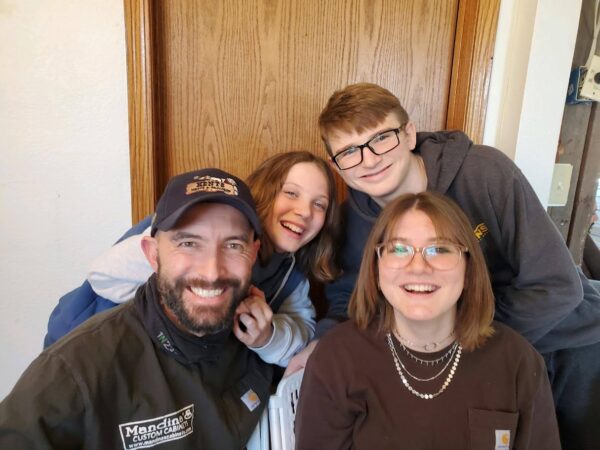
Derrick Jones and his children.
“Soccer kept us together on those weeks that the kids would go to their mom’s apartment,” he said. “I had a reason to go pick them up and go spend a few hours with them at the soccer park.”
Part of his profound sadness came from the realization that his children were now in exactly the same situation that had brought him so much childhood heartache as a kid of divorced parents.
“So for about four years, I overly involved myself in work and soccer” he said. “I drank heavily when I wasn’t with my kids because I couldn’t handle the emotions that I had without them.”

Derrick Jones and his daughters, post divorce. Photo courtesy of Derrick Jones.
“It was about grief and it was about letting my kids down and it was about missing them when they were with their mom. I’d always had that resentment toward my parents for getting a divorce, and here I was, doing the same thing to my kids. It was anger, it was grief, it was sadness, it was deflation. But at a certain point, I crossed a threshold where the alcohol didn’t work anymore in terms of quieting my mind and numbing the grief.”
Jones didn’t just get sober, but he joined Alcoholics Anonymous and enrolled in a series of programs through the Center for Advanced Recovery Education that covered the gamut from personal and professional growth, law and ethics, counseling theories and techniques, to case management, physiology and pharmacology. Jones was so committed to full disclosure about his recovery and his unwavering commitment to sobriety that his first date with Katee Tunin — the woman who would later become Katee Jones — was on the condition that she would agree to join him at one of his AA meetings.

Katee and Derrick Jones. Photo courtesy of Derrick Jones.
“You know, she’s for me,” Jones said. “She’s my proof of God’s involvement, the whole time.”
That “whole time” extends decades earlier back to Anderson High School, where the couple went to the junior and senior proms together. Jones said at the time, he had Katee on such a pedestal that she was the one who asked him to the prom. “I never had the confidence to actually date her,” he said. “So we went to prom two years in a row, then graduated and went our separate ways.”
They didn’t reconnect until after Jones’ divorce, when he’d accidently butchered an attempt to cut his daughter’s hair. He remembered he’d seen a post on social media that said Katee had left a former hair salon, and had opened her own salon in Anderson. He made an appointment and the two caught up as Katee did her best to repair Jones’ daughter’s botched haircut. Jones shared with Katee that he’d divorced. Katee shared that she was filing for divorce.
“I was like, ‘Oh, I’ve been there, and I wouldn’t wish that on my worse enemy,’ ” he said. “I had no intention at that time of even getting remarried. I was just happy to have this happy life with my kids and my sobriety, and my cabinetry.”
As the saying goes, the rest is history. The couple married in May of 2024. Jones’ three children, combined with Katee’s three children, grew the family to eight.

Katee and Derrick Jones with their children. Photo courtesy of Derrick Jones.
All Jones’ life roads — good and bad, dark and rocky – that led to where Jones is today is something he shares openly, including with students. In fact, those very earliest classes, Jones had some non-hands-on teaching time as he was anxiously waiting for the arrival of tools, equipment, and even books, but the classes were officially in session. During those hours, Jones taught about building and construction trades, but he also used the opportunity to talk — really talk — to the students.
“I talked about the industry. I described myself, where I’d come from in the industry, but I also talked openly and freely about my history with alcohol use,” he said, adding that come March 14, he will have been sober for four years.
“I told them these things because my experience was that I worked side by side in the industry with people who were way worse into drugs and alcohol. That’s a real thing out there. So I told the students that if you’re going to be in construction, you’re probably going to be exposed to it, even if you’re not the one using.”
“You know what’s funny, is although the kids were here to learn about woodworking, those kinds of conversations are what we really bonded over. I mean, now, most of what we talk about is construction. But when real life stuff gets brought up from time to time in class — these human things — we lean into it. And the thing I realized was the more I talked openly and honestly about myself, the more students talked openly to me about themselves, and what they’re going through. That’s where our relationships have gotten really strong.”
Onward
These days, Jones’ days are beyond full. In addition to teaching at West Valley and Anderson high schools, many days Jones also works at his father’s shop, Mandina’s Custom Cabinets, where Jones still operates his own business, Jones Woodworking.
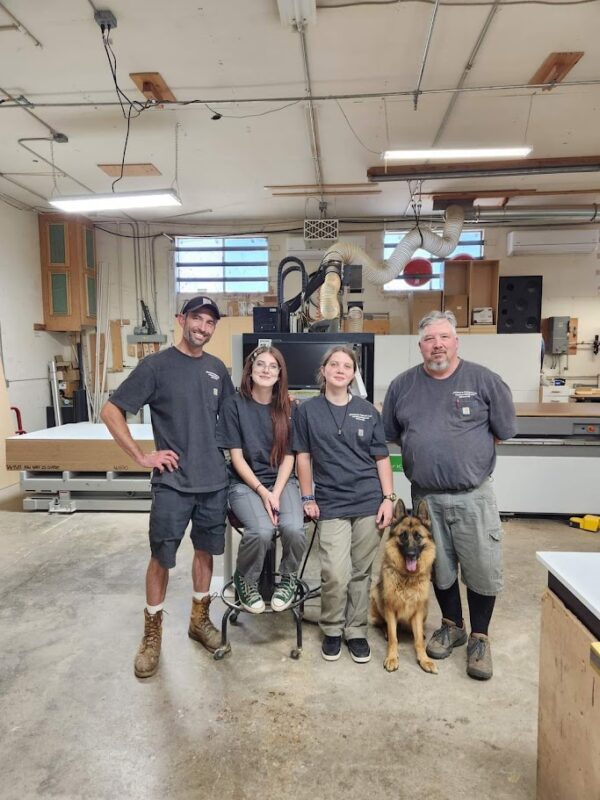
Derrick Jones and his daughters join Jones’ father inside his shop, Mandina’s Custom Cabinets in Redding. Photo courtesy of Derrick Jones.
Other days he coaches soccer. Some days include all those activities, and more. All the while, he’s living his best life for himself, his family and his students.
Some would say the job opening was an accident. Others, like Jones, would say it was meant to be.
“And now, here I am, working with these students, and I’m identifying all the things in some of them that were struggles for me,” he said.
“That’s the enlightening part; that I can look at all those things I learned through all the crash courses of my life, and I can blend them all together in my teaching by understanding what kids are going through. I see these high-energy kids, wanting to be anywhere else. They’re not necessarily bad kids, or bad students. But in the shop, we get to be ourselves.”
It turns out that Jones was right. Sometimes, good things do happen slow.
###
If you appreciate award-winning journalist Doni Chamberlain’s features, profiles, commentaries and food stories, then please consider a contribution to A News Cafe. Thank you!


