
Given the mosquitos, often blustery wind and a summer heat that can be unrelenting to those not topping a bonnet, one of the more interesting outdoor activities in the California Outback can also actually be enjoyed while indoors—as in behind the doors of your air-conditioned auto. It’s the Modoc National Wildlife Refuge, located about 2 miles east of Alturas. Even better, entry is free.
Recently, the refuge celebrated the opening of a new information center headquarters and a new 1.7 mile bicycle and pedestrian path that connects the 7,000-acre refuge to the town. The old headquarters building burnt down in October 2015—a suspected electrical fire.
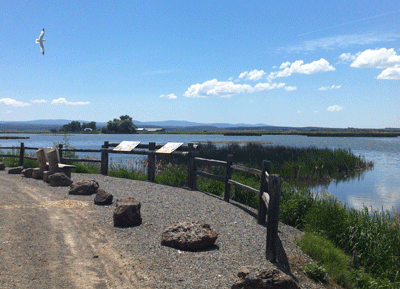
The Modoc National Wildlife Refuge auto drive offers several pull-outs and information kiosks. Photos by H.A. Silliman.
At the ceremony for opening the bicycle-pedestrian path, Alturas Mayor John Dederick said that the trail is an example of “the good that can happen to a community” when there’s a collaboration between local and federal governments—noting that the trail serves two purposes as both a recreation and public safety project.
It took $1.4 million and the cooperation of an alphabet soup of governmental agencies to get the trail built—and to add to the fun in the approval process—the pathway crosses a railroad track—which as another dignitary said, created “issues.”
The new two-lane asphalt pathway—set off on its own from the nearby county roads—is an amazing addition to the high desert—where amenities like this are few and far between—distant both in location and imagination. For up in the outback, folks don’t always have extra time for local recreation (save hunting and fishing). On Maslow’s hierarchy of needs, residents spend a lot of time on the basics—many have multiple streams of income—and there’s little in the way left (or available) for self-actualization—for pleasure.

The refuge headquarters hours are 7 a.m. to 3:30 p.m. weekdays and has displays and brochures about what birds and mammals can be seen. The refuge itself is open daily during daylight hours.
And what a pleasure the drive can be on a summer’s night along the one-way road that snakes through the refuge, edging along small levees and then running between wetlands and tules—a terrain that looks like the backwaters of the San Joaquin Delta. You can try idling through on the 3 miles of gravel road with the windows down and the fan going full blast to keep the bugs out—or enjoy with the windows up and still feel like you’re outdoors.
There are hiking trails inside the refuge—but don’t forget the Deet. A mosquito net hat is advisable for the dedicated who want to step do some intense bird counting—on their way to a “Big Year.” Modoc mosquitoes are famous—for their size and quantity (though don’t count ‘em as birds). With the refuge sitting on the South Fork of the Pit River, visitors get an extra dollop—again free—along with other winged things that flit in and out of an open car’s window.
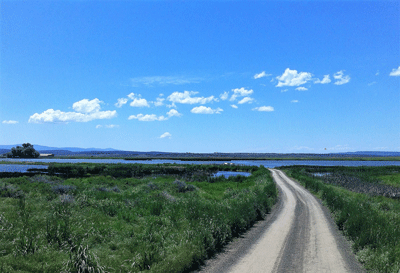
The refuge road is a 3-mile loop. Drive slowly to avoid the critters and ditches. The refuge entrance is located on County Road 115, off County Road 56 from the eastern edge of Alturas. Way signs are easy to find.
Yet, the visitor who can get past the bugs and endure earns an eyeful. The refuge is on the Pacific Flyway, with birds migrating from the north on down to the Central and Imperial Valleys. Beside the expected ducks, geese and myriad of marsh birds that the refuge attracts, it has a big reputation for the greater sandhill cranes that can be seen stalking through the wetlands.
If you’re a novice to birding and want to know what you can view out in the wild, stop by the newly built headquarters—open weekdays 7 a.m. to 3:30 p.m. The $1.4 million center offers displays of the variety birds and critters commonly seen. Those animals are stuffed—leading one to think about the various meanings to the word “conservation”—so the displays are informative as they are jarring—the most endearing, by the way, is the northern pygmy owl—a bird the size of a baby cottontail rabbit, a solid 10 on the critter cute-o-meter.
During the ribbon cutting ceremony for the center, Polly Wheeler, regional chief, National Wildlife Refuge System, told a story similar to one heard earlier in the day at the bike trail dedication—of the tribulations encountered during construction. “We are going to fix this bad boy,” is how she termed her determination to find funding after the fire destroyed the old office. “We scraped money from all kinds of different sources.”
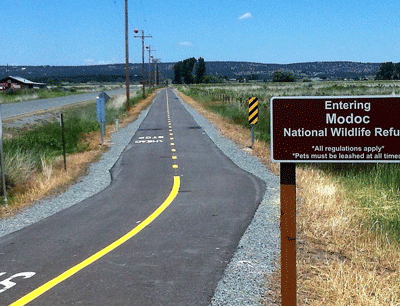
The bicycle and pedestrian path is 1.7 miles long and begins near the Modoc County Museum, on Main Street/Highway 395.
Noting the Modoc National Wildlife Refuge is one of 566 in the nation, Wheeler said, “These are your public lands,” to the assembled crowd of about 50 spectators. “Use them. Take advantage of them.” Of course, more use would make the assistant refuge manager Sean Cross happy. He counts people—and estimates up to 25,000 a year visit the site.
Before the event ended with the usual ribbon cutting—one of the scissors that survived the fire was used in the ceremony—there was a traditional Indian blessing given by Reuben Martinez, member of a local tribe. A few hours earlier he had blessed the new pedestrian path and now was here for the center. “No-ee-no. No-ee-nah,” he chanted in repetition, calling down the Great Spirit, “letting him know we are doing something good today.” The chant has no meaning other than to get the Great Spirit’s attention, he said, and then added, “Sometimes fire is a blessing.”
© 2018 H.A. SILLIMAN ALL RIGHTS RESERVED