

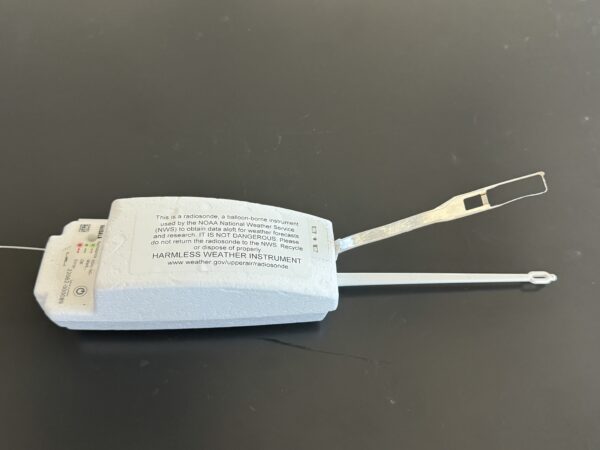
Vaisala RS41-NG Radiosonde, image from National Weather Service
There is a gap in weather monitoring data for the northern end of the Central Valley in California and Shasta College is going to help fill that data gap. Shasta College is hosting a weather balloon launch site as part of the Research and Operations Partnership (RAOP) between the California Department of Water Resources (CA DWR) and the Center for Western Weather and Water Extremes (CW3E) at Scripps Institution of Oceanography at the University of California San Diego. The balloons are equipped with sensors called “radiosondes,” which will help monitor very large storm systems (atmospheric rivers) and provide scientists with near-real-time data on their behavior. On Thursday, October 22, between 11:00 a.m. and 12:00 noon, scientists from CW3E launched a balloon to test the system. Teachers and students from a few Earth and Environmental Science classes were present to observe and record the event.
The CW3E has five sampling locations in California at and two in Washington. Selecting Shasta College as a launch site will help to provide more comprehensive monitoring for this area. Information gathered during a major storm event such as an atmospheric river helps communities plan for potentially dangerous storms, helps water storage managers determine how any given reservoir might be impacted (such as Shasta Dam, Oroville Dam, etc.), and can even provide a forecast outlook on water availability for the remainder of the year. Atmospheric Rivers are “streams” of subtropical air from the southeastern Pacific, heavily laden with moisture.
CW3E has been releasing radiosondes as part of Forecast-Informed Reservoir Operations programs since 2017. Once released, a balloon travels to about 82,000 feet in about 90 minutes. During that ascent, radiosondes collect data on air temperature, relative humidity, wind speed and direction, and air pressure. Near-real-time data from the radiosondes are sent to the global telecommunications system, making them available for data assimilation into global forecast models. CW3E will discuss the program goals and equipment at the test launch.
This partnership grew out of a Faculty Externship that Shasta College’s water science instructor, Pam Neronha, completed in 2025 with Scripps Institution of Oceanography, UC San Diego, to focus on Weather, Climate, and Water Fluency for Agriculture and Natural Resources. Dr. Julie Kalansky with the CA-NV Adaptation Program (CNAP), Center for Weather and Water Extremes (CW3E), and Scripps Institution of Oceanography, UC San Diego, supervised the externship and asked Professor Neronha whether Shasta College could launch a radiosonde program. In late July 2026, Ava Cooper, Field Research Data Analyst at the Center for Weather and Water Extremes (CW3E) and Scripps Institution of Oceanography, UC San Diego, met with Shasta College staff to further discuss equipment placement and the launch area.
The site is in a fenced-off area behind the Shasta College Campus Safety warehouse on the main Redding Campus.


