
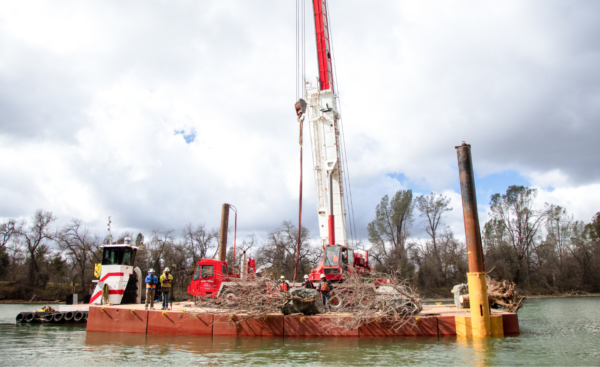
More than two dozen tree and rock structures known as “rockwads” will be added to the Sacramento River to provide juvenile salmon and trout populations with places to rest, feed, and hide before outward migration. The rockwads will replicate debris that once collected in the Sacramento River, a refuge to nurture young fish at the start of the life cycle. A coalition of farmers, scientists, and government agencies has come together to place more than two dozen structures at the headwaters of the Sacramento River in Redding.
While this effort is led by the Sacramento Valley Ecological Restoration Foundation (SAVER) and funded by the United States Bureau of Reclamation (USBR) and the US Forest & Wildlife Service (USFWS), the project is a partnership with local, state, and federal entities, including the California Department of Fish and Wildlife, Pacific States Marine Fisheries Commission, U.S. Army Corps of Engineers, California Regional Water Quality Control Board, and National Marine Fisheries Service. The project will be constructed in partnership with Sacramento River Settlement Contract members, including Reclamation District 108, the Glenn-Colusa Irrigation District, Basin Irrigation and Drainage Authority, and the City of Redding.
“By replicating young fish habitats that used to exist in the Sacramento River – without the potentially damaging impacts of loose debris – this project is helping to ensure salmon and trout populations have a place to grow and thrive here. The City of Redding has a vested interest in the health of local waterways, and this is just one of the many ways in which we are helping to take care of our natural resources,” says Josh Watkins, Water Utility Manager with the City of Redding.
The natural structures are built using 60 trees from a Woodland almond farm and dozens of five-ton boulders from a North State quarry. Together, these rockwads help provide juvenile salmon and trout with refuge from larger predators while enticing them to stay in colder waters longer. The longer they remain in these safe spaces, the greater the odds of healthy maturation for their journey to the Pacific Ocean.
With less debris naturally entering the upper portions of the Sacramento River, the rockwads represent a return to historical periods in which young fish populations flourished in old tree trunks and branches that often flowed down the river. The rockwads will sink to the bottom of the river, invisible from the surface, and deep enough so that they won’t impede boats or other watercraft.
“This is a perfect example of how we can create needed habitat based on what nature has already shown us works well,” said Roger Cornwell, President of the Sacramento Valley Ecological Restoration Foundation (SAVER). “The concept is fairly simple, and when paired with a diverse set of partners who are working collaboratively, we believe we can have a positive impact on our salmon and trout during their early life stages.”
Work will occur near the Redding Rodeo Grounds, north of the Sundial Bridge, from Monday, April 27, to Sunday, May 3. A large barge will be brought in to complete the work, which will be visible from the Sundial Bridge and parts of the Sacramento River Trail. Additionally, the Turtle Bay Boat Launch will only be open from sunrise until 9 am each day during the work period. Boats must exit the boat ramp harbor by 9 am.
The latest effort comes on the heels of earlier efforts that placed a combined 45 shelter structures in the South Bonnyview Bridge area.
“It is critical we place the structures in sections of the river that pair with key times in the juvenile salmon’s early rearing and migratory passage along the Sacramento River,” said Jeff Souza, a Biologist with Tehama Environmental Solutions. “By expanding this project, we will be able to provide more opportunities during various flow events in hopes that we can benefit more endangered fish each year.”
Led by the Sacramento River Settlement Contractors, Glenn-Colusa Irrigation District, the Sacramento Valley Ecological Restoration Foundation (SAVER), and funded by the U.S. Bureau of Reclamation (USBR) and U.S. Fish and Wildlife Service (USFWS), this is just one of several interagency projects supporting native salmon and steelhead runs in Northern California.
The Sacramento River is the only river in the world with four runs of Chinook, or “king,” salmon due to its diverse ecosystem. Near-year-round cold water, ideal for salmon populations, is driven by the area’s snowmelt, food supply, water velocity, water depth, and riverbed gravel.
The Rockwads Project implementation addresses some of the Central Valley Project Improvement Act’s mandates and also follows a comprehensive effort to recover all four runs of Chinook salmon and steelhead in the Sacramento Valley Watershed as part of the Sacramento Valley Salmon Recovery Program, the National Marine Fisheries Service’s Recovery Plan, the California Resources Agency’s Salmon Resiliency Strategy and the early implementation of the Voluntary Agreements/Healthy Rivers California action plan.


