
Don’t you hate when your doggie is sick? Dogs can’t tell us what’s wrong and they try to act like nothing is. Bobo, our Pit/German Shepherd cross, injured himself behaving like a wild animal on the Manton logging roads, where he was running alongside mountain biker Mr. Standish.
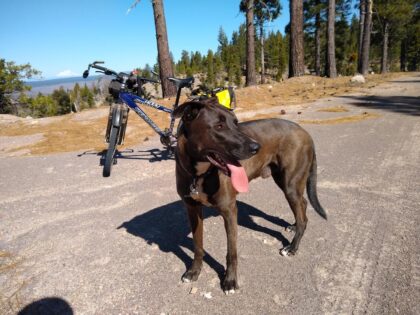
photo by Aaron Standish
Several of Bobo’s canine predecessors have also injured themselves out there, leaping over downed trees, diving off cliffs, chasing lesser critters, and crashing through brush.
Bobo was limping for a week or so and was bouncing back, when he suddenly took a turn for the worse. His ears felt warm and he was lethargic and not eating much, so we took him to Doc Lydon (world’s greatest vet) at the Shingletown Animal Clinic.
Apparently Bobo had eaten yet another fish he found in our pasture. Yes, we occasionally have fish in the field, even though we have no creek or pond on our land. They are dropped by birds on their way home from the South Fork of Battle Creek. With a pair of bald eagles nesting across the street from us and any number of great blue herons and other butter-fingered feathered fish eaters, we always have to check whatever gross dead thing the dogs are chewing.
Salmon poisoning is a serious bacterial infection caused by parasitic flatworms in salmon, trout, and salamanders. Normally, the flatworms don’t harm dogs, but some worms are infected with a certain bacteria I’m not even going to try to sneak past my spell check. That bacteria can enter the dog’s bloodstream and infect various organs. Untreated, dogs usually die within two weeks.
Treatment includes antibiotics and probiotics. Bobo is also getting a muscle relaxant and you’ve probably experienced the joy of administering any type of medical care to a pet or livestock. Bobo is being humiliated even further by rectal thermometer readings to monitor his fever – which has gone back to normal. Whew. We were almost out of lube and the weekend’s here.
Of course, Bobo doesn’t understand that we are trying to help him and that’s the most heartbreaking part. His eyes ask, “Why are you doing this to me? I’m not well and you’re hiding evil pills in treats? Anal probes? Really?” He misunderstands our intentions.
And speaking of misunderstandings, there have been plenty to go around lately, especially in the area of our water situation. People in Tehama County are in full freakout mode over a 29 cents per acre “fee” that is being considered as a funding mechanism to create a countywide well registry, because the county forgot to keep track of how many wells were being drilled and where. It is not a tax on water usage.
It may not even be a tax. I wasn’t sure what the difference was, so I consulted Casey Stengel’s ghost and he said, “You could look it up.”

Casey Stengel and Willie Mays – Tony Triolo/Sports Illustrated
I did and here’s what I found. “A tax has the primary purpose of raising revenue. By contrast, a fee recoups the cost of providing a service from a beneficiary.” The 29 cents will raise revenue to create a service to the beneficiary, so they’re recouping the cost ahead of time. Does that make it a tax instead of a fee? That’s for the lawyers to argue over. One way or another, we’ll be paying. A rose by any other name would smell as sweet, n’est-ce pas?
Do we call it a tax and have it go to ballot only to be voted down? Or do we all pitch in to get this registry created? There are probably many heavy water users who would rather not have their wells registered, as that might lead to metering and monitoring, goddess forbid.
Eventually, we need to come to terms with the fact that water is a shared but limited resource. It’s vital for daily domestic life. It’s vital to our ag businesses. The choices we make about equitable distribution have become monumentally important as that resource goes from limited to scarce.
The Groundwater Sustainability Committee is not working on anything that will help the dry well families this summer. They are working on long term stuff as assigned. Who knew we’d see such an unprecedented lack of precipitation? Only climate scientists, apparently.
Fortunately, Governor Newsom signed an Executive Order on March 28 halting all new ag well permits and alterations to existing ag wells. Yep – even here in Tehama County. That doesn’t mean the drilling will halt immediately. There are many well permits out there that have not been drilled yet. This EO is similar to the temporary moratorium the Tehama Board of Supervisors considered and tabled back in October. Now new production wells statewide will be permitted only with written verification from the Groundwater Sustainability Agency, who must also determine that the well will not damage existing wells or infrastructure. How will they do that? Wink, wink, nod, nod – you’re good to go.
Things are moving quickly all of a sudden and the 29 cents per acre is taking up more room in people’s brains than it should be. There will be public hearings about it so keep watching the paper, but this is a distraction from more immediate issues. As long as we’re talking about 29 cents an acre, we are not talking about how to help the families whose wells will go dry this year.
There were 127 dry wells reported in Tehama County in 2021. There is no way of knowing how many went unreported. Only 62 showed up on this chart, but it may have been early in the season.
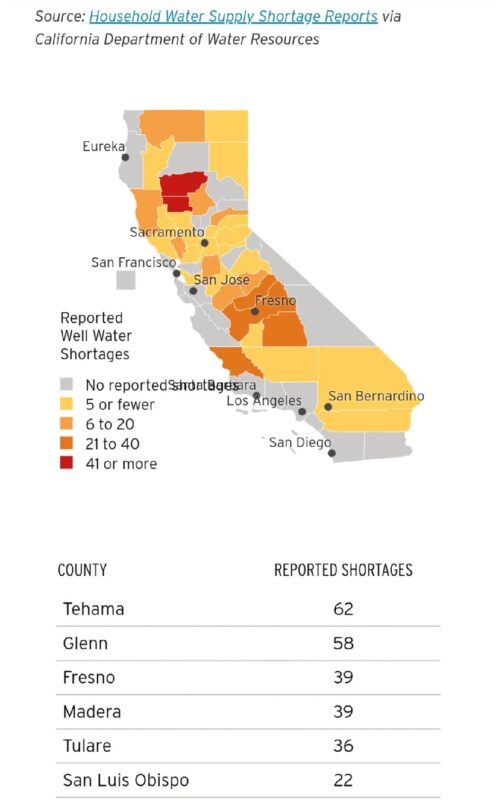
Tehama still had the highest number of dry wells in the state, even though it is number 41 in population. We’re number one! We’re number one!
What will we do if we have yet another dry winter next year? Serious conversations need to be had about which crops are able to be grown in unlimited quantities. Cactus farm, anyone?

photo by Liz Merry
The governor’s Executive Order also suspends water hauling prohibitions, as long as that water is used for domestic purposes. That will help the families with dry wells by allowing them to fill containers at public or private water sources and bring it home.
The EO also expands inspections of illegal diversion and waste and prohibits watering “non-functional” turf like decorative grass. This would not include residential lawns or grass used for recreation, such as school fields, sports fields, and parks.
All things considered, it’s a good start. The Tehama County Board of Supervisors has the authority to go even farther, by placing a temporary moratorium on ag well drilling instead of just permits. One would think nut farmers who already have mature trees would be all for this so they would have enough water to keep their orchards alive, but thus far they are hanging tight with their carpetbagging corporate brethren. With enough public pressure, the board will adopt a moratorium. Emails, letters, phone calls, and speaking (in person or by phone) during the Public Comment Period at supervisor meetings is the only way it’s going to happen.
And now a little closing advice – if you’re walking your dog in a park, by the river, or in your own backyard, fergawdsakes don’t let him eat any fish.


