

“After a mistake, any mistake, there is a moment that pleads for someone to say it wasn’t. And in its place, explain how it all fits in the grand design. That is what we look for. Forgiveness. Healing. A bit of harmony in the midst of the prevailing chaos.”
Quote from my Ometepe journal
August 14, 2017
When a friend’s been away for a long time – in an unexplained absence – and they suddenly return, we may feel a sudden surge of emotion. We may feel surprise, joy and relief to find them present before us. And we may feel irritation, suspicion and hurt that they disappeared without consideration for the precious threads that connect and hold us close. Behind all of that could be anger, doubt and distrust. We can’t decide if we want to hug or hit them. And in the midst of our conflicting, confusing swirl of pain and celebration is curiosity. We want information. Our first question is often, “Where have you been?” But what we’re really saying is, “Explain yourself.”
I have been away (again) from my post here at A News Cafe, ten months this time, and it feels appropriate to “explain myself.” An accounting is called for, I know. And the truth is, I really don’t know. Not fully anyway.
It has been my observation that many of us practice the AA adage, “Fake it until you make it.” We pretend we know what we are doing as we stumble through our lives. This past year has felt that way for me.
2017 was the year I celebrated 30 years of marriage and 30 years in my private practice as a clinical psychologist. I can’t imagine life without either of these precious blessings. For about 20 years, they were appropriately balanced as I devoted myself to my wife, daughters and work in proportions that felt healthy and correct. But as my daughters grew up and left home, and my wife’s breast cancer forced her to retire early, I found it possible and necessary to increase the hours I spent in my practice.
Eventually that meant I was spending 12 hours a day at work and scheduling 10 or 11 clients a day and catching up on paperwork and reports on the weekends. For the last decade I have averaged about 70 hours of work a week and thrived on it like the work-junkie that I am. I love what I do perhaps a little too much.
Of course, there is a price to pay for this. Most days I would forget to eat until arriving home and there was never time for exercise. I neglected my friends, house and yard as I worked until 8 or 9 every night. But somehow it felt right to me, though it clearly wasn’t balanced or healthy.
And if the box of my life wasn’t packed full enough last year, I found myself committing to various trips, unwisely jamming and forcing them to fit, even though it added considerably to my mental stress. Instead of having the weekend to catch up with work before seeing more clients, it seemed like I was always going somewhere or recovering from a recent trip. I am one of those weird people who can find vacations more stressful than working.
In April, it was Washington DC to participate in the People’s Climate March. In May it was a trip to a little cottage on the Oregon coast near Yachats. In July, it was a trip to Portland to hang with one of my daughters and her boyfriend before driving to The Gorge Amphitheatre, an outdoor concert venue adjacent to the Columbia River in Washington where we enjoyed Jack Johnson and the Avett Brothers and camped in a little tent for the night while everyone partied around us.
And then things got crazy. For our 30 th anniversary, I wanted to do something extra special. We had been to Nicaragua a couple times to visit our youngest, who lives and works there, and for our third trip, she suggested Ometepe, a 100-square mile, hourglass-shaped island known for its two volcanoes in the middle of Lake Nicaragua, the largest lake in Central America. That was scheduled for August.
And there was a family reunion in Ohio planned for September. And I mixed them up. The flight times, I mean. In my mind. And didn’t know they were mixed. I was blissfully unaware that disaster was coming. I thought I had everything under control.
We were flying out of Sacramento for both trips but the Nicaragua flight was just after midnight and the Ohio flight was 6 a.m. and I reversed them in my mind. So when I texted my eldest daughter at 10 p.m. that we were just about packed and ready for what I thought was our 6 a.m. departure, she frantically called me: “Dad!” she yelled into her phone, “You should already be at the airport! Your flight leaves at 12:30!” It was only then I checked my itinerary and realized to my horror she was right.
That was the night I learned that if you drive 90 miles an hour, you can get to the Sacramento Airport in one hour and 50 minutes instead of the usual 2 hours and 15 minutes. I also learned that you can go 90 and not get a speeding ticket from the CHP officer who passes you at 110.
Happily, the flight was delayed and we arrived before it departed. Sadly, this did not matter. When I naively asked if it was too late to board the plane, the customer service agent answered with an eruption of laughter, which I took to mean “Obviously no, you pathetic loser.” We spent the night in the airport, trying and failing to sleep in uncomfortable, poorly padded chairs near the baggage carousel while I brooded and blamed myself for what felt like a stunning, colossal failure. My furtive appeals for clemency in my own mind were met with cold, calm disgust. How could I do this? I mean, really?

We caught an early morning flight to Houston and after a long layover, flew on to Managua late that evening, where after 44 hours, we finally slept in real beds in a simple but clean motel near the airport. That next morning, we boarded a tiny plane to Ometepe so small there was no wall between the passengers and pilots. We sat a few feet behind them with a clear view out the front window as the island came into view and we felt a little queasy as it appeared we might crash into one of the volcanoes as we descended for our landing.
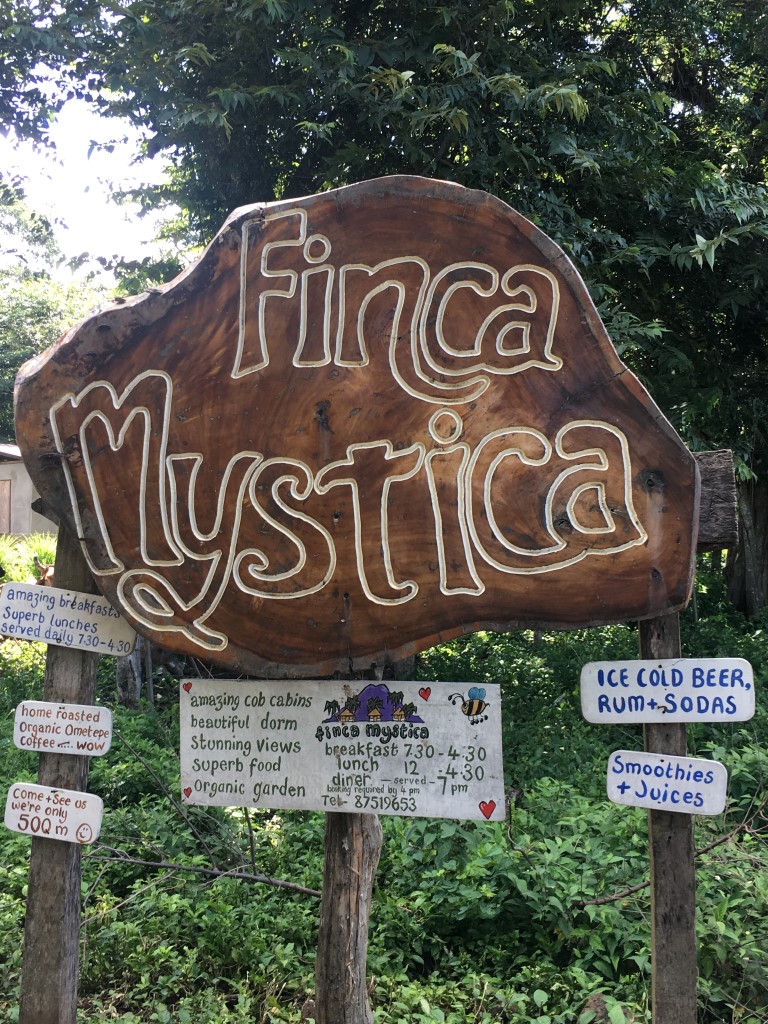
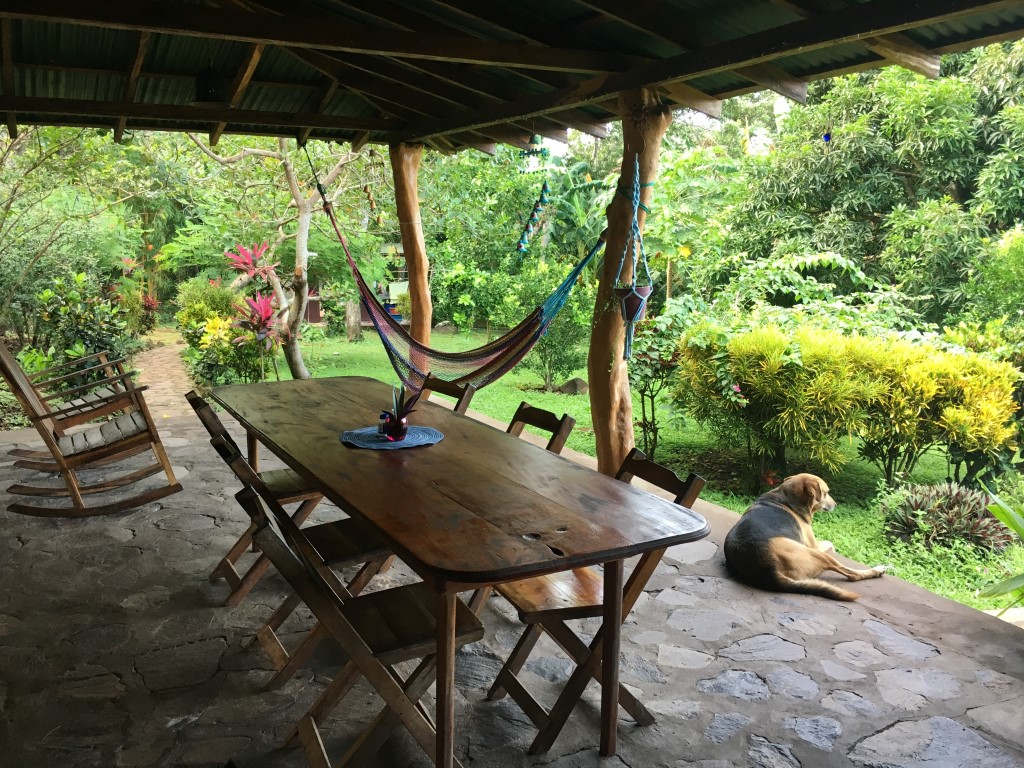
Upon arriving, our taxi driver was waiting to take us on the 80-minute ride – half of which was unpaved, uneven and rocky – to our home for the week at Ryan and Angela’s Finca Mystica, the cute collection of adobe cabanas surrounding the thatch-covered pavilion where guests gathered to eat meals and make new friends from all over the world.
The next morning, we were up early to lazily walk a mile and a half up the road to Caballitos Mar, a little inn that offered guided kayak tours. I had been careful to slather on sunscreen over my exposed skin before we got there. What I didn’t anticipate was the requirement to remove my socks and shoes before getting in the kayak, which of course exposed more skin (and my stupidity, as I forgot to apply sunscreen to my feet).
Another confession of abject ignorance: when the guide handed me my kayak paddle, I noticed the blades weren’t matched, aligned or parallel to one another. Instead the blades were “feathered” which meant they were not on the same plane. They were offset at an angle to each other, which I later learned is intentional and is supposed to reduce wind resistance on the blade that is out of the water. But it meant constant twisting of my wrists. It was one of those moments in my life where I wish I knew then what I would learn later. I should have spoken up about the feathered blades but I was too busy being a compliant tourist.
So, let’s review. I forgot to put sunscreen on my innocent pink-white feet, exposing them to the searing equatorial sun for four hours while I repeatedly twisted my wrists approximately 6,000 times. What could go wrong?
After paddling about two miles across the lake against a light but steady wind, we reached the mouth of the Rio Istian, the thin meandering river that slices into the narrow isthmus of land connecting the towering Concepcion and Maderas Volcanoes. It kind of reminded me of Florida’s Everglades, if it consisted of a lone, winding river – 10 to 20 feet wide – with a dense, forested canopy of mangoes and gnarled, mossy banyan-like trees, heavily hung with vines, a magical sanctuary of butterflies, floating water plants, howler and capuchin monkeys, turtles, fruit bats and dozens of colorful bird species of various sizes including jacanas, tiger herons, magpie-jays, woodpeckers, hawks, falcons, parrots, parakeets, whistling ducks, pelicans and especially, great white egrets that stood motionless as we floated slowly past them. Our guide kept pointing out the caimans, which I never saw, and assumed were very elusive, secretive birds like cormorants, but turned out to be the Spanish word for alligator.
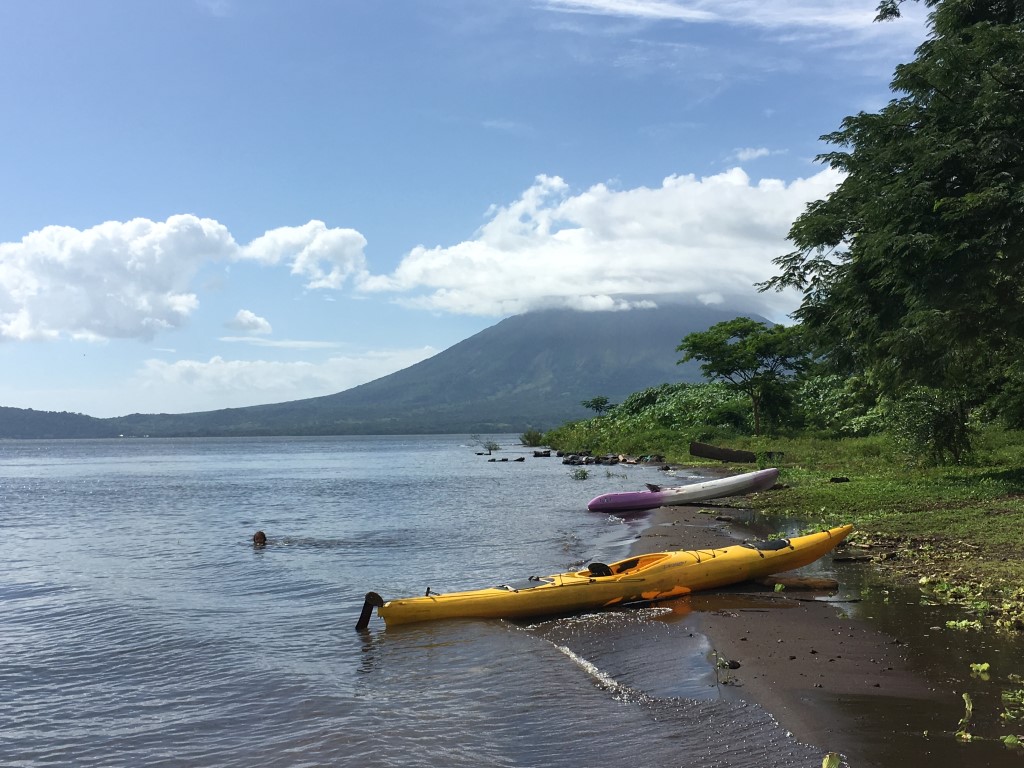
Even though I could tell my skin was already pink and verging on officially red, I foolishly declined Nancy’s offer of more sunscreen as we headed back out of the river and into the lake because it was wrapped up in a plastic bag with our phones which I was afraid might get wet. Another failure. Another regret.
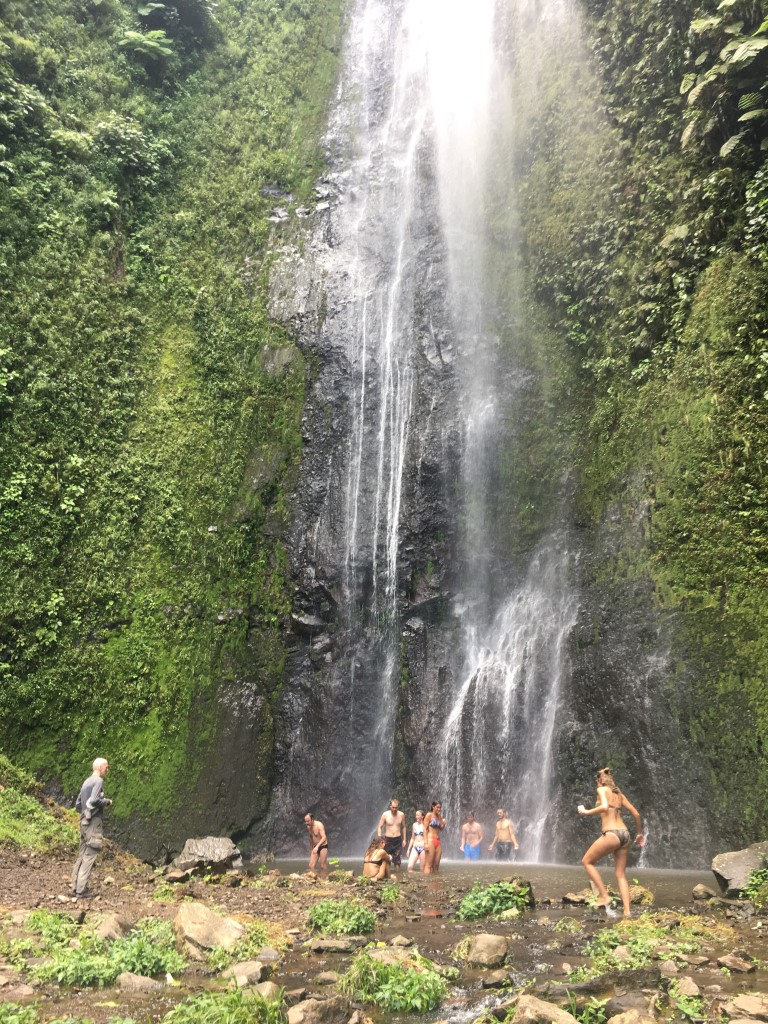
The next morning it was clear that my legs were badly burned, despite the “protection” of sunscreen I had applied to them but it was my feet that were truly scary. It looked like I painted most of the tops of both feet dark magenta. And so it made perfect sense to cover them up with shoes and socks and hike for a nine mile round trip, the last couple of hours involving a steep climb up 1200 feet in elevation on a trail that crisscrossed a steadily flowing creek that ended at the spectacular 160-foot San Ramon Waterfall.

The next morning, I discovered I had a new friend attached to my left foot, the largest water blister I had ever seen. In my journal I wrote, “I am sunburned. Seriously sunburned and a water blister the size of a fat man’s thumb is bubbled up like an amber gemstone, fossilized tree resin on the right side of my left foot.”
I could no longer wear shoes. Even my Birks were too painful to wear. I was essentially immobilized, reduced to walking the 50 feet from our little cottage to the pavilion every day to eat, drink, read, write, converse and listen to music for the rest of our stay. So much for our happy anniversary.
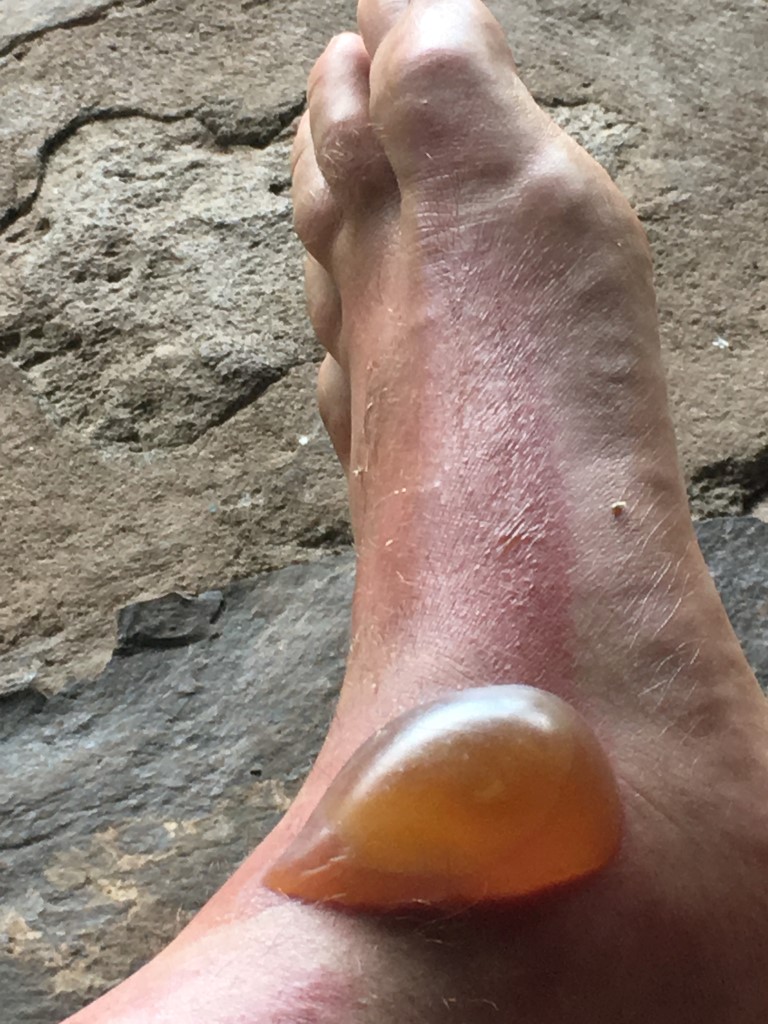
The young children of our fellow travelers would gather around me and gaze in fascinated horror at my foot as their parents would use me as a teachable moment. “See?,” they would ask with their Dutch or German accents: “This is why we nag you to put on sunblock.” The young ones would look up and nod at their parents, full of serious understanding and appreciation before asking me if they could touch it. I felt useful then, as if I had a purpose.
One of the books I read while doing a lot of nothing was Anam Cara: A Book of Celtic Wisdom, by John O’Donohue. I quoted him in my journal, “Love begins with paying attention to others, with an act of gracious self-forgetting.”
And then I wrote, “From pain comes self-pity and dark thoughts and that strange, lost feeling that no one calls you friend and no god calls you son. Not every stop on this long journey brings peace and equanimity. Sometimes we are given bitter gifts we’d rather not receive.
“Sometimes life hurts and when it does, who do we blame? Still, even now in the midst of pain, there is a silence here that doesn’t hurt. It doesn’t complain. In between the words, in the empty spaces, something powerful resides. There is a wonderful dance, marriage even, between what is and what isn’t.

“Sitting on this porch, I am surrounded by an entire world of things oblivious to my existence. Untouched by my pain, it is my teacher. The soft rain just now arriving. The brown horse with the white diamond on its head above its eyes eating green grass; the distant farmer waiting out the rain beneath a large tree; my wet blue shirt and Nancy’s floppy hat hanging on the clothesline that stretches loosely from porch post to porch post. The yellow bird chattering above my head; the stone floor beneath my feet; the pillow at my back; the Dutch woman outside her cottage, poised with a camera; the monkey in the tree she wants to photograph. Dawes singing, ‘I Can’t Think About It Now,’ the dark clouds, the distant volcano, Lake Nicaragua, cows, dogs, insects, and now the heavy rain that comes like an anthem to drench the earth with steady, persistent praise. I am alone with my pain, but now I give it to this world in which I am presently painted along with my prayers and pleas: help me forget me and my self-indulgent suffering. Let me reside in the great silence that brought all this to be with a single sound.”
A few days later, my daughter arrived on Ometepe from her home on Little Corn Island, and well-trained in first aid techniques, convinced me to ignore the Internet’s scary warnings and let her pop and drain the blister with a sterilized needle. I was relieved to see it deflate but the kids were bummed. I was no longer interesting.
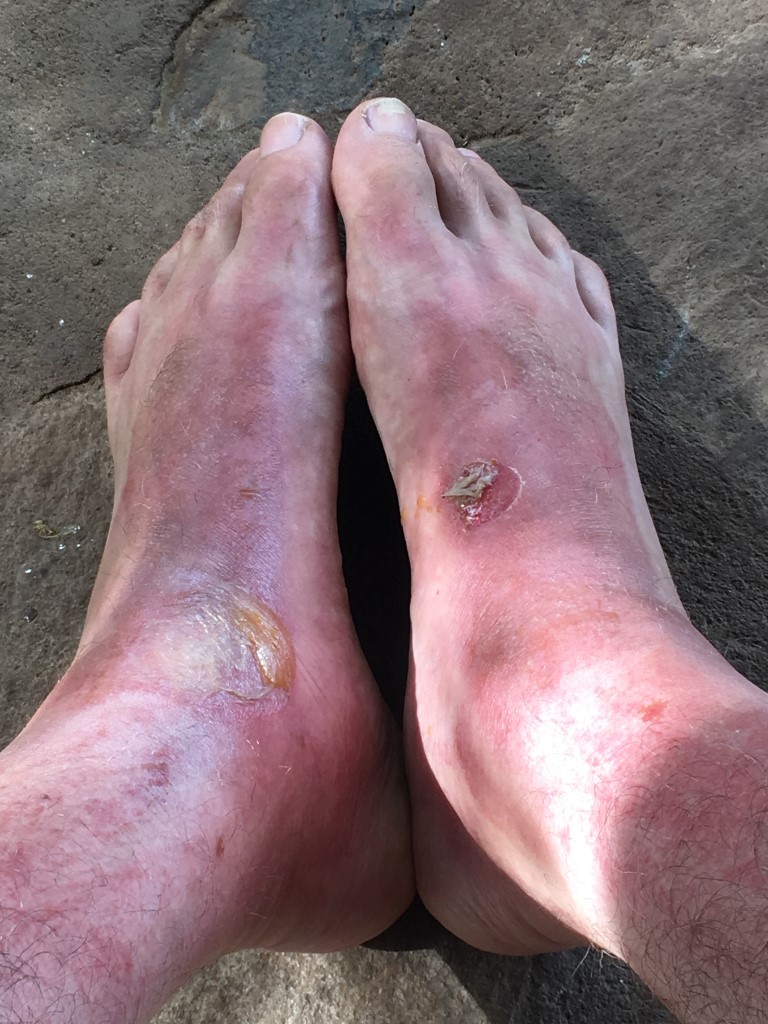
Stay tuned for part two of Explaining Myself which will attempt to answer several important questions such as…What happens when one attempts to push a wasp into a cup with their finger? What is the value of surgically removing metal plates and screws from one’s wrist? Is there an upper limit to my neuroses? Can we trust our own minds to tell us the truth? Can we ever lose if we always bet on love? Is it possible to forgive oneself after concluding one is not worthy of forgiveness? Is it a good idea to end this piece with a series of teasing questions?


