
An ambitious plan to confront Shasta County’s growing homeless problem remains just that—a plan—following a long but ultimately fruitless discussion Tuesday by the Redding City Council.
The hang-up, not surprisingly, involved money.
Councilwoman Kristen Schreder, who stepped out of her council role to spearhead the Redding Area Homelessness Coalition Project, presented that project’s report that outlines ways to strengthen and streamline the Shasta County Continuum of Care (CoC), a partnership of agencies, nonprofits and service providers tasked with delivering services to the homeless. The CoC also serves as a gateway to federal Housing and Urban Development funding, which has become increasingly competitive.
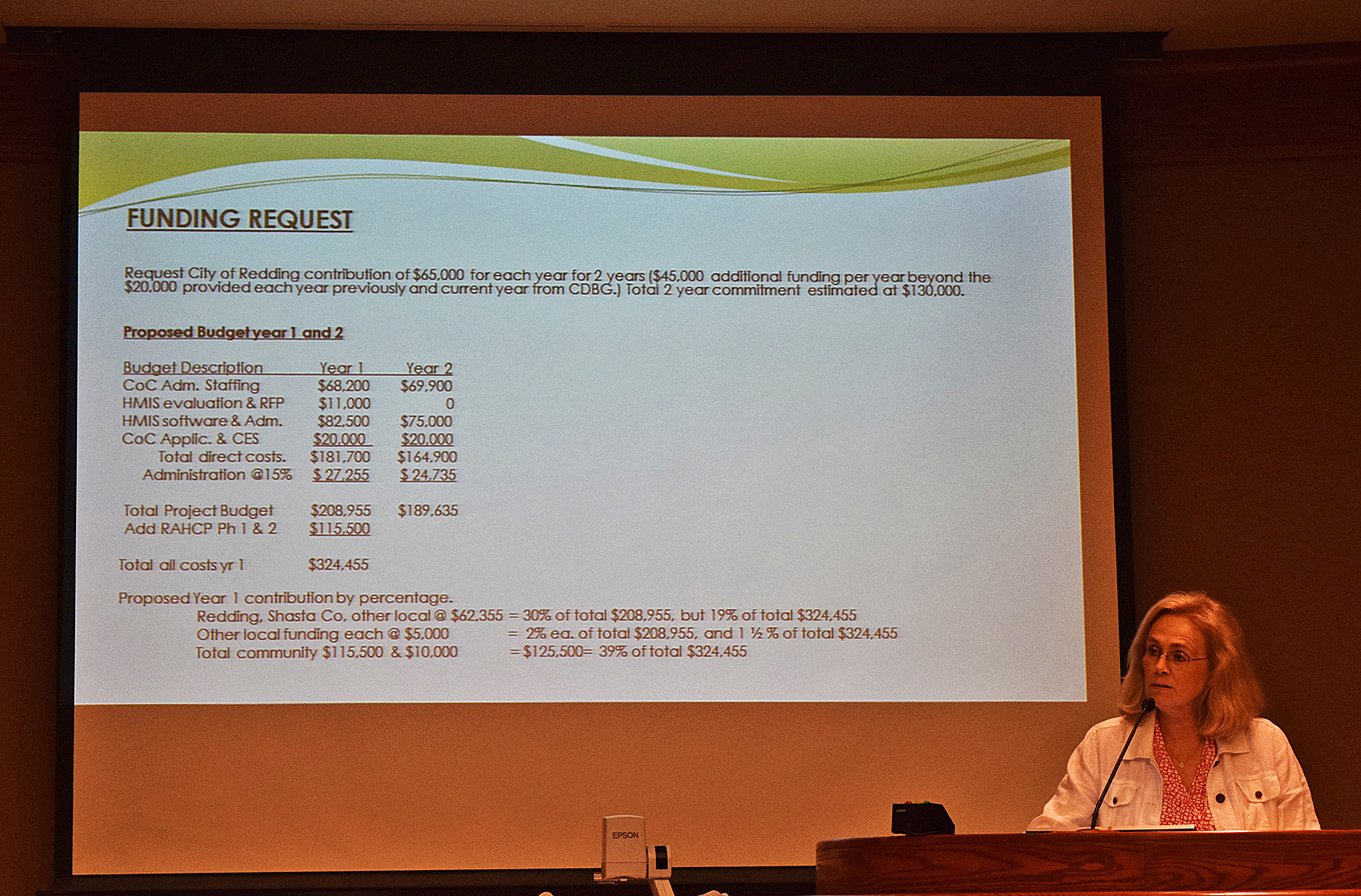
Schreder outlines her project with a slide show. Photo by Jon Lewis.
The goal is to get a handle on a growing homeless population that racks up some $34 million a year in costs and services related to health care, law enforcement, emergency shelter, food, environmental cleanup and jail space.
Redding Fire Chief Gerry Gray said his department spent $300,000 in 2015 responding to 33 homeless-caused fires. Firefighters also responded to 1,913 non-fire calls tied to Redding’s homeless population.
More numbers: a point-in-time census in January identified 934 people experiencing homelessness and another 169 who were “couch surfing” and without permanent homes. The 934 who identified as homeless represented .52 percent of Shasta County’s population of 179,533. Statewide, the percentage of homeless is .29 (based on a population of 38.8 million) and in the United States the percentage is .18, or 578,424 people out of a population of 318.8 million.
In 2015, some 2,269 people sought shelter at the Good News Rescue Mission; 3,031 people accessed health care at the Shasta Community Health Center while they were experiencing homelessness. Shasta County Health and Human Services reported that between 3,100 and 3,300 unique CalFresh (food stamps) recipients experienced homelessness during 2015.
Schreder’s group raised $115,000 from the community and used it to commission a consultant, Homebase, to prepare the Strategic Plan to Respond to Homelessness in Shasta County. The 42-page report identifies the need for a stronger CoC–to be administered by a nonprofit agency with its own full-time director—as well as a robust homeless management information system to meet HUD’s data collection, reporting and management requirements; and a coordinated entry system to more efficiently match available services with those most in need.
As currently constituted, the CoC has an annual budget of $40,000 that has been split between the city (which uses federal grant funds) and Shasta County. Under the plan presented Tuesday, its budget would be $208,955 for the first year and $189,635 for the second. Schreder, who has been working on this project for the past year, proposed Redding kick in $65,000 in each of the next two years.
Schreder is scheduled to make similar appeals to the Shasta County Board of Supervisors and the city councils in Anderson and Shasta Lake.
Murray Blake, a self-styled budget watchdog, objected to the funding request and noted the money would not take any additional homeless off the streets.
Julie Winter, a council candidate, urged the council to support the homeless project, as did Brandon Thornock, the director of clinical operations at Shasta Community Health Center.
“To me it’s a no-brainer to spend another $45,000 and put it in there and see if it will work,” said Mayor Missy McArthur. “What we’re doing now is not working. The community is fed up and we need to fix it. If we don’t, there is going to be heck to pay.”
Councilman Brent Weaver admitted that an additional $45,000 does not represent a sizable investment and a strengthened CoC will be a benefit to the community, but he said he was uncomfortable voting for the increased funding until he knows if Shasta County also will be contributing. In addition, Weaver said he wants to know which nonprofit will be running the CoC.
Councilman Gary Cadd also adopted a wait-and-see approach. “I’m not in favor of where we’re going,” he said, adding that “the city of Redding doesn’t have any money” and that the CoC proposal “will not take people off the street—it’s all going to administration.”
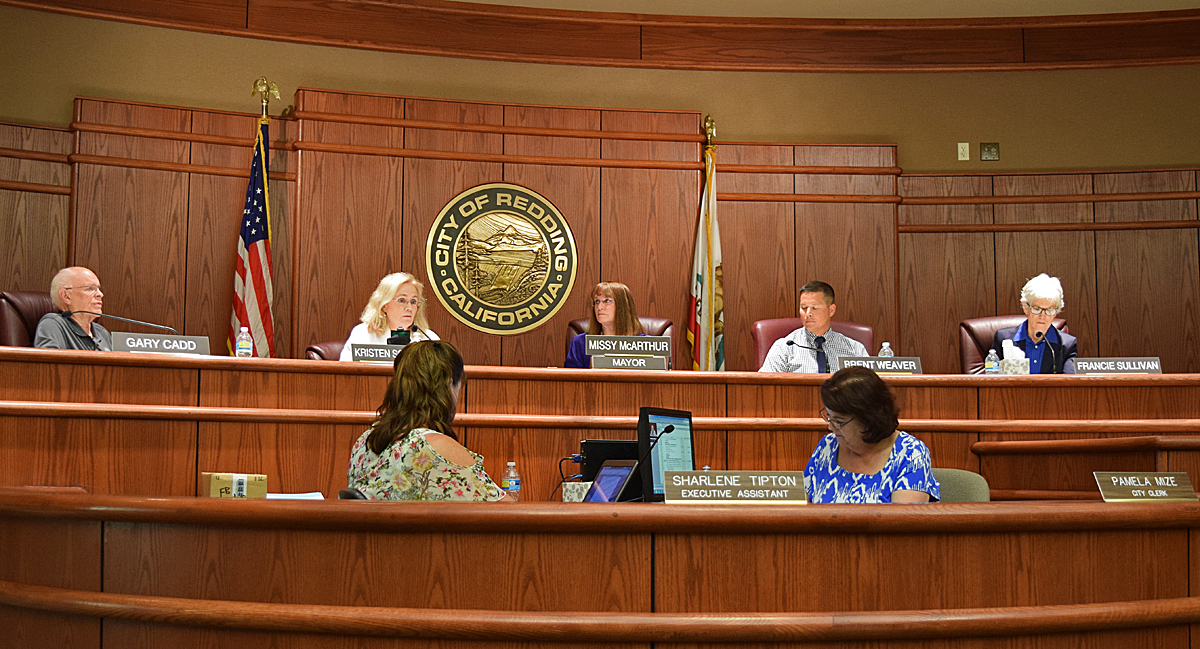
Redding City Council members discuss the homeless project funding question. Photo by Jon Lewis.
A visibly flustered Schreder said the CoC board of directors will select a nonprofit agency after issuing a request for proposals, but that the sooner the project gets launched, the sooner a strengthened CoC can begin securing grant funding to provide much-needed housing. “The time is now to take action,” she said.
Schreder expressed the concern that county supervisors, in turn, may wait to see how Redding supports the project, creating a chicken-or-the-egg scenario. “The community didn’t wait. It put up $115,000. I think it’s disingenuous to keep putting this off.”
In the end, Weaver’s motion to hold off on the funding vote passed with a 3-2 vote. Schreder and McArthur were the two dissenters.
In other action Tuesday, the council:
–Voted to have the Community Services Advisory Committee review the idea of erecting a fence along the eastern boundary of Library Park. The fence idea has been in the works for a few months and has been proposed to help keep transients and others from sleeping on private property that adjoins the park behind the Lorenz Hotel on California Street.
People illegally camping in the park have been leaving trash, dirty needles and human waste and business owners have complained about miscreants frightening off customers.
Ryan Russell, an architect who co-owns Carousel with his wife, Suzanne, said the fence is a “temporary band-aid” that will do little to curb the rampant crime occurring in Library Park and near his boutique at the corner of California and Yuba streets.
Russell suggested Library Park be turned into a community garden and offered to design it at no cost.
“Something has to be done,” said Sam Allen, the former Carousel owner who said she sold her business “because I couldn’t deal with it anymore … these people are running this town and we just roll over.”
Later in the meeting, Weaver suggested the council take a look at all the city’s under-utilized parks and come up with some ideas “not to drive people out but to get more people into them.”


