

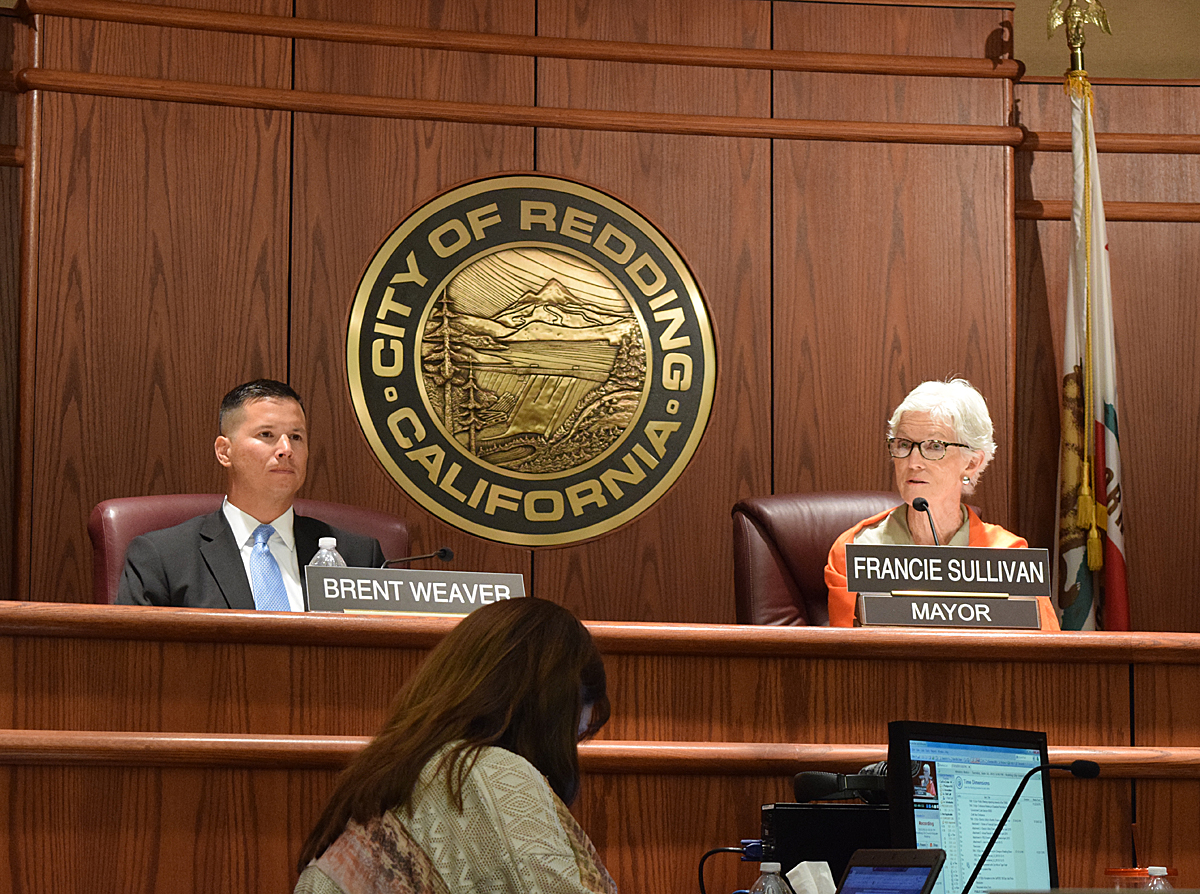
Councilman Brent Weaver and Mayor Francie Sullivan listening to concerned ratepayers. Photo by Jon Lewis.
With a surprising unanimous vote, the Redding City Council pulled the plug on a proposed rate restructuring that had been met with near-universal opposition.
Rather than schedule an August public hearing on the proposal, as Redding Electric Utility had requested, Councilman Brent Weaver’s successful motion instructed utility managers to rework their proposal and bring it back in the spring of 2017.
At issue is an effort by the community-owned utility to have ratepayers come closer to covering the utility’s fixed costs—salaries, transmission lines, transformers, etc.—regardless of how much electricity they actually use.
Barry Tippin, the REU director, said the proposed rate restructuring is similar to what other utilities are considering as the advent of solar panels and various conservation efforts have led to customers using less electricity.
As electricity use decreases, so do revenues. Unfortunately, the fixed costs of providing a reliable power grid continue to rise. To address that growing discrepancy, Tippin proposed a new rate structure that would increase the residential fixed monthly charge from $13 to $42 while reducing the energy charge from 15 cents per kilowatt hour to 12 cents.
The change would mean customers who use less power would see their bills rise while energy-gobbling households would actually see their bills go down. Low-income customers and others on fixed incomes would especially feel a pinch, and to offset that, REU would offer an “Energy Climate Credit” of $20 a month to ratepayers whose monthly usage is 600 kilowatt hours or less.
The utility would also expand its Lifeline Plus Program that assists lower-income customers.
“This is the beginning of a dialogue,” Tippin said, noting that “change is coming whether we want it or not.”
Mark Haddad, REU’s financial manager, said the utility is in a fairly unique situation. Its 44,000 customers are spread out over 61 square miles, requiring the installation and maintenance of a far-flung distribution network. In addition, Redding’s notoriously hot summers require REU to be able to power thousands of air-conditioners during the hottest part of the day.
Some 68 percent of REU’s costs are fixed but only 18 percent of its revenue is fixed, Haddad said.
“This business model will not work in the future, in a world where everybody is using less (energy) and rightfully so,” he added.
Jim Fieder, a former REU director, was the only speaker out of 22 who supported the proposed rate structure. Under the current plan, ratepayers are subsidizing solar customers. “At $13 a month, they are getting free backup. We are all paying for that, whether we know it or not.”
The other speakers were united in opposition. Some questioned the timing, while others said it would drive businesses out of town, discourage conservation and cause low-income ratepayers to incur more late-payment fees.
In explaining his motion, Weaver said he understood the issue on an intellectual level, but he just didn’t see the rate change as that time-sensitive of an issue. “I am concerned that we can’t point to other utilities for best or worst practices. Is it eminent that we act now? The playing field is changing rapidly … I’d urge us to be cautious.”
Councilwoman Missy McArthur seconded Weaver’s motion while noting that she is a solar customer and as such, she is aware that she is not paying into the system. She said changes are not too far away. “The grid is the beast that has to be fed,” McArthur said.
Councilman Gary Cadd said he wants to see “a vastly different proposal” and one that is more sympathetic to schools, seniors and low-income ratepayers.
“Who are the owners of REU?” Cadd asked while addressing the audience. “You are. I’m glad the council will listen to you.”

Jon Lewis is a freelance writer living in Redding. He has more than 30 years experience writing for newspapers and magazines. Contact him at jonpaullewis@gmail.com.


