
America’s greatness is not measured by the size of its arsenal but by the passion of its citizens.
If the citizenry is oppressed through corporate greed and manipulation, our greatness is diminished.
Remember the garment industry in New York? How about the steel industry of Pittsburgh? What about the Detroit Auto Industry? Gone, gone, gone.
How about the corner market or the locally owned hardware store? Gone and gone.
I’m not one to buy into conspiracy theories, but I also try not to bury my head in the sand. I believe these examples — and many more — represent the systematic dismantling of the middle class by corporate America. I see two obvious reasons. First, to increase profits for Fortune 500 corporations. Second, to remove the strength of unions in collective bargaining. See reason #1.
Once wages are brought down to a fraction of what they were 40 years ago, I wouldn’t be surprised if many of those jobs returned. Of course by then a large segment of the population will have lost their homes, health insurance, educational opportunities and financial security. The unions will be gone. In short it will look very similar to how it did in the late 1800s when the Rockefellers, Carnegies and Vanderbilts were the aristocracy.
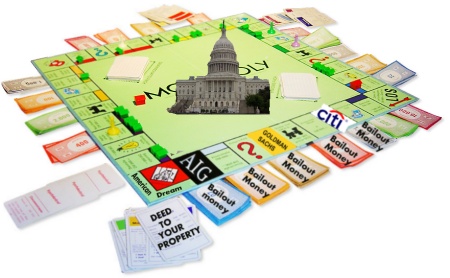
So the corporate boardroom big shots look around and say, so far so good. Let’s take it to the next level. Enter the sub-prime mortgage. Remember, the lobbyists acting like minesweepers cleared the way, through deregulation, for corporations to act with impunity. So the sales pitch begins and millions of Americans are persuaded to take the equity out of their home. What could possibly go wrong? Of course business cycles are the natural order of global economics. The problem is in a downturn many of those who refinanced can’t make the payments. And like a big Monopoly game, the hotels buy up all the little houses.
Then there’s the stock market and those titans of Wall Street, the investment banks. The stock market is a bit like the American gold rush. During the gold rush most of the money was made by those selling shovels. In the stock market, most of the money was being made by investment firms selling stocks (shovels).
Then came the coup d’etat. Those same companies that wreaked havoc on the status quo in the name of shareholder profits told Congress and the American public that there was a desperate financial crisis and we had to bail out these companies with $750 billion by Monday or the sky would fall. Members of Congress were shocked and ran around in circles screaming, “The sky is falling, the sky is falling!” So they gave those corporations the money, saying you should pay it back when you get on your feet. They never asked those companies to explain what they were going to do with the money. If you’d like to see how this is playing out, read this recent story in the New York Times.
I mention these familiar stories not to be cynical or fatalistic but rather to honestly assess what’s happened so we can come up with a workable plan to repair the damage.
The lessons learned during the formation of America’s trade unions can be useful today. At a time when big businesses were able to do as they pleased and individuals had little ability to alter the outcome of events, collective bargaining gave the American worker leverage to balance the needs of the workers with the needs of industry.
Let’s take health care as an example. There are a number of bills before congress to “fix” the health care system. We understand that Congress’ track record of being able to make real change in the face of pressure from lobbyists and corporate donations is not very good. The process would proceed more in the interest of the American public if the public had an alternative plan in the event the government plan didn’t really fix the problem.
Here’s an example (the dollar figures are for illustration purposes only):
I live in Shasta County, California, population about 163,000. My wife and I pay $500 a month for our health insurance, which covers catastrophic illnesses and has an $8,000 deductible. We have no pre-existing conditions.
Let’s say the residents of Shasta County form a not-for-profit company to self-insure residents of Shasta County.
Let’s say 100,000 local residents can afford to buy in and pay $200 per month per person. That’s a $20-million-a-month cash flow. Each of us is a stockholder and has a vote. All meetings are open to us, and no back-room deals are permitted. In a relatively small community this can be fairly manageable. Let’s say the person chosen to run this business is paid at about the rate of a community college president and the board is elected similarly to a community college board election.
As an organization, we would have tremendous leverage to negotiate prices with local health providers. Any excess money at the end of the year — excluding a reasonable cash reserve — would be returned to the stockholders in the form of a refund. Bye-bye, insurance companies.
I know there are many details not included in this brief description. It’s not meant to serve as a final blueprint, but rather as an example of creating real solutions. If a thousand counties sent a business plan like this to Washington and were ready to implement it if our elected officials didn’t create real solutions, the conversation on Capitol Hill would be very different.
Let’s look at investment banks. They have shown themselves to be the most unethical industry in the world. They have no product to sell — they are a pure greed play. Instead of giving them our savings to invest without most of us having a clue to where the money is going, what if we formed a local investment bank?
It would be similar to the big investment banks in that it would take our money and invest it. The difference is it would be mandated to give a priority to investing locally. We would benefit not only by having closer control over our savings but also through an influx of capital to worthwhile local businesses. We would improve the quality of life for ourselves and our children. We would also have control over salaries and would not be participating in paying out huge salaries to big bosses.
Again, we could use the community college as a model. If done properly, our costs would be lower, the benefit to our community would be obvious, and I can’t believe our return on investment wouldn’t be better. Bye-bye, Goldman Sachs and Citibank.
These are a couple of examples of how we can take back control of our health, our communities, our financial security and our future.
If you’ve got constructive ideas, please comment. All our futures are at stake.

Bruce Greenberg is a builder, artist, musician, world-traveler, studio fine furniture-maker and anewscafe’s business handler. His philosophy is to live creatively and take the road less-traveled. He lives and works in Igo, Calif., with his wife, Doni.


