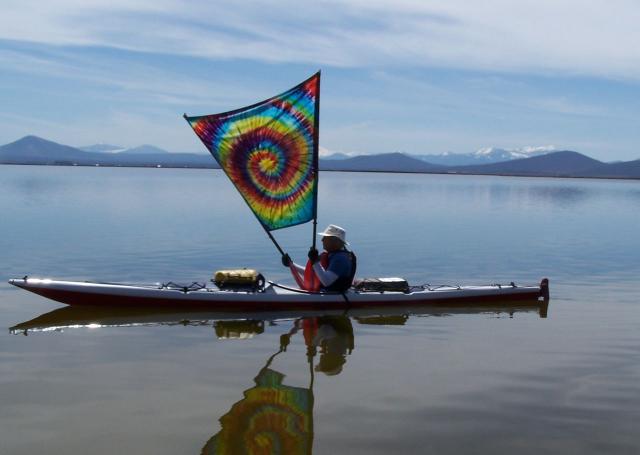
Burney’s Leroy Bettencourt uses a homemade sail to cruise along.
California boasts so many spectacular scenic landscapes. High on the list, however, has to be the incredible Fall River Valley, with Mt. Shasta anchoring the northern view and Lassen Peak and Burney Mountain off to the south and east.
Right now those mountains are still wearing their white coats, and the valley looks spectacular. A great way to immerse yourself in the area is a trip to the little-known Ahjumawi Lava Springs State Park.
That’s where I found myself on Friday, and it made for a memorable day.
Couple things about Ahjumawi: It’s tricky to pronounce (ah-joo-maw-we) and kind of hard to find. I didn’t see any signs for the park from McArthur, where you turn off. Here’s how it goes: You turn north on Main Street in McArthur and proceed past the Inter-Mountain Fair grounds onto a dirt road. When the dirt road hits a “Y,” you stay right and drive to a small boat launch area known as the “Rat Farm” (they used to raise muskrats there several decades ago).
Oh, yeah, did I mention you need a canoe, kayak or small boat to reach Ahjumawi?
In Redding, Penguin Paddlers (3330 Railroad Ave.; 244-3355) would be happy to set you up. They don’t rent kayaks, but they sell quality boats starting at around $260.
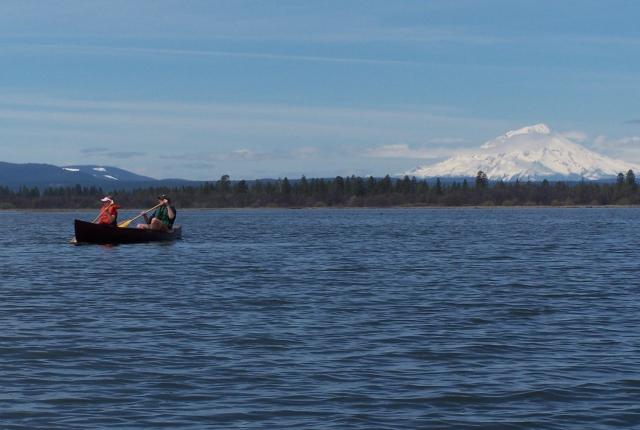
Mt. Shasta to the north from Big Lake/Ahjumawi.
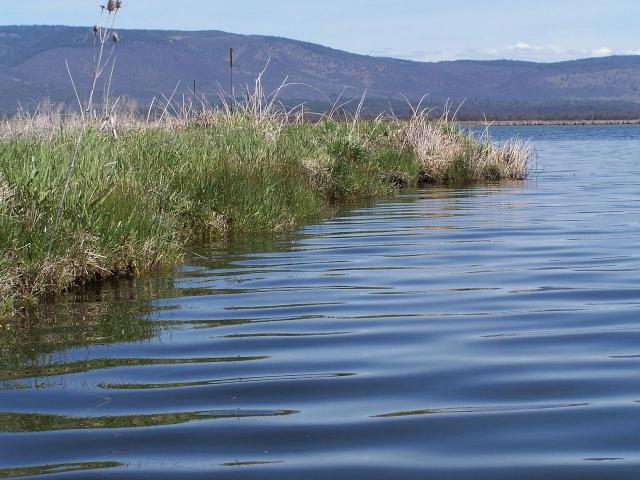
Anyway, you launch from the rat farm (don’t worry, no rats around), paddle out a small channel and then into the main body of Big Lake. To the Pit River Indians, Ahjumawi meant “where the waters come together.” The waters that come together in Big Lake include the Tule River, Ja She Creek, Lava Creek and Fall River.
Out there on the lake, the wildlife (waterfowl everywhere) and views almost take your breath away. If you can fit your camping gear onto your boat, there are nine primitive camp sites available in the park. Point the nose of your craft generally toward Mt. Shasta and paddle to Horr Pond (a little cove) where the camp sites begin.
The park is covered with black lava rock. There are huge fields of the rock (lava flows), as well as lava tubes and craters. There are 20 miles of hiking trails in the park, including a 5-mile round-trip trek to a splatter cone.
The place is a bird-watching paradise. Actually, it’s also a bird listening paradise. At one point, I just closed my eyes and took in the sounds of what sounded like dozens of species of winged creatures.
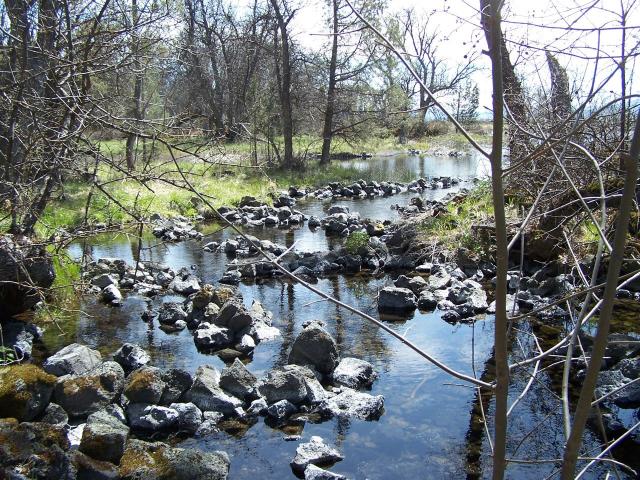
Ancient American Indian fish traps at Ahjumawi.
There are freshwater springs flowing from the lava rocks, and ancient Native American “fish traps,” little mazes made from lava rocks where Indians would spear fish.
Mostly, the park looks and feels pristine. It’s pretty much the same view of the land that natives have seen for centuries.