
People have been grafting plants for so long there is no adequate evidence of when it all began. A Sumerian text dated around 1800 B.C.E. refers to grapevine shoots that were meant to be planted at Mari (present-day Iraq). Although it doesn’t specifically mention grafting, there is speculation the shoots had to be grafted to a salt-tolerant wild grape rootstock in order to survive the desert climate. If this is true, it would be the first known evidence of grafting.
There are many references to grafting in various religious books. The Hebrew bible has the following passage in it: Isaiah 5: 1-2: ‘‘My beloved had a vineyard in a very fruitful hill. He digget it and cleared it of stones, and planted it with choice vines; he built a watchtowere in the midst of it, and hewed out a wine vat in it; and he looked for it to yield grapes, but it yielded wild grapes.” This passage is thought to refer to the wild grape rootstock taking over the preferred grafted wine grape. Greek and Roman sources indicate that grafting was well known and widely practiced throughout the Mediterranean region by the fifth century B.C.E. and during the Talmudic-Hellenistic times, when the Mishna was composed. In the Mishna, grafting and layering of grapevines appear as a common practice and planting, layering, and grafting are often described together as regular methods of fruit tree propagation.
The earliest verifiable written account of grafting is from the Hippocratic treatise, On the Nature of the Child, thought to have been written in about 424 B.C.E. by one or more of the followers of Hippocrates, hence referred to ‘‘Pseudo Hippocrates”:
‘Some trees however, grow from grafts implanted into other trees: they live independently on these, and the fruit which they bear is different from that of the tree on which they are grafted. This is how first of all the graft produces buds, for initially it still contains nutriment from its parent tree, and only subsequently from the tree in which it was engrafted. Then, when it buds, it puts forth slender roots in the tree, and feeds initially on the moisture actually in the tree on which it is engrafted. Then in course of time it extends its roots directly into the earth, thorough the tree on which it was engrafted: thereafter it uses the moisture which it draws up from the ground. ‘
This passage suggests that grafting was a common technique at that time and thus must be centuries older than the fourth century B.C.E.
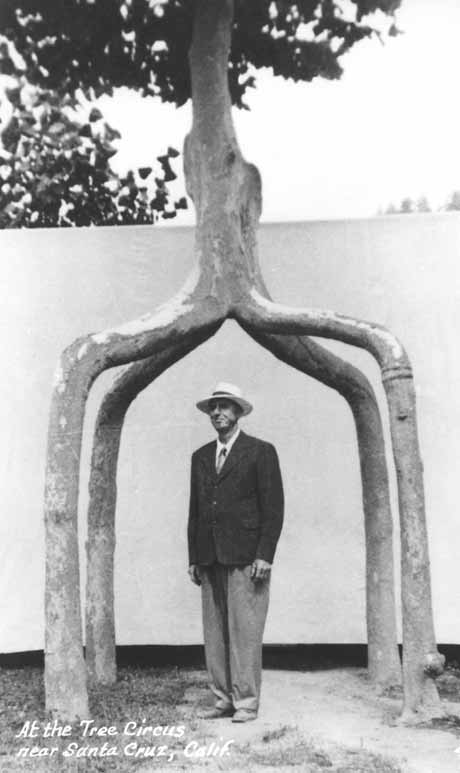
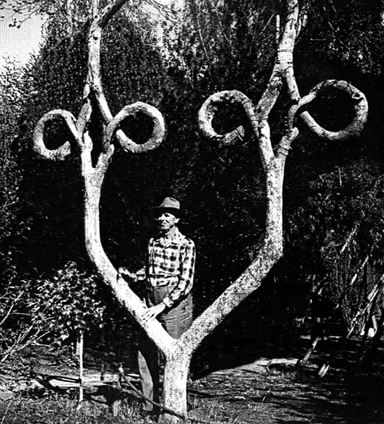
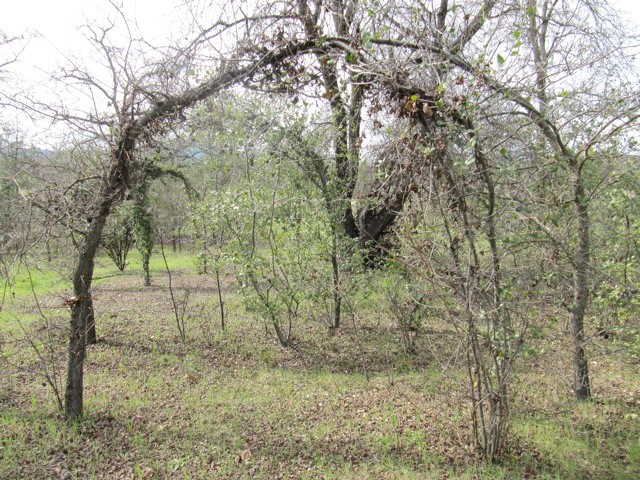
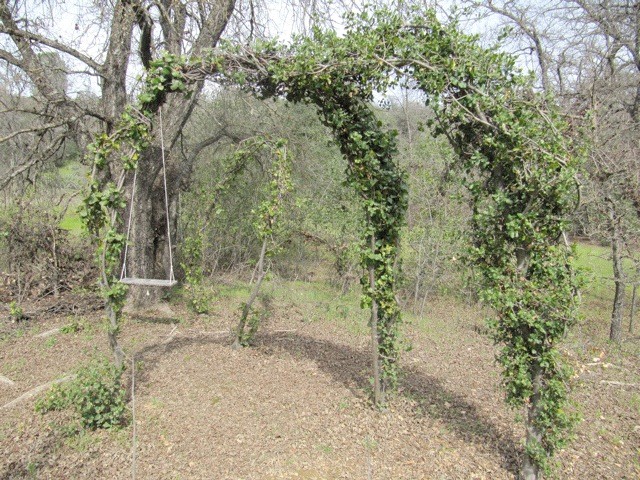
Years later (in the 1920’s actually), a man named Axel Erlandson began his journey of twisted tree grafting. Completely ornamentel, this way of grafting creates fun and interesting living shapes. Artists from around the world have been inspired by the grafting that is found in nature. These pictures, taken in an undisclosed field in Redding, are examples of what the love of nature and trees can compel people to do:
But various are the ways to change the state
Of plants, to bud, to graff, to inoculate
For, where the tender rinds of trees disclose
Their shooting germs, a swelling knot there grows:
Just in that space a narrow slit we make,
Then other buds from bearing tress we take;
Inserted thus, the wounded rind we close,
In whose moist womb the admitted infant grows.
But when the smoother bole from knots is free;
We make a deep incision in the tree.
And in the solid wood the slip inclose;
The battening bastard shoots again and grows;
And in short space the laden boughs arise;
With happy fruit advancing to the skies.
The mother plant admires the leaves unknown
Of alien trees and apples not her own.
~ Publius Verglius Maro (70-19 B.C.E.)
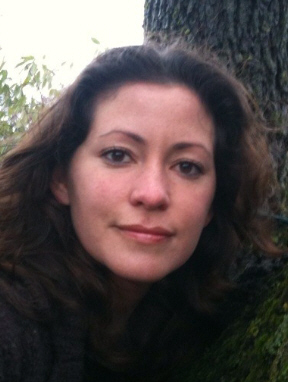 Marie Stadther’s life in Coachella Valley was void of trees. In 2001, she packed up and headed north. After a drive through the majestic redwoods, she arrived in Redding, where she immersed herself in horticulture as owner of her own landscaping company and as assistant to an arborist. She is now the lead gardener for Turtle Bay’s McConnell Arboretum and Botanical Gardens. Her love of trees is a way of life, and she shares that passion with the community. Send the Tree Goddess your questions at mstadther@turtlebay.org.


