
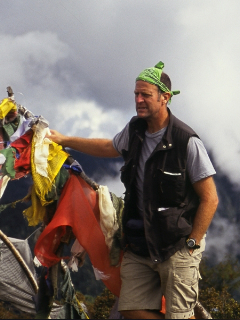
 Dan Hinkley inspires people. I think he would be inspiring to anyone, but specifically he is inspiring to plant lovers. Dan is an internationally acclaimed plantsman, plant hunter, author and former nurseryman based in Indianola Washington. He first came to national prominence in the late 1980s and 1990s, when he (at the time an instructor of horticulture at a local community college) and his partner, Robert L Jones (an architect), started a rare and exotic plant nursery and display garden on the woodland grounds of their home in Kingston, Washington: Heronswood Nursery, Ltd. Over time, due to profoundly hard work, deep passion, Dan’s adventurous plant collecting, plant education outreach and expansive personality, Heronswood Nursery became something of a Xanadu for ‘serious’ gardeners throughout the world. Photo: Dan Hinkley, Plant Hunter, in a press-shot for his new book.
 Heronswood Open Days held throughout the year were coveted horticultural experiences. The Heronswood catalogue, an annual (and weighty) compendium of personal, alluring and often witty plant descriptions, interspersed with essays on various topics written by guest experts, became collectors’ items. In the summer of 2000, Hinkley and Jones sold Heronswood Nursery Ltd. to W. Atlee Burpee & Co, which went on to close the Heronswood site in Kingston, WA in 2006 and move much of the stock to the company’s headquarters in Pennsylvania. The closure and move were accompanied by dramatic moaning and gnashing of teeth throughout the plant world – and for good reason. Photo: The Heronswood Nursery catalogue written the winter before the nursery was sold to Burpee.
Interest in Heronswood borders on cult-like even today, and when you chat gardening, a conversation while visiting a new friend’s garden can quickly move from “What kind of tomatoes did you plant this year?” to “Oh, is that a Podophyllum you have over there? I saw some beautiful specimens at Heronswood in 1999, when it was still open.”
What you know about Heronswood, and if you ever visited, might serve as an effective litmus test for a gardener’s level of passion and depth of knowledge. Well…maybe, maybe not. That said, if you did know about or visit Heronswood under Dan Hinkley and Robert L. Jone’s care, you were certainly lucky and in a good gardening place at a very good time.
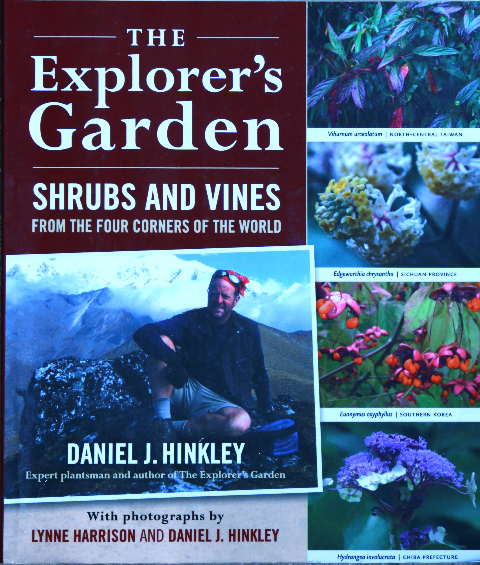 I was lucky enough to have lived and gardened in Seattle from 1995 through 1999. I was also lucky enough to have had a professional gardener for an aunt, who visited me in Seattle from her home in Virginia in 1998 and insisted we make the trek to Heronswood. I was subsequently able to visit the gardens there on several other occasions and my old Heronswood catalogues are dog-eared and marked up with margin notes: “Would Petasites do? Androsace strigillosa?” Photo: The advance preview copy of Dan Hinkley’s newest book – the second of his Explorer’s Garden publications.
So – “Why all this gushing”, my producer at North State Public Radio asked me (he is not a ‘serious’ gardener, although he is trying). “You kind of sound like a groupie.” “Is Dan Hinkley really good looking or what?” one of the radio hosts asked me. Dan Hinkley is perfectly good looking, by the way, but he seems very happy with his life as it is.
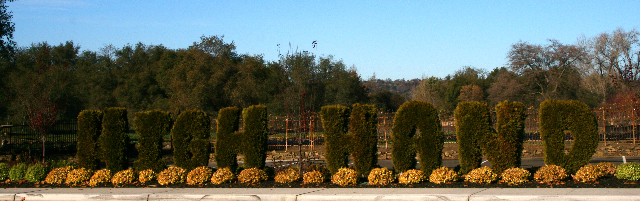 So here’s why: He’s coming to speak at High-Hand Nursery in Loomis, California June 13th and 14th. On Saturday the 13th at 1:00 pm, he will be giving a talk on “Good Plants for the Twenty-First Century”. Tickets are $5. On Sunday the 14th, at 11:00 am, he will be giving a talk titled “Recent Travels – in Search of Good Plants.” Tickets are $5. On Saturday evening at 5:30 pm, you can also have dinner with Dan in the conservatory at High-Hand Nursery. The $65 ticket price includes a copy of his newest book: The Explorer’s Garden: Shrubs and Vines From the Four Corners of the World, (Timber Press, June 2009 – $39.95). Photo: The topiaried shrubs welcoming you to High-Hand Nursery on main street in Loomis.
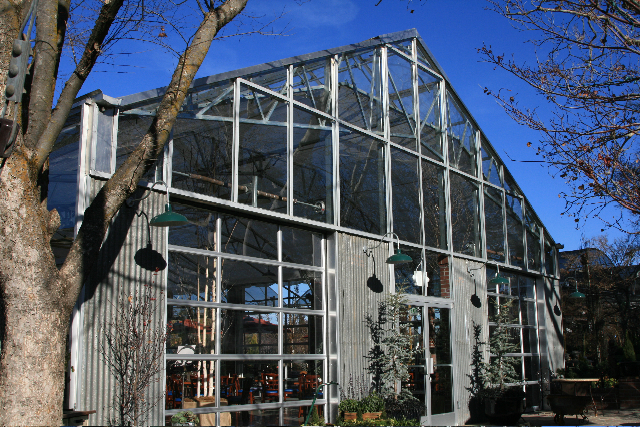 I don’t know if you have noticed this, or if it bugs you a little the way it does me, but it is not often that we as North State gardeners get a chance to meet and hear plantspeople of such a caliber in our own region. Yes, we can go to San Francisco, or Napa, Denver, Portland, Seattle, London. But not here at home. And many, many good and interesting things are happening in the world of horticulture right here in our home. I think we should support and take advantage of them when they come along and encourage them to keep coming along. Photo: The gleaming new Conservatory at High-Hand where dinner with Dan Hinkley will be served on Saturday June 13th.
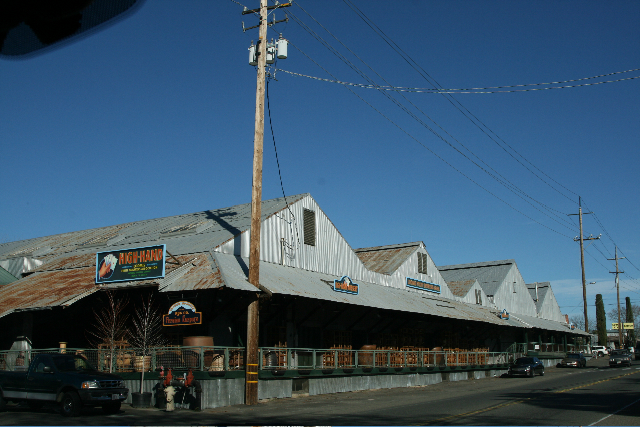 Scott Paris, owner and founder of High-Hand Nursery in Loomis spent more than 20 years as a landscape contractor in the area before beginning development of High-Hand in 2003. He and his staff have spent the last 6 years renovating the 100 year-old + historic fruit sheds of the High-Hand Fruit Company from their destitution into the destination nursery and garden center they are today. High-Hand’s buildings line one entire block of Loomis’ main street. After the nursery opened, the conservatory restaurant opened in the October of 2008. The low-slung wooden shed facility still holds all the vernacular architectural appeal of its fruit packing days: cool, dark wooden-beamed ceilings, pulleys and old rollers remain. Light filters in through ceiling cracks and side windows. “I started the nursery in part because I was tired of not being able to access the plant palette I wanted as just a contractor,” Scott told me. High-Hand’s strongest suit (pardon the card-game pun) is perhaps their unusual plant selections and their ability to help broaden the direction of gardening in their immediate vicinity through their selections. Photo: The long, connected shed buildings of the fruit packing company which originally inhabited them and for which High-Hand Nursery is named.
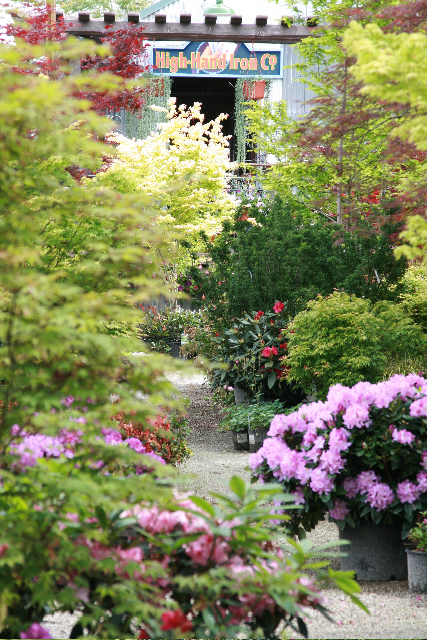 Presentation and display are perhaps their next strongest suits. The elegant cobble and stone-work nursery-yard has a personal feel – plants are displayed in pocket gardens throughout the yard, topiaries appear as focal points at the end of pathways. There is little signage “by design,” Scott tells me. “The layout of the yard is intended to slow a person down, and the displays are designed to allow you to pause and experience the plants as you would in a garden. Instead of looking at signs and focusing on words, you are looking at foliage, feeling textural contrasts, and smelling fragrance.” Staff are all around to ask for help. Besides the nursery and restaurant, an on-site iron-works holds classes and provides some of the custom iron décor throughout the nursery; an extensive pottery room holds aisles of large and small glazed pots, and a cooperative art gallery and an oriental rug dealer sit further down the building. The nursery buys from established growers but also has two growing sites of their own. Behind the conservatory restaurant is Chef Randy’s Garden a large kitchen garden of fruits, vegetables and herbs for use in the restaurant. Photo: A view down one of the aisles in the nursery yard at High-Hand.
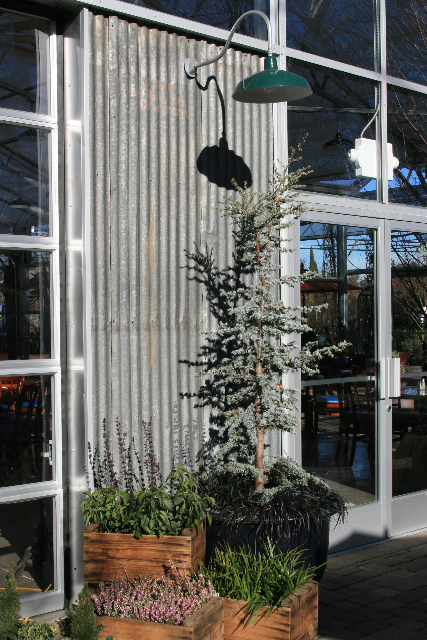 “My motivation for inviting Dan Hinkley here to speak was simple,” says Scott. “I was tired of hearing all the doom and gloom stories about the economy and I wanted to bring plants people together to celebrate that the nursery industry is still here, alive and well, passionate and doing great things. I wanted to put together a Plant Symposium that helped to show people all the enthusiasm that goes into getting any plant to market.Who better than Dan Hinkley to illustrate the passionate side of plants? So I called him up and asked him.” With some help from Monrovia, who in part sponsor Dan Hinkley’s plant collecting and with whom he is working on a line of unusual and hard-to-find plants resulting from his recent collections, Dan agreed to come. The 1st Annual High-Hand Nursery Plant Symposium was born. As Scott and I talked, he inspected some hellebores recently finished blooming. “I want people to get plants – to have a real understanding of them,” he said, and I knew what he meant. He and Dan Hinkley are clearly kindred in their desire to help people get, in the most philosophical sense, good plants. Photo: High-Hand Nursery has very nice displays and the recurring motif of the vernacular architecture of the old fruit sheds runs throughout even the new additions to the site.
 I have heard Hinkley speak on two occasions, both times he was speaking on aspects of the development of the garden he and Robert Jones are currently creating in Indianola, Washington. Called ‘Windcliff,’ this new garden is very different than their first garden (as they refer to Hersonwood). Windcliff is wide open, exposed to sky, wind and sun. It overlooks Puget Sound and on a clear day they have a dramatic view of Mt. Ranier. While I am sure they have continued sadness over the loss of Heronswood, as any gardener who has picked up roots knows, there is something breathtakingly liberating and seductive about a new garden – all its possibilities and the mistakes not yet made.
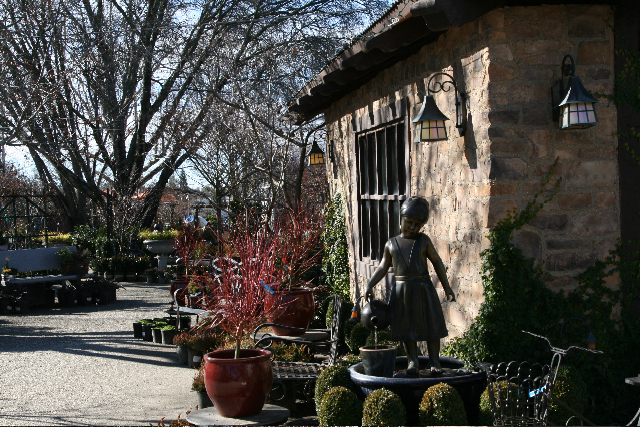 Both times I have heard Dan speak, I came away feeling smarter, more invigorated than ever about my garden and more secure than ever in my knowledge that the fellowship of gardeners and plants is positive and powerful. As in his writing, and his many educational outreach activities for horticulture groups throughout the world, Dan is very knowledgeable, sharp, funny and informative in an accessible rather than intimidating manner. He will share a personal anecdote (often poking fun at himself, telling a story about his childhood in Michigan, or both) and transmit the nuances of say, the genus Illicium, never letting on he knew that some audience members might never have heard of the genus. It is this ordinary guy, ordinary gardener attitude that makes Dan Hinkley so appealing. It is this combined with his astounding knowledge and willingness to share his knowledge that produces such a life-giving breath-of-fresh-air into gardening and horticulture anywhere he goes. And he goes a lot of places. He regularly appears at benefits for small and large horticultural groups from Washington state to the many countries where he travels to study and collect plants. Photo: The main check-out desk in the nursery is in this small, cobbled dove-cote like building in the center of the nursery yard.
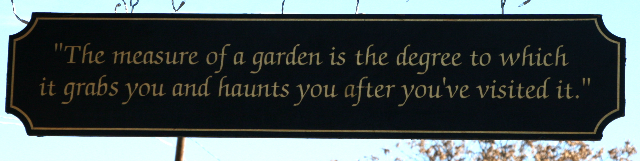 In one of my Heronswood catalogues, Hinkley’s introduction talks about meeting a less well-studied, but very enthusiastic gardener and how the interaction reminded him of the “profound importance of a simple and sincere welcome to the garden.” He goes on to write, ostensibly to his garden visitors: “This does not mean that I will always hold your hand and entice you down this precipitous slope of plants. But it does mean that as I write each description, I will strive to think of the hoop and the holler inherent to the beginning gardener…” I remember reading this at the time and first laughing out loud and then smiling with thanks. We don’t need you to hold our hands, Dan, but as gardeners of all levels we are very thankful that you and Scott Paris and others of like mind continue to inform and inspire the rest of us plant lovers. If I am gushing, well, good gardening is worth gushing over. Photo: This quote is something of a motto at High-Hand Nursery and it appears at the entrance gates, at the check-out counters and on the sides of the cardboard flats in which customers carry home their purchases. This is a quote that speaks to me.
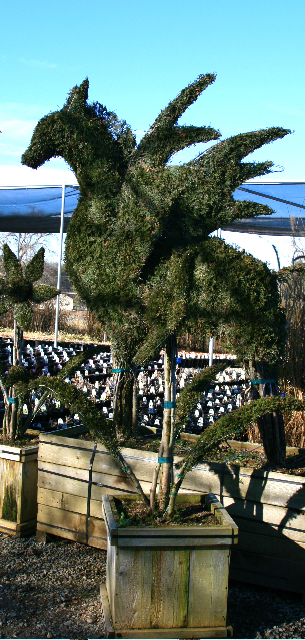 Dan Hinkley’s newest book: The Explorer’s Garden: Shrubs and Vines From the Four Corners of the World (Timber Press, June 2009 – $39.95), walks readers through a whole host of vine and woody shrub genera that he has collected, grown and studied over the past 15 years. His very readable, often conversational text provides useful but-not-so-technical-you-fall-asleep information on each genera’s identifying characteristics, propagation and care as well as stories of how and where he collected individual plants. As in his old Hersonwood catalogues, Dan’s descriptions are such that you will mark many pages to remember the plants you’d like to try. Throughout the text, as in all of Dan’s work, he addresses the issue of bio-invasiveness with all the seriousness, candor and skill the subject deserves. But Dan’s work also makes clear that in this day and age of astounding habitat loss for plants across the globe, plant study, description and careful protection through collecting are equally important issues.Photo: Topiary focal points at High-Hand Nursery.
The book will introduce you to some genera and plants completely new to you (at least, it introduced new ones to me, including Illicium, Drimys and Metapanax), but you will also meet old friends such as Spice Bush, Hydrangea, Pittosporum and Buddleja, in new ways. For example, in an early section, Hinkley discusses Calycanthus, the genus to which our native California Spice Bush (Calycanthus occidentalis) belongs. The section discusses our Spice Bush but also goes on to discuss its relatives in far away places: Spice Bush, meet your second-cousin-once-removed, Aunt Calycanthus chinensis, discovered and first described in China in the early 1960s. It’s fascinating stuff.
 End notes: According to www.heronswoodvoice.com/, a blog written by George Ball, current proprietor of Heronswood, based in Pennsylvania, the Heronswood display gardens in Kingston Washington are maintained for west coast research and trialing of plants for Burpee’s on-going Heronswood plant catalogue; the gardens are sometimes open for special occasions.
Monrovia’s website (www.monrovia.com) indicates that they will be making the first of their Dan Hinkley Collection of plants available to retailers in early Summer of 2009, including High-Hand Nursery in Loomis : “The much-awaited collection, beginning with seven exclusive and semi-exclusive varieties, is the tip of the iceberg of future Monrovia-Hinkley collaborations, and features a frost-hardy Abutilon, four stunning Fuchsia, a winter-hardy Disporopsis and a Red-Leafed Mukdenia.”
 In a North State Garden is a radio- and web-based educational outreach program of the Gateway Science Museum – Exploring the Natural History of the North State, based in Chico, California. In a North State Garden celebrates the art, craft and science of home gardening in California’s North State region. The program is conceived, written, photographed and hosted by Jennifer Jewell – all rights reserved jewellgarden.com. In A North State Garden airs on Northstate Public Radio KCHO/KFPR radio, Saturday mornings at 7:34 AM Pacific time and Sunday morning at 8:34 AM Pacific time. Podcasts of past shows are available here.


