
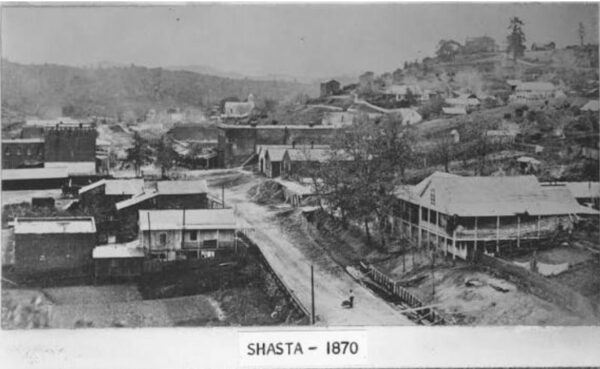
Source: Shasta State Historic Park
In May of 1876, the quiet residential streets of the historic town of Shasta were disturbed by a grim discovery that brought a deeply private tragedy into public view. Beneath the floor of a small woodhouse behind a home on Back Street, a woman’s ordinary household routine led to the discovery of a female infant’s remains. The discovery led to a coroner’s inquest and placed several of Shasta’s established citizens in the unusual position of determining what could—and could not—be concluded about the child’s death.
The Discovery on Back Street
The discovery was made on May 23, 1876, at the property of local resident Jack Anderson, who lived on Back Street in Shasta. While attending to her daily household chores, Mrs. Jack Anderson entered the woodhouse at the rear of the dwelling. There, she discovered the body of a female infant concealed beneath the floor. The remains had been wrapped in several pieces of wearing apparel and lightly covered with loose earth and rubbish.
Most disturbing was a strip of muslin cloth, approximately two inches wide, that had been drawn twice around the infant’s neck and tied in a hard knot. The circumstances immediately raised questions about how the child had died and why the body had been hidden beneath the floor.
The Coroner’s Inquest
The discovery was reported to Shasta County Coroner William P. Hartmann, who convened an inquest on May 24, 1876. A coroner’s jury was assembled from among men known in the community. Their names included August Grotefend, Adolph Dobrowsky, Julius Leiter, Emanuel Lewin, Jasper Smith, and John Stowell.
These were not anonymous men. They were established residents of a community that, although considerably diminished from its Gold Rush heyday, still retained a network of merchants, craftsmen, and other longtime citizens. Their participation illustrates how such investigations in a small nineteenth-century community could quickly become matters of public knowledge. The jury examined the infant’s remains and heard the testimony presented to the coroner. The cloth around the child’s neck was an unsettling piece of evidence, but the circumstances surrounding the birth and death were not sufficiently clear to establish that a criminal homicide had occurred.
A Cautious Verdict
The jury ultimately determined that the deceased was a female infant approximately one and a half months old. Their verdict stated that the child was “supposed to be stillborn.” That conclusion was significant. Rather than declaring that the infant had been murdered, the jurors stopped short of finding that the child had been born alive and subsequently killed. The evidence available to them apparently did not establish that the infant had lived independently after birth.
The verdict therefore left unanswered the most disturbing questions surrounding the case. The cloth tied around the child’s neck remained an ominous detail, but the jury did not convert that circumstance into a formal finding of homicide. The jurors did, however, record one additional conclusion: they believed the infant was the child of a local woman named Sarah Baxter.
What the Record Tells Us—and What It Does Not
The identification of Sarah Baxter is one of the most revealing aspects of the surviving account, but it must also be treated carefully. The inquest record, as reported, identifies her as the presumed mother; it does not by itself establish the circumstances surrounding the pregnancy, the birth, or the infant’s death.
It would be tempting to assume that the hidden burial resulted from the social pressures surrounding an unmarried pregnancy or an illegitimate birth. Such pressures certainly existed in nineteenth-century California, but the surviving account does not provide enough evidence to say that this was Sarah Baxter’s particular situation.
What can be established is more restrained—and in some ways more haunting. A newborn child had been concealed beneath the floor of a backyard woodhouse. The infant had been wrapped in clothing, a strip of muslin had been tied twice around her neck, and a coroner’s jury was unable to determine conclusively that she had been born alive. The jury nevertheless recorded the name of the woman they believed to be her mother. Beyond that, the historical record becomes silent.
A Glimpse Behind Shasta’s Public Facade
Cases such as this offer a different view of Shasta than the familiar stories of merchants, miners, freight teams, saloons, and bustling streets. Shasta had been a ramshackle mining community from the beginning. By 1876, the great Gold Rush boom had long since passed, and Shasta was a much quieter place. Yet behind the town’s surviving buildings and familiar pioneer names were private lives marked by poverty, family difficulties, childbirth, death, and circumstances that rarely appeared in the official histories of the community.
The tragedy discovered on Back Street lasted only briefly in the public record. There was no celebrated criminal trial and no dramatic conviction. Instead, the story survives through the terse proceedings of a coroner’s inquest—a handful of names, a concealed infant, and a verdict carefully limited to what the evidence could establish.
Today, the case of Shasta’s forgotten infant is a reminder that the history of a frontier town was not made only by the men whose names appeared in business advertisements or public offices. It was also shaped by ordinary people confronting deeply personal tragedies, sometimes behind closed doors and sometimes, as in May 1876, beneath the very floorboards of their homes. The jury could determine only what the evidence allowed. The questions they could not answer remain buried with the child. No record has yet been found identifying where the infant was ultimately buried.
 Jeremy M. Tuggle, a native of Redding and descendant of 11 pioneer families who settled Shasta County between 1849 and 1889, has researched Shasta County history and genealogy since 2003. He is the author of Rooted in Shasta County (2003) and A Journey Through Time: Ono and the Bald Hills (2008), and maintains the local-history blog Exploring Shasta County History, and maintains a YouTube channel called @jeremytuggle6424. Tuggle served for twelve years as the Education and Community Engagement Manager at the Shasta Historical Society and received a 2017 Community Service Award for historic preservation from the Major Pierson B. Reading Chapter of the National Society of the Daughters of the American Revolution.

