
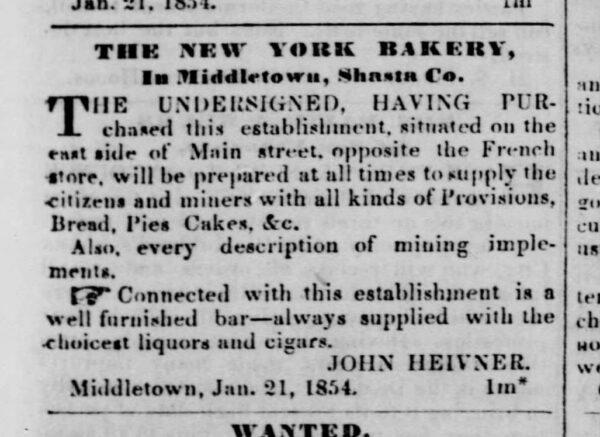
The New York Bakery at Middletown, purchased by John Heivner in 1854, offered bread, pies, cakes, provisions, mining implements, liquors, and cigars from its location on the east side of Main Street. From the Shasta Courier newspaper of Shasta, edition of January 28, 1854.
About six miles west of present-day Redding, in the rolling country between the historic town of Shasta and the old mining settlements along Clear Creek, once stood Middletown. Today almost nothing remains to suggest that hundreds of people who once lived, worked, traded, celebrated, and searched for gold there. Yet during the 1850s, Middletown was one of the important mining communities of western Shasta County, surrounded by exceptionally rich placer ground and connected by roads and stage routes with Shasta, Horsetown, Muletown, Texas Springs, and other settlements scattered throughout the Clear Creek mining country.
Middletown’s story did not end when the first great placer-mining era faded. Although the community began declining during the late 1850s and eventually disappeared as a recognizable town, mining continued around the old settlement for generations. Farms, orchards, vineyards, homes, and a winery later occupied portions of the surrounding countryside, while miners continued searching the Middletown mining district for gold into the 2oth century. Middletown disappeared as a Gold Rush town, but it did not disappear as a place.
Middletown developed amid extraordinarily rich placer deposits during the opening years of the California Gold Rush. By March 1853, reports from the district were already attracting attention. A miner identified as Mr. Dilicolli discovered a piece of pure gold valued at $200 in his claim on Tadpole Creek near Middletown. The following month, A. E. Calloway recovered 11 ounces of gold and another six dollars from his claim near Middletown, while neighboring miners were reportedly earning between 18 and 25 dollars per day. Later recollections reinforced just how rich the district had been. One newspaper remembered that there was no richer placer camp in the county than Middletown. Its surface gravel, heavily mixed with quartz, reportedly paid miners from 10 to 20 dollars per day, with gold occurring from the grass roots down to bedrock. Large quartz boulders containing free gold were also encountered, suggesting that the rich placer deposits might have originated from undiscovered quartz ledges in the surrounding hills.
The remarkable discoveries continued. In March 1854, a lump of gold mixed with quartz weighing more than 100 ounces was reported from the Middletown diggings and valued at no less than $1,000. Later that month, Hendricks & Stroud recovered another impressive piece weighing 28 ounces and five and one-half dollars in additional weight, with an estimated value approaching $500. The gold drew a substantial population into the surrounding country. A later pioneer account remembered that when the Clear Creek Ditch was completed, more than 3,000 miners were waiting for water throughout Muletown, Middletown, Jackass Flat, Texas Springs, Horsetown, and neighboring camps. Cabins were reportedly so numerous between Middletown and Briggsville that the four-mile road connecting them was remembered as almost a continuous street. Decades later, James Gleason, who had grown up in the neighboring Horsetown country, remembered Middletown and Centerville as good business centers and recalled that Middletown itself had spread across a comparatively large area.
As the population increased, Middletown quickly became part of western Shasta County’s transportation and commercial network. In 1853, a new road was constructed between Middletown and Horsetown, and Middletown became a stop on Hall & Crandall’s United States Mail stage route connecting Shasta with Marysville and Sacramento. Businesses followed the miners. In November 1853, property on the west side of Middletown’s Main Street containing a tavern, store, and bakery was offered at auction. The tavern alone could accommodate approximately 50 boarders and included a cellar and large corral. In January 1854, John Heivner purchased the New York Bakery on the east side of Main Street, where customers could purchase bread, pies, cakes, provisions, mining implements, liquors, and cigars. Another pioneer, John Doebelin, was remembered in a 1935 obituary as having owned the first bakery in Middletown. Whether his establishment was connected with the New York Bakery is uncertain, but the accounts demonstrate the extent of Middletown’s early commercial development.
Among the town’s most important merchants were William Weil and L. Weil, who established their original store at Middletown in 1854. Their enterprise subsequently expanded to Texas Springs and Horsetown. The Union Hotel became another important Middletown institution. William S. Hughes assumed management in January 1855, offering food, lodging, a well-stocked bar, and stabling for travelers’ animals. Middletown also supported an active social life. Balls and dances were held at its hotels, and a dancing school operated there in 1855. People were beginning to establish families as well. On June 4, 1855, M. L. Richmond and Mary McGuire were married at Middletown. The following month, John Doebelin was born there, beginning a life that would eventually span Middletown’s transformation from thriving Gold Rush settlement to ghost town.
Middletown’s growing importance was further reflected in the establishment of its own post office. A federal postal register for Shasta County lists Charles W. McKinney as Middletown’s postmaster beginning June 18, 1856. The Middletown post office remained in operation until April 19, 1858, when the register records it as discontinued. Its existence provides another indication that Middletown had developed beyond a temporary collection of miners’ cabins into an established community. The timing of its closure is also noteworthy. The post office was discontinued during the same year that Judge Chauncey C. Bush Sr. later remembered as the beginning of Middletown’s decline, although the surviving postal record does not establish a direct connection between the two events.
For all its mineral wealth, Middletown suffered from one fundamental problem: water. During the winter of 1854, drought brought mining throughout the surrounding dry diggings nearly to a standstill. Without water, miners could not wash their gravel. Without gold, money disappeared from circulation, hotels lost boarders, and merchants lost customers. The solution appeared obvious—bring water from Clear Creek. A public meeting was called at the Excelsior House in Middletown in February 1854 to consider constructing a ditch and flume system. A proposal envisioned a roughly 16-mile canal built cooperatively by approximately 100 miners. The movement continued in March when miners assembled again at Middletown, with James S. Ralston serving as chairman and Brice Grimes as secretary. The resulting plan called for 100 shares valued at $500 each, with shareholders providing part of the necessary labor. Later accounts celebrated the eventual completion of a Clear Creek ditch system supplying the surrounding mining country, although a direct organizational connection between that completed ditch and the cooperative enterprise proposed at Middletown in 1854 has not been established.
Life in Middletown could also display the rougher character of the California mining frontier. In April 1855, the store of William Weil & Co. was burglarized, and approximately $1,500 in gold dust disappeared along with a black mare mule believed to have been used by the thieves. The merchants offered a $200 reward for recovery of the stolen property and apprehension of those responsible. At the same time, Middletown developed the civic institutions of a settled community. It sent delegates to county political conventions, produced candidates for public office, and maintained its own election precinct. These details reveal a place considerably more developed than the term “mining camp” might suggest. Middletown possessed businesses, hotels, homes, roads, stage service, political institutions, social gatherings, and a permanent population.
According to Judge Chauncey C. Bush Sr., who recalled Middletown’s history during an 1893 land dispute, the community reached its height between 1853 and 1857, when approximately 500 people lived there. He remembered saloons, hotels, merchants, and substantial buildings, including a fireproof brick store occupied by Weil. Because Judge Bush was describing events several decades afterward, his testimony is best regarded as a pioneer recollection rather than a contemporary population count, but his description agrees closely with the substantial community documented in newspapers of the 1850s. Judge Bush placed the beginning of Middletown’s decline in 1858, when the Frazier River excitement drew miners and residents away. The distinction is important: 1858 marked the beginning of Middletown’s decline, not its end.
Middletown remained an established election precinct in 1858, with William Weil serving as inspector, and commercial life continued. In late 1859 and early 1860, William Weil & Bros. advertised the Middletown location as one of the firm’s established “old stands,” alongside stores at Horsetown and Texas Springs. A butcher shop operated by Bennet & Waggoner also opened at Middletown, sending wagons throughout Buckeye, Churntown, Whisky Creek, Shasta, Texas Springs, and neighboring settlements. The Weil enterprise changed hands in 1861, when William Weil and L. Weil sold their interests to David Weil and Joseph Weil before returning to Germany. The two brothers later returned to California in 1867, after which the family established itself in Shasta.
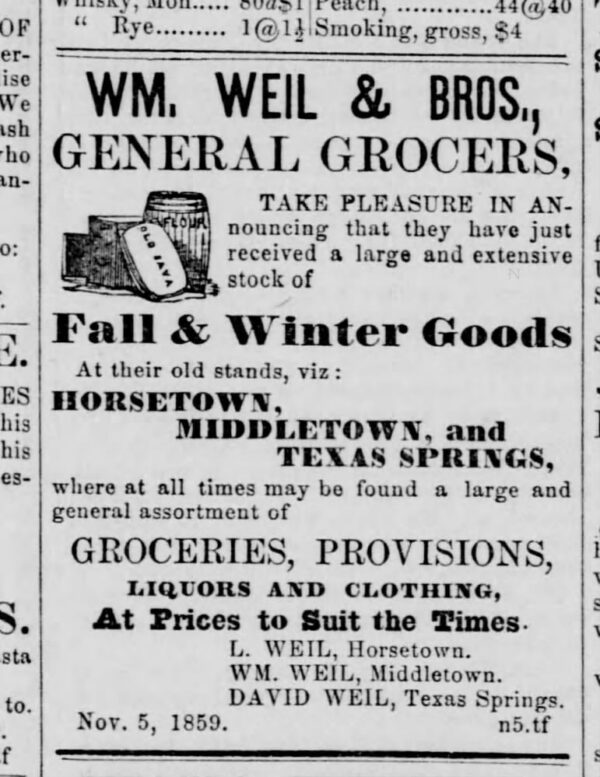
William Weil & Bros. advertised Middletown as one of the firm’s established “old stands” in 1859–1860, evidence that commercial activity continued after Middletown had begun to decline. From the Shasta Courier newspaper of Shasta, edition of January 7, 1860.
An 1862 sheriff’s sale involving merchant Augustus Kessel provides one of the best surviving descriptions of Middletown’s physical layout. In April of that year, Emanuel Lewin and Ferdinand Baehr obtained a judgment against Kessel for $2,867.90, plus interest and costs. Among the property subsequently offered for sale was a parcel on the west side of Middletown’s principal street containing the fireproof brick store erected by William Weil & Co. Another parcel stood opposite Kessel’s dwelling and included the site of his former storehouse. The measurements recorded in the legal notice reveal a developed commercial street containing defined lots, fences, residences, stores, and substantial buildings rather than merely the temporary cabins commonly associated with early mining camps. Even in 1863, Middletown remained socially and civically active. Michael B. Hickey hosted a grand St. Patrick’s Day Ball at the Union Hotel, and the community continued functioning as an election precinct. Middletown was smaller, but it was still alive.
As the great placer-mining era faded, attention increasingly turned toward quartz. In January 1864, the Shasta Courier identified James Loag as the owner of a quartz mill near Middletown. A cleanup following the crushing of 50 tons of quartz from Jolly & Co.’s Muletown claim produced 17 pounds of amalgam, with experienced observers estimating the ore at approximately 40 dollars per ton. Two months later, an eight-stamp quartz mill at Middletown was offered for sale. The mill had recently been thoroughly repaired, contained two sets of Norton’s Patent Amalgamators, and was described as being in good running order. Importantly, the advertisement stated that it was being sold to close a partnership rather than because the operation had failed.
Mining continued around Middletown long after the original town began declining. William Peterson developed a gold-bearing quartz ledge near Middletown, sank a shaft, constructed a roasting furnace, and built an arrastra. Other prospectors searched the surrounding hills for the quartz ledges believed to have produced the district’s extraordinary placer deposits. In 1876, Michael Hickey applied for a federal patent covering the twenty-acre Hickey Placer Mine in the Middletown mining district. The property description is particularly valuable because it placed the claim near John Heivner’s dwelling and garden and property associated with William Peterson. Heivner had purchased the New York Bakery more than twenty years earlier, while Peterson was associated with the district’s later quartz development. Their appearance in the same property description shows that Middletown’s later landscape contained not simply abandoned diggings, but residences, gardens, established property boundaries, and active mining claims.
The concentrated settlement nevertheless continued to disappear. By 1893, Judge Bush recalled that not a single vestige of the old town remained. Yet only two years later, a newspaper column headed “Middletown Notes” described a very different kind of community occupying the surrounding countryside. Peter McCann was pruning his orchard and sowing grain. Wolfgang Nachreiner was planting eighty acres of wheat and oats. Martin Nachreiner was clearing land, Anton Schwagel planned to sow 40 acres of oats, and Jacob Peterson intended to cultivate 25 acres on Chris Stabler’s ranch. Even the miners were reported to be making spring gardens and planting trees. The Gold Rush town had disappeared, but Middletown had become a dispersed rural community where mining existed alongside orchards, grain fields, gardens, homes, and ranches.
Agriculture eventually produced one of Middletown’s most distinctive later industries. By 1899, Charles Brouillard was identified as the “Middletown wine maker,” and by the following year he was described as proprietor of the Middletown Winery. Brouillard’s operation produced Claret, Zinfandel, White Wine, Riesling, Sauterne, Port, Sherry, Angelica, and brandy, with a distribution depot maintained at 305 Oregon Street in Redding. When the Middletown Ranch and Winery was advertised for sale in 1911, the property encompassed approximately 270 acres, including forty acres planted in grapes and fruit, 220 acres of pasture, and ten acres of mineral land. Even on a ranch devoted to agriculture and wine production, the mineral potential of the old Middletown country had not been forgotten.
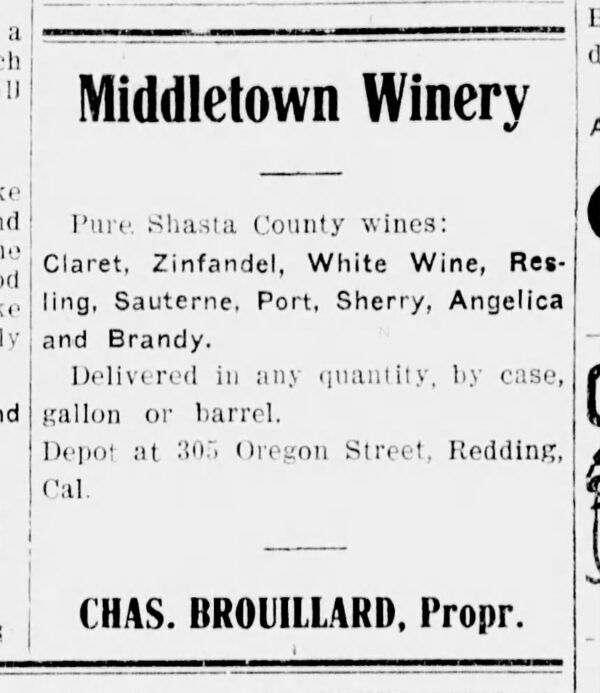
Charles Brouillard’s Middletown Winery produced a variety of locally made wines and brandy and maintained a distribution depot at 305 Oregon Street in Redding. From the November 22, 1911, edition of the Courier-Free Press newspaper of Redding.
Nor had mining disappeared. New quartz claims continued to be recorded in the Middletown mining district during the twentieth century. In 1915, the Jim Loag Mine at Middletown was equipped with a two-stamp mill, ore discharge, rock breaker, and hoist, while other prospectors continued locating quartz claims throughout the surrounding country. By 1930, miners were still staking new ground in the Middletown district. The following years demonstrated that the old mining country could still produce the ambition and uncertainty that had characterized it since the Gold Rush.
In 1932, the White Mine was being developed near Olney Creek behind the old Middletown Cemetery, approximately five miles west of Redding. Dawson, Swinney, and Samson operated the property under lease and bond from Edwin White of Redding and installed a mill capable of processing approximately 50 tons of ore per day. Just as operations were preparing to begin, someone deliberately dynamited the cement diversion dam constructed across Olney Creek to provide water for the mill. The 15-foot-long and eight-foot-high structure was shattered. No known dispute over mining or water rights explained the destruction, and the motive remained a mystery. The operators nevertheless intended to rebuild the dam and continue mining. Nearly 80 years after Middletown’s first great placer discoveries, people were still searching the surrounding hills for gold.
One physical remnant of the pioneer community proved especially enduring. The Middletown Cemetery, established near the settlement during the pioneer era, continued serving the surrounding countryside after the town’s stores, hotels, saloons, and residences disappeared. Pioneers including John H. Owens, Bernard Scheurer, and George Miller were buried there. When Solomon McDaniel of the neighboring Centerville district was laid to rest in the cemetery, the Weekly Searchlight described his funeral as the largest ever held at Middletown, with mourners traveling from Redding and the surrounding countryside. The cemetery’s continued use demonstrates that Middletown remained a meaningful community identity even after its commercial center vanished.
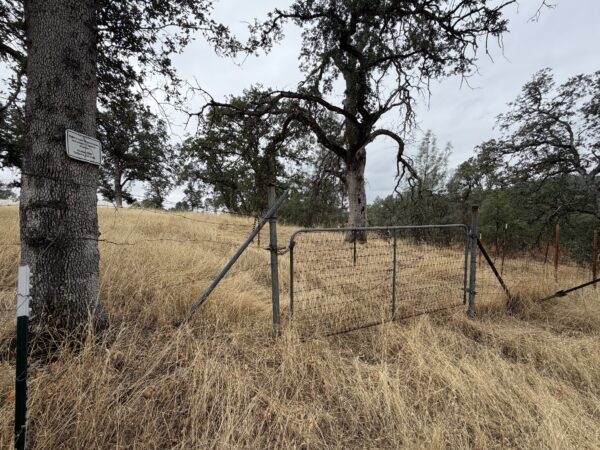
The entrance to the historic Middletown Cemetery, established during the 1850s near the once-thriving Gold Rush community of Middletown in Shasta County, California. The cemetery remains one of the few surviving physical reminders of the former settlement. Photograph taken by Jeremy M. Tuggle on September 1, 2026.
Few lives illustrate Middletown’s transformation better than that of John Doebelin. He was born at Middletown in July 1855, when the settlement was near the height of its prosperity, and spent most of his eighty years in the surrounding mining country. When Doebelin died in 1935, his obituary described his birthplace as a ghost town situated between Briggsville and old Shasta. The infant born amid the Gold Rush boom had lived long enough to see his birthplace become a historical memory.
Middletown’s history, however, was not simply the story of a mining town that flourished briefly and disappeared. Its first great era belonged to placer mining, when gold drew hundreds of people into the district and created stores, hotels, bakeries, homes, roads, stage connections, political institutions, and a thriving community. The Frazier River excitement began Middletown’s decline in 1858, but decline was a process rather than an event. Merchants remained, elections continued, quartz mills operated, and residents maintained homes and gardens. As the concentrated settlement disappeared, farms, orchards, vineyards, and homes spread across the surrounding countryside, while prospectors continued recording mining claims into the twentieth century.
The town disappeared, but Middletown survived as a place. Its name remained attached to the countryside, its mines, farms and vineyards, roads, family memories, and most enduringly, its pioneer cemetery. Today, the Old Middletown Cemetery remains a tangible connection to a settlement whose Main Street and buildings have otherwise vanished—a surviving landmark of one of western Shasta County’s richest Gold Rush communities and a reminder that Middletown’s history continued long after the boomtown itself disappeared.
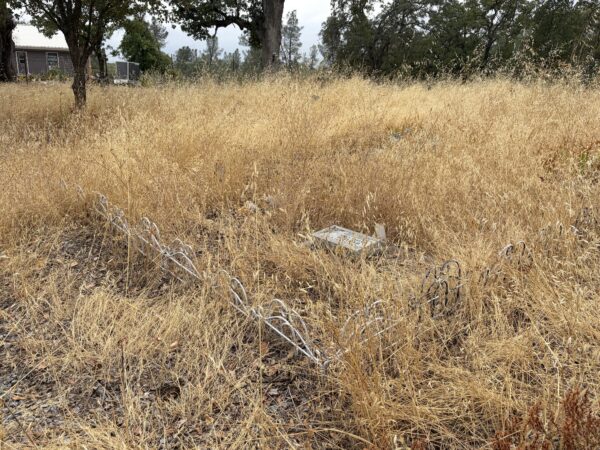
Tall, dry grass surrounds a modern grave within the historic Middletown Cemetery in Shasta County, California. Established during the 1850s, the secluded cemetery remains one of the few surviving landmarks associated with the former Gold Rush community of Middletown. Photograph taken by Jeremy M. Tuggle on September 1, 2026.