
What would you think if someone told you about a sophisticated system contained within a relatively small space with trillions of its residents taking on roles of engaged managers, creative agents, adept healers or ruthless killers? This isn’t a video game though it may sound like one… this amazing world is contained within you!
Blood
The blood system within the human body contains trillions of blood cells. It contains many cells taking on specific roles, like carrying oxygen to other areas of the body or helping with clotting in case you cut yourself.
The blood system also contains the building blocks of your immune system – blood stem cells – that play a pivotal role in keeping us healthy and protecting us from uninvited guests, like viruses and bacteria. Some of these guests play well with others and can hang around in our bodies, while others are simply kicked out of the house before they make us too sick.
Most people are familiar with the concept of donating blood, even if they are too busy to do it or too scared. We know how important donating blood is to saving lives, but hope that others will do it for us. It’s not until we are sitting by a hospital bedside next to someone we love, watching precious life-saving blood bring color back to our child’s face or energy back into a grandparent’s voice that we realize yes, blood donors do save lives.
Less than four out of 10 people are eligible to donate blood on any given day. Less than one out of 10 donate and almost all of us will either need blood or know someone who needs it during our lifetimes.
There are plenty of ways to help if you are unable to donate blood. Volunteer to help host, organize or serve at local blood drives or at health fairs to encourage others to donate something precious and lifesaving. Call 866-822-5663 or 530-243-0160 today to find ways that you can help!
All blood centers are regulated by the Food and Drug Administration and accredited by many state and federal agencies. The common foundation for all is that blood donors are not allowed to donate whole blood or blood components if they do not meet specific guidelines.
Whole blood donation
Whole blood donation is what most people think of when the local blood center comes to their school, workplace or church. It takes about an hour and these donors can give every 8 weeks if they are feeling well. These whole blood donors are critically important to meet the need for red cell usage. A motor vehicle accident may involve several victims all who could possibly use 50+ units each of blood products depending on the severity of the injuries.
Donating blood components: Red cells, platelets or plasma
The primary blood components collected are plasma, platelets and red cells. Donating components is accomplished by a process called apheresis that collects specific blood components using automated technologies. Blood components donors can donate more frequently, maybe even up to twice a week! During this process, a donor’s blood is collected and passed through a machine that collects the needed component(s). The rest of the blood is returned to the donor. It takes a little longer and donors can often watch a DVD or work as they donate.
Donating blood components allows for a greater volume of the specific product to be collected and makes the transfusion process safer for the patient. The easiest way to find out if you can be a blood components donor is to ask about it the next time you donate blood. Not everyone can donate blood components. A small sample tube from your whole blood donation may be tested to see if you have enough components to share.
Plasma
Plasma is the liquid portion of blood that holds various blood cells (red cells, white cells, and platelets) and also contains essential proteins. Plasma is often used by trauma patients, burn victims, and cancer patients and can be frozen up to one year. Plasma-derived pharmaceuticals such as IVIG (Intravenous immunoglobulin) can also be used to help patients with specific types of autoimmune diseases, such as those with primary immunodeficiency disease. At BloodSource with locations throughout Northern and Central California, only men are allowed to donate plasma at this time due to the risk of transfusion-related reactions in patients who may receive plasma from female blood donors. Eligibility may change in the future as transfusion specialists further analyze the link between blood donors and patient transfusion reactions.
Tom McClure received scores of plasma units when he suffered an electrical injury twenty years ago. He now donates plasma and thanks the people who donated when he was in need.

Platelets
Platelets help to form clots that stop bleeding and are often used by trauma patients, transplant recipients, and cancer patients who have undergone radiation and chemotherapy. Because platelets only last five days, a constant supply is vitally important. When they are extracted, platelets are yellowish in color.
Vicki Wolfe, a patient who battled leukemia, noted that it was far easier for her to receive transfusions of platelets that came from one donor. “When I got platelets that came from different donors, I had a lot of transfusion reactions but when the units – up to three – came from a single donor it was much easier on my body. I am so thankful for platelet donors!”

Red cells
Red cells carry oxygen and may be used to help patients who have experienced a severe blood loss for any reason. Red blood cells are viable for 42 days. On House or Grey’s Anatomy television episodes, the ER doctors call out, “Get more blood!” and viewers see packs of red cells being run into surgery, often type O, the universal donor. Although these scenes are often over-dramatized, what’s important to remember is that critically injured patients need blood when they arrive at the hospital. Regular blood donation allows hospitals to have blood on the shelf for immediate use to help patients.
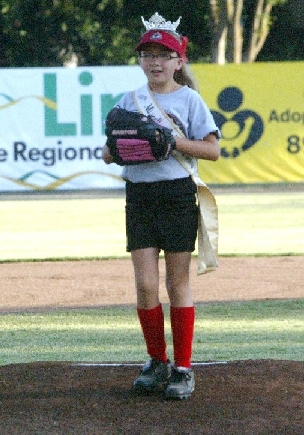
Brennah Payne received red blood cells following a horrific car crash but is well and healthy today, seen here throwing out the first pitch at an Outlaws game while wearing her Missette Butte County tiara.
Please give what is needed today
Donors can now be asked to give the blood components needed that very day to help patients. The critical elements are the donors’ ability to give and patients’ needs. A donor may be able to donate two units of platelets one week and a unit of red cells another day.
Be the Match
Joining Be the Match – the national marrow donor registry – is another way to help patients in need. There are 70 diseases for which a marrow transplant is considered potentially curative, the most common being leukemia. 70% of patients in need of marrow transplants do not have a matched donor in their families so they go with great hope to Be the Match where over seven million people have volunteered to donate healthy blood-forming cells. Registrants with diverse racial and ethnic heritage are especially needed.
Trevor did not find a match and passed away at six months.
Tony found a match on the registry and is doing great two years after transplant.


Readers of anewscafe.org can join Be the Match if they’re between the ages of 18 and 60 years and in good general health. Joining the registry is easy:
-
Get educated and make a good faith commitment to donate blood stem cells if a match to someone in need
-
Click here for Be the Match Eligibility Guidelines and Donation FAQs
-
Get swabbed – this involves completing paperwork and swabbing the inside of your cheek with a kit provided by Be the Match
-
Stay in touch – keep your contact information updated because YOU may be the only one to match a patient hoping for a second chance at life
If you are match to someone in need you will be asked to donate blood-forming cells either through a surgical procedure or an apheresis procedure similar to donating blood components.
-
Join online at Be the Match – enter the code MonthYear e.g. November09 or January10 and a swab kit will be sent to your home
-
Go to BloodSource to join the registry at no cost to you. BloodSource works with Be The Match in the Northern California Region
Now that you have learned about the amazing world of blood and the various ways you can help patients – donating blood, blood components, joining Be the Match, volunteering – please help to encourage and educate others. So often, people do not step up to do these things because quite simply, they feel as if they have never been asked. You are now being asked!
For more information on local blood donation, please go to www.bloodsource.org or call Dannielle Smith, BloodSource Account Manager 866-822-5663 or 530-243-0160 to set up a blood drive at your place of work, worship or community event. Local blood drives can be found at Find a local drive and just enter your zip code.


