

I’m an unabashed fan of Redding guitarist and slide player Eric Day. Whether it’s blues, jazz, rock or country, I always find his playing to be exciting and inventive.
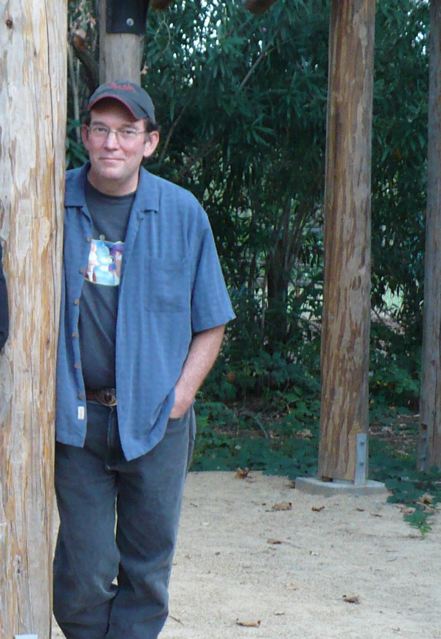
Aside from a six-year stint in Nashville, Day has played primarily around the north state, often at the Post Office Saloon in downtown Redding. He was in a group called (get this) Uncle Robert’s Magic Zapp Juice Band with Steve Huff, Rob Swendiman and Robert Moore back when they attended Shasta High School in the early 1970s. The group occasionally reunites.
He continues to play in a great band with Huff (the Salamanders), slums occasionally in the Jim Dyar Band, and has been jamming lately with Scott Joss and Kevin Williams (of Merle Haggard’s Strangers) and Rick Hobbs in an ensemble that I’ve simply got to hear.
Eric also happens to be a laid-back awesome fella, so he kindly agreed to chat with me in an Q&A feature I hope to continue here on A News Cafe.
Jim Dyar : You’re playing is so killer — kind of loose, dirty and inventive all at the same time. We’ve talked before about you making a big jump with your playing after you went to Nashville. When did you go there and how did it improve your playing?
Eric Day : I lived in Nashville from 1998 to 2004 or thereabouts. I had moved there to jump into a bigger pool of good players, and hopefully be included on a CD and to do some touring. I wasn’t looking to make it big — I didn’t need a gig with Emmylou Harris to be happy — I just wanted to play and maybe see more of the U.S. I hadn’t seen before.
I got a gig with Goose Creek Symphony within a few months, and that was the start. Goose Creek does original music that has very specific parts to play – orchestrated, using guitars, fiddle, etc. and the parts are often pretty complex. That was the first wave for me — learning the parts to their music took discipline and was a satisfying challenge. Playing with them taught me how to be a better ensemble player — that as a part of the whole, I needed to listen more than play. It was a shift from what I had been doing as a guitarist, I’m sorry to say, but the lesson sunk in. We did a CD while I was in the band, titled “Goin’ Home.” It’s a good record and I’m very proud to be on it.
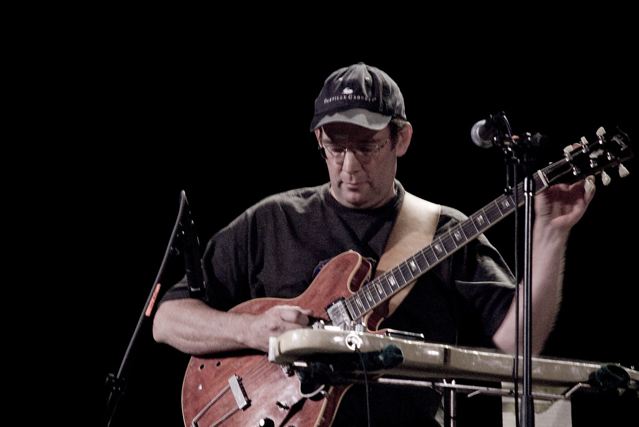
Eric Day tuning up during a show at the Cascade Theatre.
Some of the best guitarists I saw back in Nashville were singer-songwriters playing to accompany themselves. The best of them would get this thing going with their right hand that would sound like bits of a fully-stocked backup band — melody, harmony, rhythm — all at once and just enough of each to let your mind fill in the rest.
In general the guitar playing that impressed me the most was very much in context with the music, to the point of being by itself not that interesting technically. The shift from, “What cool lick can I fit in here?” to “What notes would help the song along right here?” not only helped me to hear the bigger picture of the song, but it encouraged me to practice restraint in my playing.
Jim : Wow, I hear that kind of thing a lot from great players – less is more and finding the right notes to boost the song along. As Merle Haggard has said, “the song is the star.” Still, your lead playing is right on the edge and really creative. How do you make your lead playing so imaginative?
Eric : I’m often right on the edge when I’m playing a solo, if it’s a good night. Playing for me can be divided into two sections, roughly: mechanics and inspiration. The mechanics include muscle memory (very important), musical theory, and all other physical aspects of playing the guitar. Inspiration feels like my mind is out of the way of the music, and the notes happen almost on their own. It’s easier to get to when you’ve worked on the physical part enough to not have to fight it, and when you know the material pretty well. Get that stuff out of the way and inspiration has a clear landing strip. Practice enough so your fingers know where to go for the note you hear, then let ‘er rip!
Jim : I been asking you lately how to improve my own playing and you’ve given me some scale work and fingered arpeggios. What general tips do you have for guitar players who want to improve?
Eric : My first tip is to buy a good in-line tuner (I use a Boss TU-2) and use it regularly. Keep it plugged into your guitar as you practice, and every couple of songs re-tune to see how far you’ve drifted. Using a tuner like this will, over time, teach your ears to hear better what’s in tune and what’s not. Playing in tune is always No. 1.
Another thing is a metronome — this gadget will do for your sense of time what the tuner does for your sense of pitch. Practicing with a metronome click track helps a player listen while they play too. It can be annoying and frustrating at first, but it’s worth the effort as a foundation for playing well. Even if you don’t use it every day but just here and there, you’ll still benefit.
For working on soloing, one thing I’ve found valuable is to identify parts you want to learn and hum them. Get the phrase firmly in your mind so you can hum it confidently, then pick it out on the guitar note for note. This works for parts you want to learn off a record (which is a great resource for new and cool licks/techniques), but especially for lines you think up. As you listen to a song, imagine the most best and excellent solo you can think of then hum it out loud. Record it if you need to, then go back and figure out on the guitar what you just hummed.
I would also suggest considering the “less is more” aspect of playing — that the audience can fill in what they don’t hear sometimes, and that space in music, where nobody’s singing or soloing, is as or more important than the notes played.
A solo consisting of a few well-chosen notes is always more appealing for me than a flurry of technique and mayhem. Almost always — sometimes a song just begs for a bit of mayhem!
Jim : What guitar players really knock you out?
Eric : So many… I’m a fan of slide guitar playing so Sonny Landreth has to be in there, Roy Buchanan, Jeff Beck, Amos Garret, Ry Cooder, David Lindley, Joe Satriani, John Fahey, Joe Pass — the list is endless. I try and pick up something from every guitarist I hear, no matter what their experience level.
Jim : What are some bands or CDs that you’re really into right now?
Eric : I’m a huge fan of Randy Newman — he does film scoring as well as songwriting and his sountrack from the film “Avalon” (older flick) is beautiful. He has a CD entitled “Faust” (the tale of a young man who makes a deal with the devil in exchange for knowledge) that features Randy as the devil, James Taylor as God (who else?), and Don Henley as Faust. All original tunes and entertaining as hell if you are of that mindset.
Other than that I’ve been listening to Department of Eagles, Slaid Cleaves, Fleet Foxes, Lyle Lovett, Paul Thorn, Span, Incubus, James McMurtry, Janis Ian (God and the F.B.I. is a great CD), Radney Foster, and David Francey, just to name a few. The ol’ MP3 player stays on random…
Jim : Stepping out of music for a second, you’ve suggested some wines to me that have been so excellent. What are your top three wine picks (and what’s that one from Costco?)
Eric : That Costco wine is gone, but it was the 2006 Alexandar Valley Cab. Top picks: Edna Valley Chard, Layer Cake Primitivo (Zin), and um … maybe the good old standby Bogle Petite Sirah.
Jim : Your pal in the Salamanders, Steve Huff, is such a cool player and excellent music mind. What impresses you about him?
Eric : Well, Steve’s sense of style in clothing has been a big influence on me for sure. His hairstyle is also remarkable. Too bad it requires actually having hair on your head to make it work … I can’t, ’cause I don’t.
Steve plays bass in the Salamanders — sometimes guitar — and his less-is-more attitude shines in his playing on either instrument. He’s a seasoned pro who knows what the function of the bass is in an ensemble, and I feel fortunate to be playing with him — especially in a town the size of Redding. He hears the big picture and plays like it, and it shows. He da mang!
Jim : No, you da mang! Hey, thanks so much for your time.


